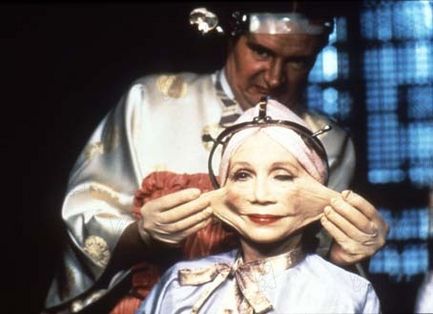
A few years back, I read an exciting essay in The American Enterprise that explored the neorealist trend in modern painting. Turns out that Jacob Collins, one of the artists featured in the piece, ran his atelier not far from where I lived in Brooklyn. I went one cold winter afternoon over there with some friends to see the work of Collins and his students. The atelier was dark and cold, but the work these students were doing was phenomenally beautiful. I could hardly bear to leave it, but in truth, it was so frigid that we couldn't handle staying. I left thinking: these people are relatively poor, but they know what beauty is. This is a good place, I thought.
Back on the street level, a friend who was with me was attracted by the warm glow from the windows of an art gallery next door. It was posh and inviting, so we went in. The art was grotesque, horrifying. One of the main pieces was an installation involving dismembered baby dolls with bloodstained dresses and rubber body parts. Despite the light, there was so much darkness. This is an evil place, I thought. We couldn't wait to get out of there.
I got to thinking about all that just now when I saw that Roger Kimball of The New Criterion discovered a similar atelier in Harlem, and gave a talk there the other day. He reproduces it on the mag's blog. Well worth reading. Here's a quote:
The serious art of today tends to be a quiet affair. It takes place not at Tate Modern or the Museum of Modern Art, not in the Chelsea or TriBeCa galleries, but off to one side, out of the limelight--at The Harlem Studio, for example. This is because real art tends to involve not the latest thing, but permanent things. Permanent things can be new; they can be old; but their relevance is measured less by the buzz they create than by the silences they inspire. In other words, the future of our artistic culture is not in the hands of today's taste makers, but those whose talent, patience, and perseverance will ultimately render them the taste makers of tomorrow. I mean, of course, that the future is up to artists like those who congregate around the Harlem Studio and other such outposts of civilization.
Andrew, by the way, is fuming at Ramesh Ponnuru over his new book "The Party of Death," about abortion culture in the US. Andrew thinks it's a slander against the Democrats. The subtitle of the book, though, indicates that Ramesh is criticizing not just the Dems, but the media, the judiciary and all the forces in our society that denigrate human life (Amy, who has read the book, explains this point.)
The editors of Touchstone took grief for titling a piece I did for them a few years ago "The Godless Party." It was an essay based on that widely-circulated Bolce & De Maio study examining survey data and media accounts to show that a) the Democratic Party is as heavily influenced by militant secularists as the GOP is by religious believers, and b) that the media completely missed the secularization of the Democratic Party, probably (the social scientists postulate) because the MSM is so overwhelmingly secular-liberal that they literally couldn't see what was happening to the Dems -- it struck the media as normative. The title of the Public Interest essay in which the scholars presented their findings was titled "Our Secularist Democratic Party." Which is a nicer way of saying, "The Godless Democratic Party." Right?
That's not to say that all Democrats are godless, any more than it is to say that because you might fairly call Republicans "The God Party" -- and mean it cynically -- that all GOPers are religious. Still, it would do the Democrats good to think about why so many people of faith want nothing to do with them. It is not good for people of faith, either, to feel that they have nowhere to go but to the GOP. A lot of us religious folks sympathize with the Dems on some issues, but vote Republican precisely because of the bedrock issues Ramesh talks about in his book.
Andrew Sullivan is right: the bipartisan demagoguery on the Hill over gas prices is shameful to both parties. I guess it's predictable, but jeez, this is leadership? Both sides are an embarrassment, and in particular, watching Pelosi swan around with her cheap and opportunistic rhetoric makes me fear for the country if she should ever become House speaker. As you know, I've been hell on Exxon Mobil for its lavish retirement package for Lee Raymond, but the price of gas today is not the fault of the oil companies, or of Washington. Here's Andrew:
[L]et the market show people that there are costs to things. This president has never let reality intrude on his conversations with the American public on energy, war, or much else for that matter; so maybe reality will have to speak for itself. Maybe the only way people will stop using SUVs is when they actually have to pay for their ecological destruction and energy inefficiency.
One simple conclusion: conservative government really is dead, isn't it? A conservative government would simply say: we have no control over global oil prices; consumers reap what they sow; companies should be left alone; and if your wallet is empty because of all that gas in your SUV, you've learned a useful lesson in self-government. If only Margaret Thatcher were around to punctuate that lecture with a swipe of her handbag.
I gave a talk last night at St. Peter's Classical School in Fort Worth, and met some great folks before and after the talk. I got this e-mail this morning from one of them, a Southern Baptist. In it, he alludes to the house Julie and I bought a couple of years ago near downtown Dallas -- a small 1914 Craftsman cottage in a gentrifying neighborhood. We got it for next to nothing in part because people in Dallas strongly prefer to live in the suburbs, or at least in newer, bigger dwellings. (That, plus the fact that the public schools in Dallas aren't great). But since we bought it, our part of town has become hot, and with the price of gas going up, there seems to be the beginnings of a migration back to the city center. We couldn't afford to buy our little house today. Anyway, this guy makes some great points, and I can't wait to read what the rest of you think about them:
Your comments struck a strong chord in my wife and me. As you said, we have generally found that evangelicals are pretty good in identifying worldliness in the church with regard to sexual issues: adultery, fornication, pornography, divorce and the vulgarity of the media. The sin of lust is well recognized and condemned. But with regard to the worldliness of consumerism there is near silence. The sins of greed and envy are virtually ignored. There are prayers for "financial freedom" but this is understood as "God, give us more money so we can pay for all our stuff."
This may be so because it is such a struggle to get our bearings; if we are not Amish or monastics we are just lost at sea in such a capitalist/consumerist world . Like you, we would like to live close to downtown in a smaller house with sidewalks and trees, but find that these have been bid up to where they are now quite expensive and "objects of desire" in their own right, with polished hardwood floors and granite and stainless steel kitchens. We would like to buy the small, frayed, 1930's rental house we live in now, but it is in a "tear down" neighborhood close to the cultural district. It will soon be sold by our landlord for 300K plus and replaced by a million dollar, zero lot line house. The "new urbanism" developments are also expensive, so the houses that are affordable for ordinary people are in the decaying 1960's suburbs, ranch houses with no sidewalks, no front porches and fenced backyards, or in the new, desolate, crackerbox subdivisions far out of the city.
Tim Keller, a wonderful preacher and teacher at a PCA church in New York, Redeemer Presbyterian, has a theory on why dealing with our own greed always escapes us in America. He says that no matter how much money we make, or how rich and indulgent our lifestyle, we always have friends who have more and better possessions than we do, so in comparison we feel we aren't and can't be the greedy ones. People who make 60K, have nice used cars and a 3/2 in the suburbs have friends who make 100K, have new cars and a 4/3 with a pool out back. People who make 400K and have a million dollar home in Plano know people who make 900K and have a two million dollar home in Highland Park, as well as posh vacation homes at the lake and in the mountains. And so it goes, on up the ladder.
It seems to me that the competitive instincts of men have been almost totally corralled by this race for success and acquisition in western, corporate culture. This may be preferable to having these instincts gathered for war, as in the Crusades for example, but still not ideal. (It seems that militant Islam has decided that war is preferable to capitalist modernity as the employment of male competitive energy. That is why we need to fear them; they will be a formidable enemy for a long time. We have the wealth and technology, but they have the will, the patience, and the bodies to sacrifice.)
I don't know if these instincts can be marshaled in a quest for virtue or holiness i
n the culture at large; maybe this can only been done in a monastic or small sub-culture setting. In Jefferson's and Kirk's rural world, in the world of the southern agrarians--Tate, Percy, Ransom and Berry--it may have been easier for these instincts to be tamed on behalf of family and community (although, as you know, real and perceived racism has always plagued this vision.) It may be only Jesus who was able to value his own local, particular, tribal world and still be universal in his love for those who were different.
Wish that David Brooks' column today wasn't behind the New York Times firewall. It's an important one. He writes about how ever so slowly, the Democratic Party is eking its way to saving liberalism. He points out that all the spark has gone out of the Dems' 1990s obsessions, all having to do with multiculturalism and identity politics. What's happening now, Brooks argues, citing a Michael Tomasky essay in The American Prospect, is that some smart liberals are starting to realize that interest-group politics are a dead end ... and that liberals need to start thinking and talking about the common good. As Brooks puts it, "Goodbye, Jesse Jackson. Goodbye, Gloria Steinem. Hello, Harry Truman."
Well, I sure hope so. It might give conservatives like me a real choice in some elections. And even if I never do vote for a Democrat, anything that gets us away from this Balkanized social model extolled as virtuous by the left for a generation is a huge step forward.
The Tomasky essay is a must-read, because it's one of the first things I've seen that suggests that the really creative political thinking is, for the first time in ages, going on among liberals, not conservatives. I have had real trouble even wanting to read liberal political writing over the past few years, because it's often so whiny and self-absorbed. Tomasky says in his piece that the Democratic left wants to think it's still 1968, and the Democratic center wants to relive 1992 again. But this is 2006, says Tomasky, and something else is required. Harry Truman-style civic republicanism, perhaps?
I remember watching the 2004 Democratic convention and listening to that race-hustling fraud Al Sharpton deliver a "forever Selma" speech--the kind of greatest-hits talk that could have been handed down from the podium at any Democratic convention since 1968. It was all grievance, all backward-looking.
But Barack Obama, now that man gave one hell of a speech. It was about, yes, civic republicanism, and what unites us as Americans. It was inspiring, it was fresh, it was just terrific --and I thought, you know, it might be heresy to think this, but I could see voting for a Democrat with a vision like that. But I'd rather vote for a Republican with that kind of civic-republican vision. Do we have any?
Here's a story to knock you back: The Rev. James Moran, a Catholic priest in DC, has resigned (and been removed from) active ministry to protest the U.S. Catholic bishops' disgraceful handling of the priest sex-abuse scandal. Here is his resignation letter (PDF).
Father Moran says he was raped as a seminarian in 1970, and nobody in the hierarchy cared to do anything about it; his rapist went on to abuse minors. Read the WaPo account; Father Moran is clearly a broken man. He wrote in a letter to his parishioners that the US bishops "are more concerned with the things of this world than they are in simply Christian justice. … I have loved serving the Church, but I cannot go against my conscience in standing up to the bishops in calling for them to take responsibility."
Someone in the comment boxes below wanted to know how I could make the comment that I did about seeing the damaging effect of centralized power on ordinary people and still affirm the Catholic hierarchy. The answer is that the abuse of power doesn't invalidate the structure that bad men used to abuse the powerless. Nevertheless, the scandal itself has precipitated a crisis of faith in me. In 2002, when a prominent archbishop was trying to get me to quit writing so critically about our scandal-ridden church, I told him that I believed Catholic laypeople had a duty to speak out, because I no longer trusted the bishops to take care of the problem. He responded by saying that if I didn't trust the bishops, how could I still be Catholic? Well, I told him, my faith depends not on the competence or goodness of bishops, but on the teachings of the church.
Four years on, I admit that I struggle mightily with this. I still believe it's true, but the faith we hold, if it is to have meaning, must be incarnate. It can't be merely an abstract thing, merely a pleasant ideal. The moral malfeasance of the American bishops do not invalidate the faith by any stretch, but for some people--like Father Moran, apparently--it can be such a scandal that they find it impossible to continue in their relationship with the church.
I can't get out of my mind the stories I've been told by victims and their families, nor the stories I've been told by priests of what they've seen, but won't talk about because they are afraid of being punished by their bishops. It wears me down, I confess. The trust left long ago, as did the expectation that any of these bishops will be held to justice by the Vatican or the criminal courts, but it's the loss of the joy that I find so difficult to deal with.
I look at my two little boys and worry about the lousy icon of Christ that I, their father, am presenting to them. It used to not be this way, but Father Tom Doyle warned me five years ago that if I kept digging into the scandal, I would have to confront a kind of darkness that I would not be prepared for. I believed him, but having gotten into the story by investigating how the Archdiocese of New York had covered up for three priests who had taken sexual advantage of a fatherless immigrant teenage boy, I figured I couldn't look away.
That boy's father was in Nicaragua when his mother took him to the priests looking for a father figure until her husband could get to New York. And when the father arrived, and discovered what had happened, he went straight to the Archdiocese, which offered to cut him a check in exchange for his signing over the right to his legal counsel to the Archdiocese's lawyers. The father might have been a simple immigrant laborer, but he had enough sense to see what was happening, and to walk out, get him a non-Catholic lawyer, and take the Archdiocese to court. At the time, I thought: of course I'm going to keep looking; I have a Catholic son of my own, and I want to do this for the sake of that immigra
nt father and his son, and all those like him.
That was 2001, before the Boston blow-up and everything after. Five years later, I look at my two little boys and am as certain as I am of anything else that if either of them had been raped by a Catholic priest, that they and their mother and me would have been treated like dirt by the bishop and his representatives. And that is a thought that sits in my heart and mind like a radioactive rock that I cannot manage to dislodge.
A bipartisan Senate panel says FEMA is so screwed up that it cannot be saved in its present form, and ought to be abolished. Maybe that's true. But I can't help wondering to what extent the Bush administration bears direct blame for reducing FEMA to its current miserable state.
Why? As we learned in the immediate Katrina aftermath, five of the eight top FEMA officials were political appointees who lacked emergency management experience. This is the single revelation that soured me on this administration; the Harriet Miers debacle only solidified my belief that this is an administration that values loyalty over merit. On PBS Frontline last year, former FEMA director (under Clinton) James Lee Witt, a professional emergency responder, talked about how he reformed the agency to make it more responsive, but how after 9/11, the Bush Administration let it all fall away. You might say: of course he'd say that, he's a Clinton guy. But I have to say, after 9/11, it is jaw-dropping to me that the Administration would go back to business as usual with the federal government's emergency management agency, and send political cronies in to run it.
What I'd like to know is: was FEMA broken before the Bush administration came in to "fix" it by turning it over to purely political appointees and folding into the Dept of Homeland Security? Perhaps it was, but before I can be convinced that FEMA is unfixable, I'd like to know how it got to be so broken.
Are you planning to see "United 93"? David Beamer, the father of Flight 93 passenger Todd Beamer, says that we should all see it, if only to be reminded of the kind of enemy we face.
This seems right to me, though I admit I will see it with real reluctance. The emotions from that day are still surprisingly raw for me, and probably for a lot of people. As I've written before, I was a New Yorker on 9/11, and saw it all play out in front of my eyes. If you smelled the sickly-sweet aroma of burning human flesh wafting over your neighborhood from lower Manhattan, as all of us who lived in Brooklyn did, you'll never, ever forget what happened. Nor should you. Nor should any of us.
I think it's important to see movies like this for that reason. I don't think it was a good idea for the networks to refuse to show images of people jumping out of the burning towers. Americans need to know precisely what the Islamofascists did to innocent people, and would do again if they had the chance. At the same time, emotions are a powerful thing, and if we allow them to get the best of us, we run the risk of making rash judgments that end up costing us a very great deal.
Still, it strikes me as bizarre that "United 93" is the first Hollywood movie about 9/11, and that it has come almost five years after the event. This is longer than it took from the time Pearl Harbor dragged the United States into World War II until Japan's surrender ended that conflict. Hollywood churned out gobs of World War II films in the interim.
Why has Hollywood been silent about the war on Islamic terror? I think it's political correctness, in the main. Hollywood fears and loathes George W. Bush more than it does the kind of Islamofascists who would be the first to cut the throat of artists if they had their way (they did so in the Netherlands, by executing the filmmaker Theo van Gogh, who spoke out against Muslim abuse of women, on the street of his own city--an act of villainy that the cowardly American film industry did little or nothing to mourn or protest).
I have a feeling that the message of "United 93" will be not only to remind us of the kind of nihilist cutthroats we face in Islamist terrorists, but also that even as we are victimized, we do not have to be victims.
An interesting observation in this Bruce Bartlett column alleging that the GOP and George W. Bush are a drag on the conservative movement:
In his new book, "The Making of the Conservative Mind: National Review and Its Times" (ISI Books), [Jeffrey] Hart blames Bush's disconnect from historical conservatism on his evangelical Christianity. He cites an important analysis of this view by Wilfred McClay of the Ethics and Public Policy Center in Washington. Said McClay in a Feb. 23, 2005, speech, "[Evangelicalism], by its very nature, has an uneasy relationship with conservatism."
That is because [Evangelicalism] emphasizes the personal relationship between man and God, disconnected from doctrine and tradition. In short, it is diametrically opposed to the Catholic vision of Christianity, which many conservatives view as being much more compatible with the nature of philosophical conservatism because it is anchored in doctrine and tradition.
Consequently, Bush is too easily able to invoke God in support of whatever he has decided to do. To evangelicals, his understanding of God's word is as good as anyone else's, and so he is perfectly entitled to do so. They view the depth of his belief as the principal determinant of the genuineness of his vision, not whether it is well grounded in a proper understanding of biblical principles, logic and history.
Last night I went to a big 'do awarding the $50,000 Hiett Prize in the Humanities to Hillaire Kallendorf, a Princeton Ph.D. who teaches literature and Hispanic studies at Texas A&M. She's an altogether extraordinary woman. She's only 31, and is writing her third and fourth books at the same time. Her work to this point has involved a literary and cultural investigation into exorcism in the Renaissance times, trying to mine the past to figure out what we can learn about human nature from the way exorcism was practiced and thought of. And she openly attacks postmodernism as a venomous form of nihilism -- one she wants to dedicate her scholarly career to fighting (Here's an interview I did with her from the Dallas Morning News, which gives you a better idea of where she's coming from).
In her Hiett address last night, she talked about how she intends to spend her career as a public scholar, not one locked away in the ivory tower. The intensely charismatic Dr. Kallendorf is open about her Christian faith, and insists that it is possible to synthesize faith and reason. She takes as her model the Christian humanists of the Renaissance. In interviewing her, and listening to her talk last night, I couldn't help thinking of Maria Theotoky, a character in one of my favorite novels, the "Cornish Trilogy" of Robertson Davies. We're going to be hearing a lot more from Hillaire Kallendorf.
In yesterday's Dallas Morning News, we published an editorial that, among other things, asked where is the outrage and activism from the world's Muslims over the genocide that Sudanese Arab Muslims are committing against the black Muslims of Darfur? Honestly, where are all the Islamic mobs who poured into the streets screaming bloody murder to protest the publication of cartoons? Do images in a Danish newspaper mean that much more to them than the bodies of actual human beings (Muslim human beings, not that it should matter)?
Last week, Salih Mahmoud Osman, a Darfurian Muslim and human rights activist, came to our newspaper to meet with the editorial board. He told us that not a single outside Muslim group has come to Darfur and expressed sympathy with the suffering of its people at the hands of the Janjaweed militia and the government of Sudan. In fact, he told of one Egyptian professional organization that came down, looked around, and went back to Egypt to denounce the claims of genocide against Darfur's black Muslims as a conspiracy cooked up by the Zionists and the Crusaders.
In my book "Crunchy Cons," I make a big deal out of Joel Salatin, a conservative Evangelical free-range farmer in the Shenandoah Valley. According to the NYT Book Review, he's also a star of Michael Pollan's new book, "The Omnivore's Dilemma." That's fantastic! Joel Salatin does deserve to have a big deal made out of him. But there are lots of Joel Salatins out there, including, down here in Texas, Robert Hutchins and Mike Hale -- both of whom are also in "Crunchy Cons."
On the First Things blog, Jody Bottum flacks Gilbert Meilaender's long trashing of "Crunchy Cons" in the current issue of the magazine. I don't subscribe to FT, so I haven't seen the review -- I've asked a friend to fax it to me -- though someone did write me last week to ask if I'd kicked Gilbert Meilaender's dog. Well, no, not yet, anyway.
(It's a joke. Don't write me about dogs. Which I don't like as a rule, but that's beside the point.)
Jody, who is a friend, accuses crunchy cons -- well, me, I guess -- of "moral preening." What could he mean by that? I hope he'll explain himself, though I gotta admit it's an amusing jab coming from the editor of a magazine whose reliably arch and genuinely enjoyable "On the Square" column at times raises moral preening to an art form. Anyway, I'll wait till the Meilaender fax comes in to respond to the substance of the criticism.
I happen to think it was a pretty great move by the White House to make Tony Snow the press secretary. He's an actual media professional, someone who knows how the media work. He's quite personable and will be infinitely more capable of thrusting and parrying with the White House press corps than his predecessor. It will be hard for him to live down the nasty things he's said about the Bush administration, but I think that'll be a one-week story, if that. The gain to this doldrumish White House is well worth the hits they'll have to take. And I think too that it's a sign of it finally dawning on them how much trouble they're in that they took on a guy who has been an open critic of the administration. You'd expect that they'd have put Tony on the Enemies List by now.
Jane Jacobs has died. She was a heroic figure who dared to stand athwart the urban planning history of the 20th century and yell, "Stop!" She stared down Robert Moses, the man who bulldozed many vital New York City neighborhoods to build his freeways, and rallied the forces to keep him from destroying wide swaths of lower Manhattan. Her 1961 masterwork "The Death and Life of Great American Cities," was a full-on attack on modernist city planning, which she contended destroyed the lively diversity of urban neighborhoods by forcing people to live in built environments that had little to do with human nature. Most of her traditionalist ideas are now widely accepted; New Urbanism is unthinkable without Jane Jacobs.
Here's what she said in a 2001 interview with Jim Kunstler, explaining her motivation for writing the book:
Well what was getting immediately under my skin was this mad spree of deceptions and vandalism and waste that was called urban renewal. And the way it had been adopted like a fad and people were so mindless about it and so dishonest about what was being done. That’s what ticked me off, because I was working for an architectural magazine and I saw all this first hand and I saw how the most awful things were being excused. ... I didn’t have any ideology, in short. When I wrote that about "we may become so feckless as a people" I had no ideology.
...But I was angry at what was happening and what I could see first hand was happening. ... I was thinking about and how this had extended to "we didn’t care how our cities worked anymore." We didn’t care to show where the entrances were in buildings and things like that. That’s all I meant. It was not some enormous comment on abstract American society. And I thought this is a real decadence of some sort.
Can public school teachers read a gay fairy tale to seven-year-olds without first asking permission of their parents? That's at issue in a Massachusetts case.
Of course, this is about normalizing homosexuality in the minds of children, a strategy that has been openly proclaimed and followed in that state. Still, now that gay marriage is legal in Massachusetts, I find it hard to understand on what grounds teaching about gay couples can be kept out of public schools. Because of this, I think also that this issue stands to drive traditionalist parents and their children out of public schools.
Massachusetts is a long way away from Texas, Nebraska, and other socially conservative states, but if the U.S. Supreme Court legalizes gay marriage by fiat, it is hard to know what grounds conservative parents will stand on to protest this sort of thing. The "no sex ed without prior permission" defense being used in the Massachusetts case is pretty weak. It is plainly possible to talk about gay couples without bringing up sex, just as it is possible to do so about straight couples.
Fact is, cultural conservatives have lost definitively in Massachusetts.
A few more words about crunchy conservatism, and where I'm coming from with all this.
My conservatism is of the traditionalist kind. I am religious. I favor social tradition as a reliable guide to conduct (but not as something that should be slavishly adhered to). I am preoccupied with questions of our social and cultural character, and how the freedom and material abundance we all live under now affects that character. I mistrust abstraction, particularly the abstracting effects of large institutions and the effects they have on the lives of ordinary people, whether we're talking about the Department of Defense, Enron, or the Roman Catholic Church, of which I am a communicant.
I differ from many mainstream conservatives by being skeptical of their libertarian attitudes toward the free market. To many fellow conservatives, Enron's folly is merely the price we pay for having capitalism. When I think of Enron, I think of my friend S., whose working-class father owned a lot of Enron stock after his company got bought out by Enron, and the employees were strongly encouraged to buy it for their retirement funds. When Enron went belly up, S.'s widowed mother was left nearly penniless.
That widow is not collateral damage. She is a human being. I favor a Bedford Falls kind of capitalism, not Potterville's. This is why I am so troubled by the giant retirement package Exxon/Mobil CEO Lee Raymond got.
Christopher Lasch wrote in 1994 that Americans used to worry about the social and moral effects of some people having too much money. That's gone now; I don't think many of us much care. And I don't think I am personally exempt from this, either. I am as deracinated as any other middle-class professional.
David Rieff, reviewing "Cobra II," the recent history of the Iraq War, says that he came away from the book thinking about the American national religion--not Christianity, or even capitalism, but Optimism. I am preoccupied by the lack of a tragic sense of life in America. We Americans feel that we are entitled to live as we like, without boundaries or ties to the past or anybody or anything else. We think of ourselves as a Chosen People. We are defined by our wants, and our wants justify themselves. We think the world is here to serve us and our desires. We don't appreciate how fragile it all is, and how quickly it can turn to ashes. We mean well. We are spoiled children. We are, above all, Optimists.
How to separate Hope from Optimism is a key task of crunchy--that is, traditional--conservatism. I am caught up in this consumerist frenzy like everybody else, guilty but trying to figure out how to live honestly and justly, preserving my faith, my family, my community, and what T.S. Eliot called "the permanent things."
Spengler has a bracing column up this week. In it, he eyes without pity the fate of the poor New Orleanians who were displaced by Katrina. He notes a recent NYT story in which diaspora blacks talk about how being sent out of New Orleans was the best thing that happened to them, because it got them out of an environment that paralyzed initiative, and helped immerse them in poverty. Spengler makes a powerful point here:
Many of Katrina's refugees are ascending out of the humiliating poverty that blighted their lives back home. Now they will have the means to watch sex and violence on plasma-screen televisions, spend their free time in the esthetic dystopia of shopping malls, and worship in mega-churches. Will more money make them happier? I do not think so, any more than the loss of traditional Chinese culture in the globalized urban jungle of the coastal cities will make Chinese peasants happier.
...What it will do, however, is enable them to contemplate their unhappiness with a sense of empowerment. People with money, education and opportunity may be as miserable as any illiterate dirt farmer, but they have the means - how did Thomas Jefferson put it? - for the pursuit of happiness. Whether they choose good or ill is not up to this writer. But it is a vicious form of condescension to condemn people to perpetual poverty in the name of preserving traditional culture.
For a conservative, you sure sound like a liberal. You are a nervous nellie about the environment, you complain about what you consider capitalist excess, you moan ceaselessly about the Bush administration and its pursuit of the war in Iraq. Why are you not a Democrat?
Yours, etc.
Good question, which has been asked in one way or another by one or more commenters below. I am not a Democrat because I am a religious and social conservative, a Catholic, and the things that are most important to me are the things that the Democratic Party despises my kind for.
Broadly speaking, I'm most concerned about sanctity of life issues (from abortion to biotechnology), as well as various things that I consider a threat to the traditional family (gay marriage, certain economic policies, etc.). I believe, with Russell Kirk, that the family is the institution most necessary to conserve. And I don't believe that religious faith is something to be driven out of the public square, as the Democratic Party leadership class seems to. People like me can get a hearing in the GOP. The Dems think we're the enemy (really, you can check it out).
That said, I am a traditionalist conservative, which is necessarily going to put me at odds with the mainstream of the Republican Party. I don't share the mainline GOP's reflexive fear and loathing of environmentalists and their concerns.
I'm a Hobbit-con; I am disturbed by Saruman's hiring Jack Abramoff to buy off Republicans so that he could turn the shire into Mordor-mart. I also do not share mainline GOPdom's exaltation of commerce; I'm a Chesterbelloc-con, and put my trust in small business owners, family farmers, and artisans. And in any case, big business, like big government, is a thing to be viewed with suspicion, because any time you give that much power to human beings, especially those so abstracted from the lives of real people, there is danger.
And on Iraq, I have this quaint, old-fashioned belief that if we are to send young men and women away from their families to kill and maybe even to die, it should be done with utmost deliberation and care. That is not the view of the Bush administration and its Defense Secretary, wedded to his abstractions.
There are some who believe that conservatives ought to keep quiet on the failings of our own, because we'll give aid and comfort to the Enemy. I've seen that strategy at work in the Catholic Church, re: the sex abuse scandal. It doesn't work--in fact, refusing to face up to our own failings only delays the reckoning that will surely come. If you believe keeping the Republican Party in power is the point of conservatism, you will not like my kind of conservatism.
In the end, I point those skeptical that I'm a conservative to Bruce Frohnen's answer in his interview up today on NRO. Bruce is a co-editor of the new "American Conservatism: An Encyclopedia." Here's the main reason why I identify as a conservative:
In very basic and general terms, a conservative is someone who understands that some things are simply true, and chief among these is that our limited reason and experience make it imperative that we look to the way our parents and grandparents did things in order to figure out how we should act; and that this is how you are most likely to do the right thing, and avoid making life unnecessarily difficult for yourself and everybody else.
More generally, and at the heart of the encyclopedia, you have to deal with the fact that there is conservatism, and there is the conservative movement. The first is a specific political philosophy with some pretty dee
p roots in Christianity, Western Civilization, and thinking on the importance of decentralized power and the ways in which tradition (concrete conduct), faith, and reason interact in each of us, and in the institutions that make up any tolerable society.
The conservative movement, of course, is a coalition of people, institutions, and philosophies, including traditionalists, libertarians, agrarians, neoconservatives, fusionists, and a dozen other smaller, more specifically intellectual groups. It was in part to help people sort out these groups that the encyclopedia (which includes entries on just about all of them) was put together.
You'll be hard-pressed to find a more thoughtful and enthusiastic defender of capitalism than Clive Crook, which is one reason why his latest National Journal columnis so important. He argues that the rash of outrageous examples of executive pay undermines the public's confidence in the free market. Money (ahem) graf:
Most CEOs understand, or say they understand, that capitalism needs the tacit support of the public to function well. In fact, to judge by much popular culture, Americans are already fairly distrustful of capitalism--but these things are relative. If Americans were as hostile to big business as, say, the French are, then the tax and regulatory regime for American companies would quickly evolve to become as unfriendly and dysfunctional as France's. When compensation committees vote huge and patently unwarranted pay increases for their nonperforming CEOs, they are working to that end. They are not just failing in their duty to the shareholders whose interests they are paid to uphold, they are hurting the rest of us as well. They are undermining capitalism more surely than its avowed opponents and making its defenders look like spokesmen for base hypocrisy.
Here I was all ready to blast the Norwegian Lutherans for the deadly bomb attacks in Egypt today, but a retired Egyptian general suggests that the Mossad might have been behind it. Well, that clears that up. What would we do without retired Egyptian generals?
I'm reading "Cobra II," the much-praised Michael Gordon/Bernard Trainor history of the Iraq War, and I'm telling you, a cold fury creeps over me with each passing page. It's not a polemical book, but the details about how Defense Secretary Rumsfeld and the rest of Team Bush refused to take seriously warnings about throwing enough troops at the war, and did not plan for the occupation, infuriates me and completely undermines my confidence in the judgment of this government's national security team. You hear people say that the mess in Iraq was anticipated by people who weren't listened to, but read this book and you'll see it documented. This is like a chapter out of Tuchman's "The March of Folly," or the sequel to Errol Morris's "The Fog of War."
I keep thinking about how close a near relative came to being sent to Iraq. He's a National Guardsman, and a series of events, including Hurricane Katrina, kept him stateside. I doubt he'll have to go now, but there's no guarantee. Anyway, he's a fine soldier, and would not have complained. But he could easily have been over there and come home in a coffin (as some of his pals did) or maimed, leaving his wife and three children without a father, or with a severely diminished one, as has happened to so many American families. If a soldier and his loved ones have to make that kind of sacrifice, it's a terrible thing, but life sometimes demands that. But to make that kind of sacrifice and then to read about how this staggeringly arrogant SecDef and the administration he serves made the situation for US troops far worse than it had to be had they listened to advice that contradicted their supremely confident assumptions?
I'm beginning to understand, I think, the rage over Vietnam that preoccupies so many in the previous generation. I ran into an old friend down in Louisiana on Friday. I used to work for him years ago. We got to talking about the war, and he told me that his older brother had been killed in a plane crash in Vietnam. He said he holds Robert McNamara directly responsible for his brother's death, because in my friend's view, the US had no business there. My friend said he was offered the opportunity to meet McNamara at Harvard a few years ago, but he refused to shake the old man's hand.
Driving back from the Dallas airport this past weekend, I heard a segment on "This American Life" about an American civilian who worked in the Pentagon picking out bomb sites in Iraq and helping figure out how to hit them to reduce civilian casualties. I thought that this was an impressively humane way to wage war (which is an insane thought, but still...). The guy talked about how sitting in the Pentagon, he saw video from a drone aircraft show bombs dropped on a site where they thought Chemical Ali was hiding. The video showed body parts flying everywhere, and the Pentagon boys were thrilled. Some time later, this same man was in Iraq, standing in the crater, listening to an old Iraqi man sob over how the blast had killed 17 members of his family. This got to the American. It got to me.
Life is so tragic, and we Americans, we seem to have no comprehension of the tragic sense. Father Alexander Schmemann observed in his diaries that that seems to be characteristic of the middle-class mentality. Maybe so. I still think the witness Pope John Paul II made for peace in the weeks leading up to the Iraq war was deeply flawed, and did not take seriously Saddam's evil. And my anger at John Paul's Vatican for marshaling all its resources and focus on opposing the Iraq War, but finding no ability to do the same thing about the sex-abuse scandal (on which it really could have done good) is undimmed by the passage of time.
Still, I regret having written this in the Wall Street Journal. I was rash. I should have thoug
ht more deeply about what John Paul had seen of war in his youth, and the way war cannot be controlled easily, and can lead to all sorts of unanticipated consequences. I shouldn't have been so arrogant. I should have thought more tragically.
I wish it weren't so, but Alan Dershowitz, writing in the Spectator (reg. req.), says that Iran's march toward nuclear weaponry is all but unstoppable.
In a nutshell, he offers three reasons:
1. The "international community" cannot and will not get its act together.
2. Because of the Iraq debacle, the US public will not support another large Mideast war -- nor will America's allies.
3. An Israeli attack cannot eliminate the entire Iranian weapons program, and would serve to inflame and unify the Islamic world against Israel and her chief ally, the United States.
Writes Dersh:
History may well conclude that America and Britain fought the wrong preventive war against a country that posed no real threat, and that fighting that wrong war stopped them fighting the right preventive war against a country that did pose a danger to world peace.
Can you imagine the meeting at which the people who run the museum at the Majdanek concentration camp decided it'd be cool to stage "Jesus Christ Superstar" on the site of a mass slaughter of Jews? What on earth is wrong with people? It's offensive enough to do an overtly Christian (which is to say, non-Jewish) ceremony on a Holocaust site, but to add insult to injury by choosing the cheeseball, dated Andrew Lloyd Webber stage show? Vomit.