
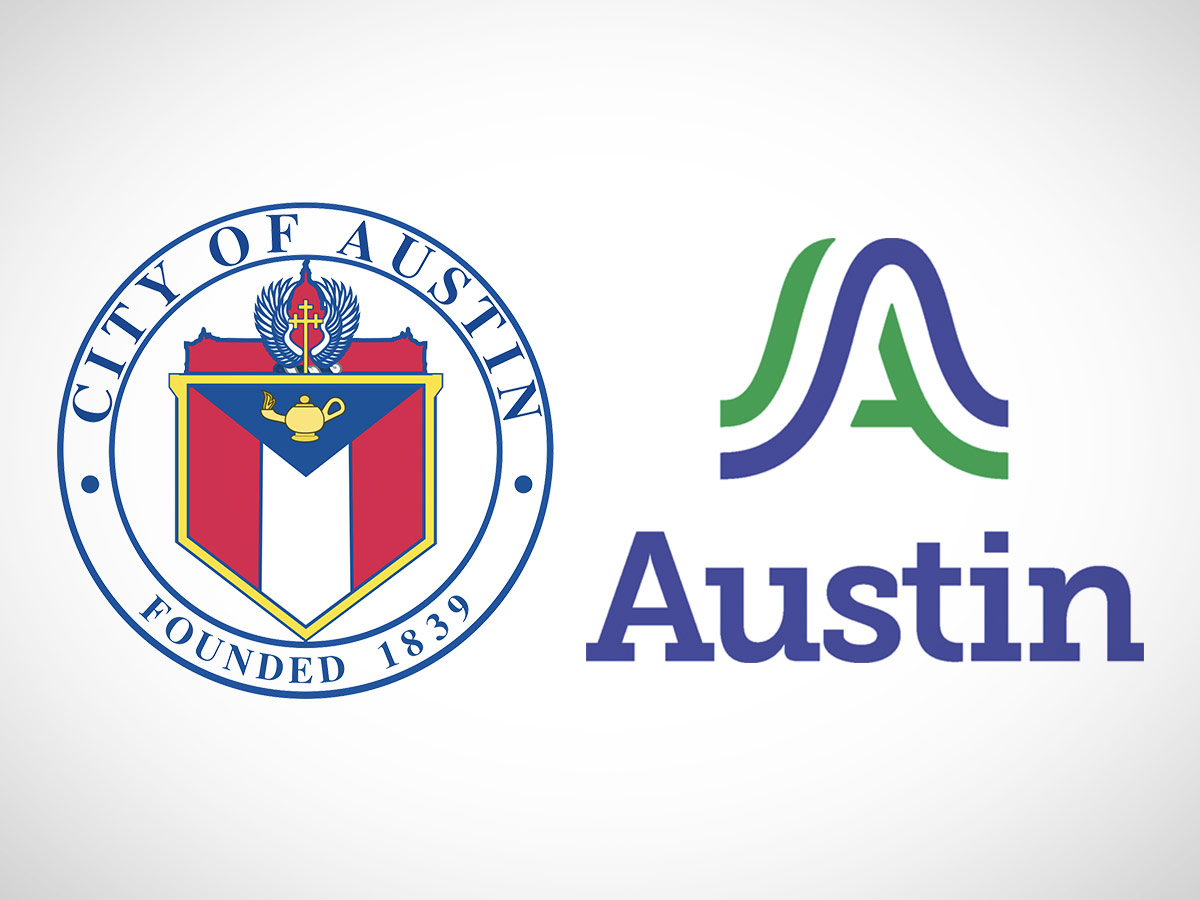
The City of Austin has rolled out a new official brand logo, replacing its historic seal, which featured a Latin cross. The city said the old design no longer reflected its values.
City Manager T.C. Broadnax announced the redesign, describing the new logo as a way to unify the city’s identity and better connect with its residents. “For the first time in Austin’s history, we will have a logo to represent the city services and unify us as one organization, one Austin,” Broadnax told reporters.
The new design features the letter A, which is shaped like rolling green hills, accented by blue and green flowing lines meant to symbolize rivers, hills, and the “dynamic energy of Austinites.” Officials said the imagery is “more than just a letter,” and a visual meant to represent the city’s natural beauty and forward-looking spirit.
The city developed the look with Austin-based creative agency TKO and international design firm Pentagram. While Pentagram is an award-winning design studio, its name—a five-sided star—has drawn attention among some Christians, who connect the symbol with the occult.
The logo will officially launch on October 1, and updates will follow across the city’s website, social media, newsletters, and department branding.
Until now, Austin’s city identity has rested on its official seal, which was designed in 1916. That seal was based on the coat of arms of Stephen F. Austin, the city’s namesake and the so-called “Father of Texas.” At its center was a gold Latin cross with wings, set against the Texas State Capitol.
Though cherished by some, the cross has also been a source of tension. In 1987, the atheist Society of Separationists filed a lawsuit claiming the Christian imagery violated the Texas and U.S. Constitutions. A U.S. appeals court dismissed the case in 1991, ruling the cross reflected Austin’s family heritage and was not a government endorsement of religion.
Still, city leaders said recent surveys showed most residents had little recognition or affinity for the seal. “Through community feedback sessions, we learned that a large majority of Austinites don’t have recognition of or a strong affinity for the city seal, which has been used in place of a logo,” Broadnax explained.
City spokesperson Erik Johnson told The Christian Post the seal “is not a brand, and does not promote the City’s distinctive values and mission.” He added that while the seal will remain for historical purposes, the new logo “reflects Austin’s growth over the last century and what it represents to its residents.”
Officials emphasized that the decision was not about erasing history but about meeting the needs of a modern city. “After conducting surveys and focus groups with a wide array of community members,” Broadnax said, “it was clear residents wanted a modern government that reflects the community’s values and is consistent, connected, and responsive across departments and services. And that’s what this brand does.”
The move comes as corporate and civic rebranding efforts have faced heavy scrutiny. Just weeks ago, Cracker Barrel was forced to walk back a proposed logo redesign after public backlash accused the company of going “woke.” Shares of the restaurant chain briefly tumbled before recovering when the company restored its classic logo.
Austin’s leaders say they are confident this new look will unify rather than divide. Yet given the city’s choice to move away from a symbol marked by Christian heritage, debate over whether the change honors Austin’s past—or dismisses it—seems likely to continue.
 Read Previous Post