
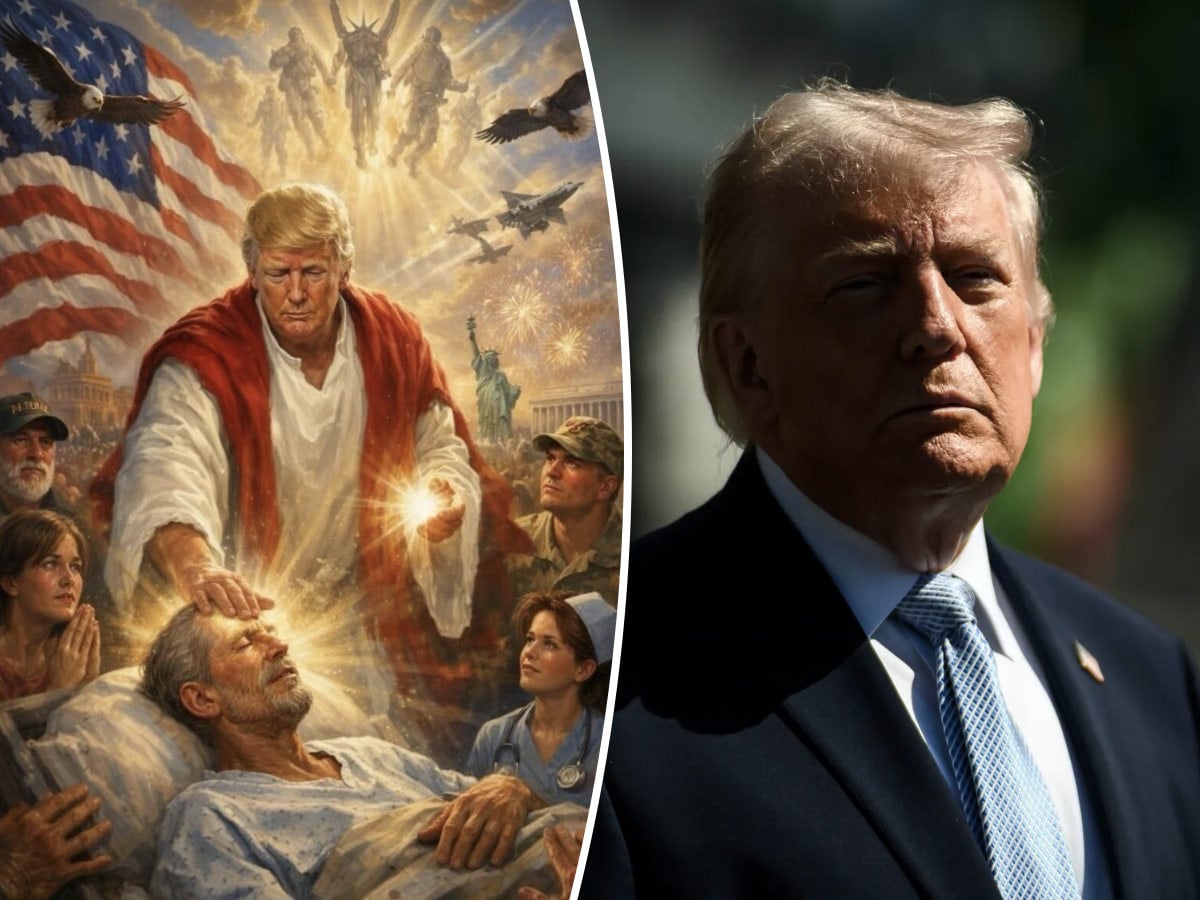
On April 12 – Easter Sunday on the Orthodox Calendar, and one week after the Western Church celebrated Easter – President Trump’s Truth Social account posted an AI-generated image of him as Jesus, healing someone while supporters floated in the air like angels, along with an American flag and military planes. Not surprisingly, the reaction was quick; perhaps surprisingly, the backlash came from some people who have supported him. Even the comments on his Truth Social account called this “blasphemy.” On Monday, Trump admitted posting the image; however, he claimed that he thought it depicted him as a doctor, not as Jesus. The post has since been taken down.
We might expect Christians who disagree with Trump politically to attack this post. Conservatives might be inclined to dismiss such attacks as political. But when Christians across the theological spectrum speak out, it deserves a deeper look.
Most Christians, in viewing the artwork that Trump’s account posted, would probably feel uncomfortable. However, scripture tells us not to trust our “feelings” (see Jeremiah 17:9). So, which scripture passages offer guidance regarding Trump’s depiction of himself as Jesus on his social media account?
Let’s start with the first three of the Ten Commandments:
- No other gods before God (Exodus 20:3)
- No graven images, and no bowing down to them or worshiping them (Exodus 20:4-5)
- No taking God’s name in vain (Exodus 20:7)
The first one is clear – putting anyone else in God’s place is forbidden. As for “making a graven image and worshiping it,” it can clearly be argued that creating an image depicting a person as Christ at least calls for others to worship it. (It would be hard to argue that President Trump does not want people to worship him, so it is not a stretch at all to see this as a “graven image.”)
But it is the third commandment that really stands out here. The NIV translation of Exodus 20:7 says, “You shall not misuse the name of the Lord your God, for the Lord will not hold anyone guiltless who misuses his name.” Many people think of “taking the Lord’s name in vain” as “cussing.” While that is certainly one application, it is not the only one, as the NIV rendering shows. One way to misuse God’s name is to imply that God has either commanded something or has blessed it, thereby showing His approval. Depicting President Trump as Jesus clearly seeks to associate Jesus and His Father with President Trump.
In Acts 12, King Herod gave a speech to some visitors from Tyre and Sidon. When they heard him speak, they acclaimed him by saying, “This is the voice of a god, not of a man” (Acts 12:22-23). Because Herod did not immediately deny this and give praise to God, he was struck down and died. As God Himself said through the prophet Isaiah, “I am the Lord; that is my name! I will not yield my glory to another or my praise to idols” (Isaiah 42:8).
In scripture, “blasphemy” refers to actions that attribute God’s actions to men, or men’s actions to God. For example, when Jesus told the paralyzed man that his sins were forgiven, the Pharisees charged Him with blasphemy, because only God can forgive sins (Luke 5:21). The religious leaders charged Jesus with blasphemy because He compared Himself to God (John 10:33). In that context, President Trump portraying himself as Jesus clearly falls within the common understanding of “blasphemy.”
That’s why the reaction has been prompt and strident across the political and Christian spectrum. For example, Riley Gaines posted that she could not understand why President Trump would post this. “Either way, two things are true: 1) a little humility would serve him well; 2) God shall not be mocked.” Jon Root from OutKick described the post as “blasphemous” and “reprehensible.”
If this post weren’t enough, President Trump has continued to attack Pope Leo XIV, claiming that the Pope is “WEAK on Crime, and terrible for Foreign Policy.” Most Christians probably recognize that the Pope’s focus as the leader of the Roman Catholic Church is spiritual, rather than political. President Trump apparently reacted to the Pope’s call for leaders to work for peace, in which the Pope denounced “the delusion of omnipotence.”
While the original post remained on Trump’s Truth Social account for 12 hours, it was later taken down after the torrent of condemnation from both conservative and progressive Christians. Trump claimed, after deleting the post, that he believed that it portrayed him as a doctor, rather than Jesus. After admitting that he himself had posted it, he claimed, “Only the fake news could come up with that one” [the picture depicting him as Jesus]. But it would be hard for anyone in the United States to look at a picture of a man in a robe, with a red sash around his neck and a glowing orb in his hand, laying his hand on a sick person while others watched, and think “doctor.”
Some political pundits wonder if perhaps this time, President Trump has “crossed the line.” Many conservative Christians’ reactions would seem to indicate that the answer is “yes.”
 Read Previous Post