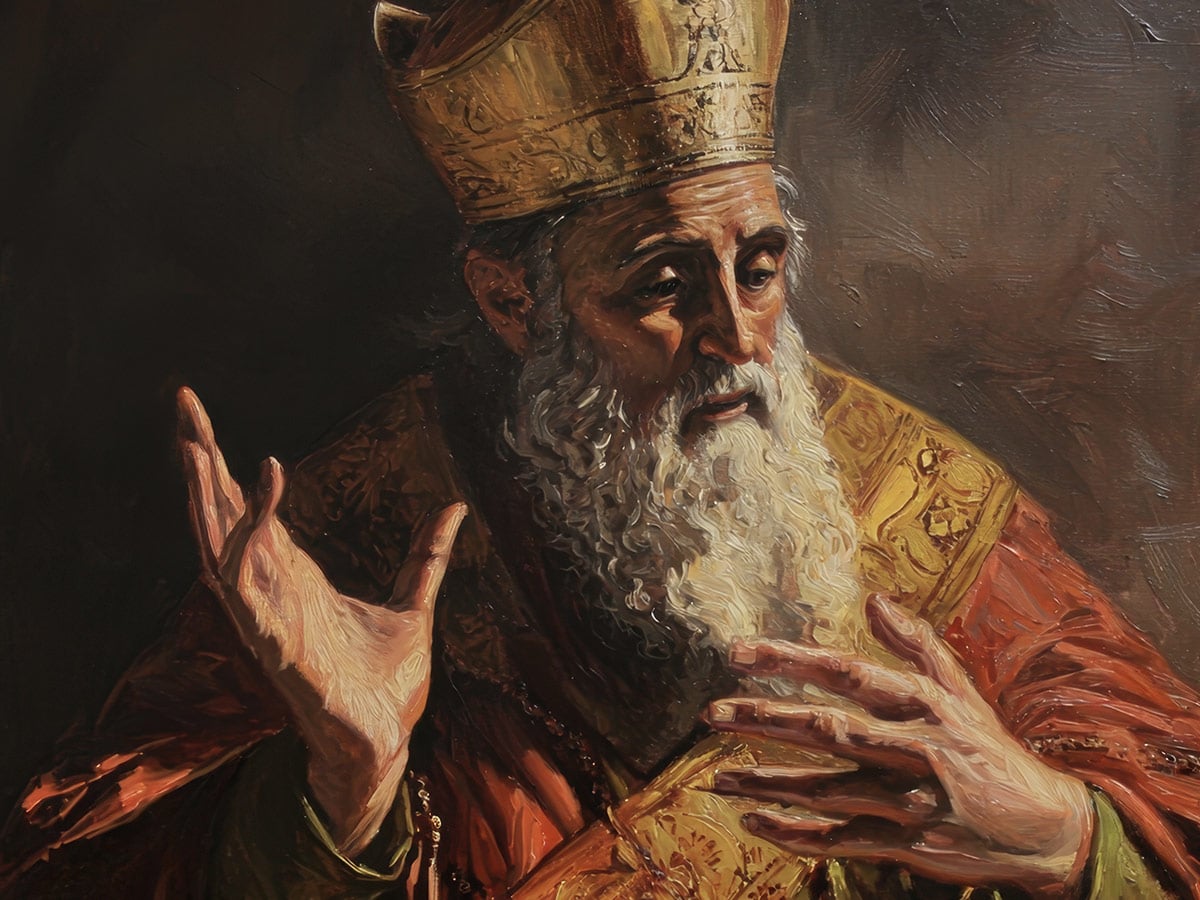
Two sermons found in Poland have been authenticated to belonging to one of Christianity’s most important church fathers. The discovery began with a 12th-century manuscript containing four sermons preserved at the diocesan library in Pelplin in northern Poland. The manuscript had resided in the collection for years, but it was not until 2024 when independent researcher Paul Alexander Nebauer, who specializes in medieval history, reached out to professor of classical philology at the University of Würzburg, Christian Tornau about translating and identifying them.
Tornau, with the help of Clemens Weidmann, a researcher at the “Corpus Scriptorum Ecclesiasticorum Latinorum” in Vienna, Austria, and a team of young scholars analyzed the sermons and determined that two of them were sermons that had been previously known: one confirmed to have been Augustine of Hippo, better known as St. Augustine, and one sermon that has been labeled “pseudo-Augustinian.” The other two, however, were not so easily identified. “We transcribed the new texts and began analyzing them with a view to a future edition. We were fascinated, of course, by the idea of having found new sermons by St. Augustine, but we soon became skeptical because, in some places, the sermons did not seem to have been written by Augustine,” Tornau explained to ACI Prensa, the Spanish-language sister service of EWTN News.
The team’s research would take two years to verify that the sermons were indeed from St. Augustine. The famous church father lived during the 5th century AD, meaning the sermons had been copied through the centuries by church scribes, with the possibility of errors in the transmission during that time. However, Tornau described the documents as “a very good text” and that there were a few “critical corrections” made to reconstruct what St. Augustine was conveying. The preacher appeared to be very familiar with the work of St. Augustine in a way that seemed attributable to St. Augustine himself and used language and theological thought consistent with St. Augustine himself. “Since the preacher is indistinguishable from St. Augustine, we consider it methodologically sound to accept St. Augustine’s authorship rather than inventing an anonymous ‘disciple’ or ‘follower,’” Tornau concluded.
Not only were the researchers able to identify the sermons as being previously undiscovered sermons by St. Augustine himself, but they centered on a very interesting passage from the Bible in 1 Samuel 28, which describes the encounter between King Saul and the Witch of Endor. In the passage, King Saul has fallen out of favor with the Lord and has spiraled into an obsessive hatred against the shepherd David, who will ultimately replace him as king of Israel. King Saul attempts to seek advice from the prophet, Samuel, who has died, meaning he needs to seek aid from a woman referred to as the Witch of Endor to conjure up the spirit of Samuel.
It’s a hotly debate passage amongst Christians even today, who argue whether the witch was really able to conjure up Samuel or created some sort of illusion through ventriloquism. “This narrative posed a problem for early Christian exegesis. How could a necromancer wield magical, diabolical power over Samuel, a saint of God? Is God unable or unwilling to prevent it? Evidently, this raises the question of theodicy,” Tornau noted. St. Augustine’s sermons offered up both possibilities that God permitted Samuel to be summoned or that a demonic spirit impersonated Samuel. According to Augustine, both interpretations were acceptable as neither contradicted acceptable Christian doctrine.
Tornau now plans to publish the sermons in 2027. The publication will include a critical edition of the Latin text with a German translation as well as an introduction to explain the sermons’ discovery. Tornau hopes to present the edition to Pope Leo XIV himself. “This is not a sensational find like the 30 writings of St Augustine that were discovered in Mainz in 1990. But we are supplementing Augustine’s extensive body of writings with two further exciting texts in a critical edition.”
 Read Previous Post