
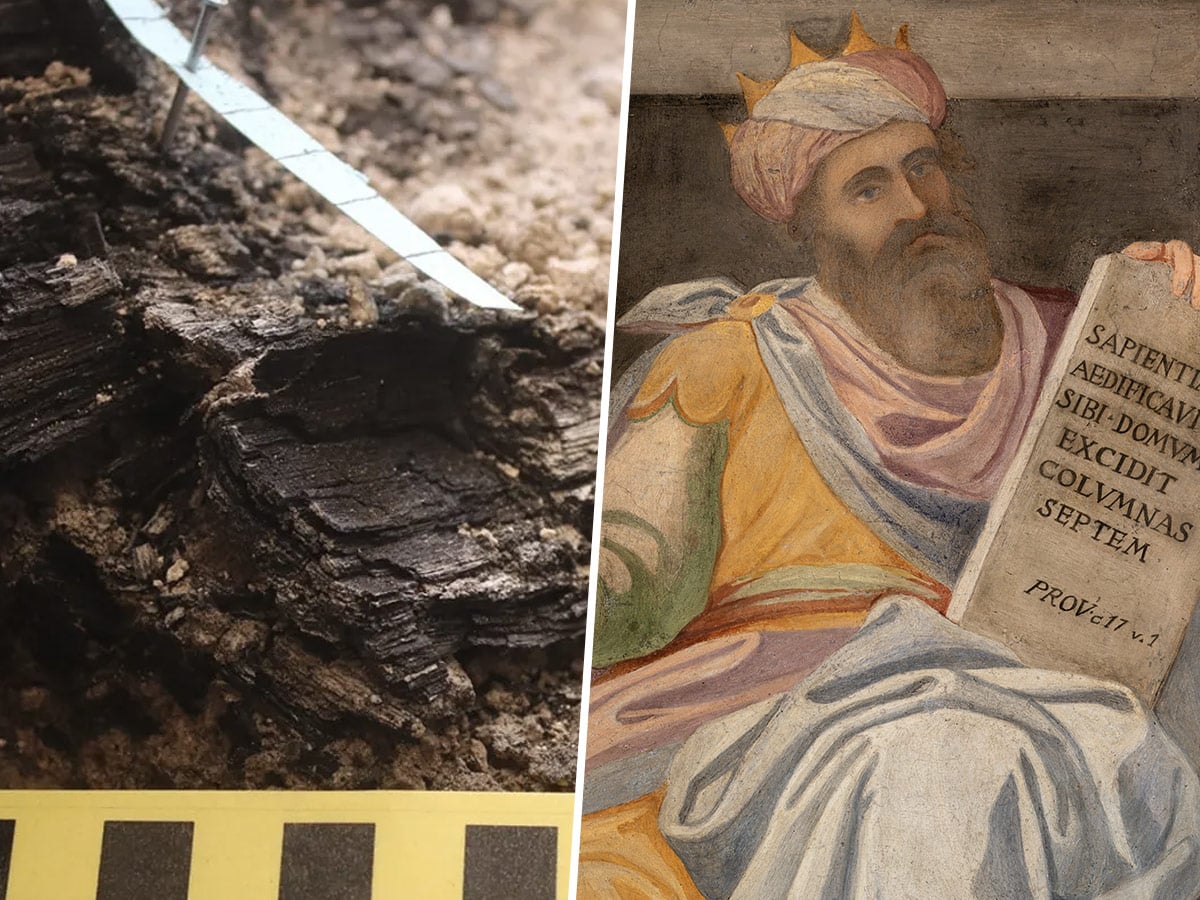
Charred beams discovered beneath the Givati Parking Lot in Jerusalem could be remnants from the destruction of the temple built by King Solomon, better known as the First Temple. The beams were discovered during a dig at the Jerusalem Walls National Park in the City of David inside a building that appeared to have collapsed from a fire. Melted plaster from the building’s walls may have helped in preserving the beams according to Israel Antiquities Authority (IAA) excavation director Efrat Bocher. The beams appear to be around 2,600 years old, dating to the time when the First Temple, built by the Biblical King Solomon, was destroyed by King Nebuchadnezzar II in 586 BC. Solomon had instructed the Temple to be built to house the Ark of the Covenant, which had brought the Israelite’s many victories after they’d escaped from Egypt under the leadership of Moses.
The beams offer a rare opportunity of exact dating given the number of identifiable growth rings on them. “It is very rare in Israel to find wood with such a large number of growth rings. Here in the City of David, we found thick beams with many rings, offering significant research potential, with more growth rings enabling higher dating resolution,” said Dr. Johanna Regev of the IAA. “Until now, we could date finds within a range of hundreds of years. Now, we can attain much greater precision, narrowing the dating range down to as little as 10 years.”
The beams may have formed part of the inner courtyard of a First Temple building. Other beams from the same building were previously found on the southern end of the parking lot, indicating the original building must have been quite large. More interestingly, it appears the destroyed structure was left standing on purpose by the ancient residents of the time, perhaps as a standing memory of a dark period in Israel’s history. The Bible records the return of residents to Jerusalem after a period of time known as the Babylonian Exile. “The concept of a landscape of memory is familiar from many cultures around the world. Preserving memory is a human need, seeking to preserve what once existed,” said said Dr. Yiftah Shalev, director of the excavation on behalf of the IAA. “Here we see it in its clearest form: a deliberate choice to leave ruins in place as a testament to the destruction and build the new layer over them.”
Interestingly, the discovery was made just before Tisha B’Av, which commemorates the destruction of the First Temple. Bocher spoke of the poignancy of the discovery. “We are just before Tisha B’Av. This discovery makes you feel that you are witnessing the very moment of destruction, the moment when it all happened. It’s deeply moving.”
 Read Previous Post