- Faith: Christian
- Career: Coach
- Birthday: March 15, 1972
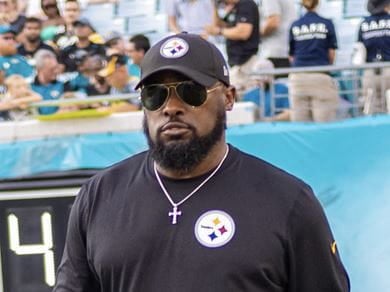
Mike Tomlin is a NFL football coach who most recently served as the head coach of the Pittsburgh Steelers for 19 seasons.
Tomlin was the younger of two sons born into a family with deep football roots. His biological father, Ed Tomlin, had played football at Hampton Institute during the 1960s and was drafted by the Baltimore Colts before playing for the Montreal Alouettes in the Canadian Football League. However, Tomlin hardly knew his birth father, who passed away from an apparent heart attack in January 2012 at age 63 in Ocala, Florida. Instead, Tomlin was primarily raised by his mother, Julia, and his stepfather, Leslie Copeland, who married when Tomlin was six years old. This blended family structure provided the stability and support that would shape his character and leadership approach.
Growing up in Newport News, Virginia, Tomlin attended Denbigh High School, where he graduated in 1990. His athletic prowess earned him a spot at the College of William and Mary, where he pursued a sociology degree while playing as a wide receiver for the football team. During his collegiate career, Tomlin earned second-team All-Yankee Conference honors in 1994, demonstrating the competitive spirit that would later define his coaching career. He graduated in 1995 and became a member of the Kappa Alpha Psi fraternity, building relationships and leadership skills that would serve him throughout his professional life.
Tomlin's coaching journey began immediately after graduation in 1995 when he accepted a position as wide receivers coach at Virginia Military Institute under head coach Bill Stewart. This initial role launched what would become an impressive ascent through the coaching ranks. In 1996, he moved to the University of Memphis as a graduate assistant, working with defensive backs and special teams. After a brief stint at the University of Tennessee at Martin, Tomlin joined Arkansas State University in 1997 as a defensive backs coach, a position he held for two seasons.
His collegiate coaching career continued at the University of Cincinnati from 1999 to 2000, where he further honed his defensive coaching philosophy. These formative years established Tomlin's reputation as a skilled position coach with an eye for developing talent and implementing effective defensive schemes.
Tomlin's transition to the NFL came in 2001 when he was hired as the defensive backs coach for the Tampa Bay Buccaneers under head coach Tony Dungy. This appointment proved transformative for Tomlin's career trajectory. Working under Dungy, Tomlin learned the Tampa 2 defense that he would later employ in his own coaching positions. More importantly, he absorbed Dungy's leadership philosophy, which emphasized faith, character, and treating players with dignity and respect.
When Jon Gruden replaced Dungy as head coach, Tomlin was retained, a testament to his coaching abilities. His tenure with Tampa Bay proved highly successful. During the 2002 and 2005 seasons, the Buccaneers led the NFL in total defense, allowing the fewest yards per game. Throughout Tomlin's five years with the team, the defense never ranked worse than sixth overall. The pinnacle came in January 2003 when the Buccaneers won Super Bowl XXXVII, with the defense recording a Super Bowl-record five interceptions, three returned for touchdowns. Tomlin's work with the defensive backs played a crucial role in this championship success.
In 2006, Minnesota Vikings head coach Brad Childress selected Tomlin as his defensive coordinator, marking another significant career advancement. At just 33 years old, Tomlin faced unique challenges—two players on the Vikings roster were older than him, and he had been a college teammate of Vikings safety Darren Sharper at William and Mary. Despite these unusual circumstances, Tomlin led the 2006 Vikings to the NFL's eighth-best overall defense, with the unusual distinction of finishing as the top-ranked defense against the run while ranking last against the pass.
After only one season as a defensive coordinator, Tomlin's leadership potential attracted the attention of the Pittsburgh Steelers, who were seeking a replacement for the retiring Bill Cowher. On January 27, 2007, at age 34, Tomlin was hired as the 16th head coach in Steelers franchise history. The hiring made Tomlin the 10th African-American head coach in NFL history and the first for the Steelers organization. Though his ascension has often been cited as evidence of the Rooney Rule working as intended, Steelers owner Dan Rooney clarified that the team had already fulfilled the rule's requirements by interviewing Ron Rivera before meeting with Tomlin.
The reported four-year contract worth $2.5 million per year with an option for a fifth year reflected the organization's confidence in their young coach. Tomlin's hiring continued the Steelers' tradition of selecting head coaches in their thirties, following in the footsteps of Cowher, Chuck Noll, and several others throughout franchise history.
Tomlin made strategic decisions early in his tenure that would prove essential to his success. Unlike Cowher, who had retained only longtime running backs coach Dick Hoak from Chuck Noll's staff, Tomlin kept many of Cowher's assistants, most notably defensive coordinator Dick LeBeau, whose defensive philosophy actually contrasted with Tomlin's own. This decision maintained team chemistry with players who were only one year removed from a Super Bowl victory. The approach worked—in 2007, the Steelers finished with the top-ranked defense in the NFL and secured the AFC North Division championship with a 10-6 record. Though the Steelers lost in the first round of the playoffs to the Jacksonville Jaguars 31-29, Tomlin had established himself as a capable leader.
Tomlin's second season brought remarkable achievement. After the Steelers defeated the Baltimore Ravens 23-14 in the 2008 AFC Championship Game, Tomlin became the youngest NFL head coach to lead his team to a Super Bowl at age 36. He also became the third African-American coach to reach the Super Bowl, following Tony Dungy and Lovie Smith. On January 29, 2009, Tomlin was named the 2008 Motorola NFL Coach of the Year.
Three days later, on February 1, 2009, Tomlin achieved the pinnacle of coaching success when the Steelers defeated the Arizona Cardinals 27-23 in Super Bowl XLIII. At 36 years old, he became the youngest head coach to win the Super Bowl, breaking Jon Gruden's record, who was 39 when he won Super Bowl XXXVII with Tampa Bay. In a meaningful full-circle moment, Tomlin had served as defensive backs coach under Gruden during that Buccaneers championship. Tomlin's record for youngest Super Bowl-winning coach stood until Sean McVay won Super Bowl LVI at a slightly younger age.
Following a contract extension in July 2010, Tomlin led the Steelers to a 12-4 record and back to the Super Bowl for the second time in three years. Though the Steelers fell to the Green Bay Packers 31-25 in Super Bowl XLV, Tomlin had cemented his status as an elite NFL head coach. By November 2011, Tomlin had won his 50th game as Steelers head coach, becoming only the fourth coach in franchise history to reach that milestone.
Throughout the 2010s, Tomlin established himself as one of the NFL's most consistent coaches. He received another three-year contract extension in July 2012 through the 2016 season. The 2012 season brought the first real challenge to Tomlin's tenure when injuries to quarterback Ben Roethlisberger and offensive line struggles contributed to an 8-8 record and missed playoffs—only the second time the Steelers failed to reach the postseason under Tomlin.
The 2013 season brought controversy when, facing the Baltimore Ravens on Thanksgiving Day, Tomlin appeared to interfere with a kickoff return by Jacoby Jones. Video replay showed Tomlin standing just off the field along the sideline as Jones broke free, briefly placing his foot onto the field as he jumped away, causing Jones to veer inside where he was tackled. Though no penalty was called during the game, the NFL fined Tomlin $100,000—tied for the second-highest fine for a coach in NFL history. Despite this incident and another 8-8 finish, Tomlin's job security remained intact.
The 2014 season marked the beginning of what became known as the "Killer B's era," featuring the peak years of quarterback Ben Roethlisberger, wide receiver Antonio Brown, and running back Le'Veon Bell. The Steelers improved to 11-5 and won the AFC North, though their playoff run ended with a Wild Card Round loss to Baltimore. The following years saw continued success: 10-6 in 2015, 11-5 in 2016, and an impressive 13-3 in 2017. The 2016 season was particularly notable as the Steelers reached the AFC Championship Game for the first time since 2010, though they fell to the New England Patriots 36-17.
The 2019 season tested Tomlin's coaching abilities when the Steelers lost Ben Roethlisberger to injury after just two games. Despite starting 0-3, Tomlin guided the team through multiple quarterback changes between Mason Rudolph and undrafted rookie Devlin Hodges, finishing 8-8. The season demonstrated Tomlin's resilience and ability to maximize limited resources—a hallmark of his coaching tenure.
In November 2019, following an incident where Browns defensive end Myles Garrett struck Mason Rudolph with a helmet, Tomlin maintained a measured public response. When Garrett later accused Rudolph of using a racial slur, Tomlin appeared on ESPN to defend his quarterback, showing his commitment to supporting his players while handling sensitive situations with appropriate gravitas.
The COVID-19 pandemic in 2020 brought additional challenges. Tomlin was fined $100,000 by the NFL for not properly wearing a face mask during a Week 8 game, as required by pandemic protocols. Despite these obstacles, Tomlin led the Steelers to a 12-4 record, and after Week 9, he recorded his 14th consecutive non-losing season since becoming head coach, tying Marty Schottenheimer for the longest such streak of all time. Though the Steelers lost in the Wild Card Round to the Cleveland Browns, Tomlin had established an unprecedented level of consistency.
In April 2021, Tomlin signed a three-year contract extension through 2024, cementing his long-term future with the organization. The 2021 season marked the final year of the Ben Roethlisberger era—a partnership that had defined much of Tomlin's tenure. Since Tomlin's hiring in 2007, the Steelers posted a record of 137-70-1 in games with Roethlisberger as starter. The 2022 season was historic as Tomlin's 16th with the team, surpassing Bill Cowher for the second-longest tenure as Steelers head coach.
Tomlin achieved another milestone on December 1, 2024, when a 44-38 victory over the Cincinnati Bengals gave him his 18th consecutive non-losing season, breaking the all-time NFL record he had previously shared. This unprecedented streak of consistency places Tomlin in elite company—only Tom Landry (21) and Bill Belichick (19) have had longer such streaks at any point in their careers. When Bill Belichick departed the New England Patriots after the 2023 season, Tomlin became the NFL's longest-tenured active head coach. Following Gregg Popovich's departure from the San Antonio Spurs in 2025, Tomlin became the longest-tenured active head coach in all major American professional sports.
Despite this remarkable consistency, Tomlin has faced criticism for postseason struggles. Since the team's 2016 AFC Championship appearance, the Steelers have not recorded a playoff victory, giving Tomlin the second-longest playoff win drought in NFL history behind Marvin Lewis. Following another Wild Card Round exit in January 2025—a 28-14 loss to the Baltimore Ravens—calls for change emerged from some quarters of the fanbase and media. However, Steelers owner Art Rooney II confirmed there were no plans to fire Tomlin, and the team declined a trade request from the Chicago Bears for Tomlin's services.
On June 10, 2024, Tomlin signed a three-year contract extension through the 2027 season; however, on January 13, 2026, it was announced that Tomlin had resigned from his position as head coach after 19 seasons with the Steelers.
Tomlin met his wife, Kiya, while both were students at the College of William and Mary. Their relationship has endured throughout his demanding coaching career, providing stability amid the pressures of professional football. The couple has three children together and resides in the Squirrel Hill neighborhood of Pittsburgh. Kiya has been described as a stylish first lady of the Steelers organization, supporting her husband while maintaining her own identity and interests.
Family remains central to Tomlin's life outside football. In a 2023 interview, he spoke warmly about the influence of his stepfather, Leslie Copeland, emphasizing the importance of father figures in young people's lives. This appreciation for paternal guidance has manifested in Tomlin's annual ManUp Pittsburgh event, which he has hosted for over a decade to mentor young men in the community. The event reflects Tomlin's commitment to being a positive influence beyond the football field, particularly for youth who may lack strong male role models.
Mike Tomlin's Religious Beliefs
Throughout his coaching career, Mike Tomlin has been open about his Christian faith, which he describes as the foundation of his identity and leadership approach. He attends Allegheny Center Alliance Church in Pittsburgh, a Christian and Missionary Alliance congregation. During Super Bowl XLIII media week in 2009, Tomlin took advantage of the international platform to publicly discuss his faith for the first time at such a scale.When asked about his personal beliefs by a Baptist Press reporter, Tomlin responded clearly and directly: "First and foremost, I want people to know who I am and what the most important thing is in my life, my relationship with Jesus Christ. Football is what we do; faith is who we are all the time." This statement encapsulated Tomlin's view that his profession as a football coach represents his vocation, while his faith defines his essential character and values.
Tomlin credits Tony Dungy, his mentor from their time together in Tampa Bay, with demonstrating how to integrate faith into professional coaching. "The biggest thing I learned from Tony Dungy was an unyielding belief in his message of faith," Tomlin reflected. "It was displayed all the time with him. He was extremely consistent and that's what I want to take to maximize my faith." This consistency—applying the same principles in public and private contexts—became a hallmark of Tomlin's approach to leadership.
His spiritual convictions shape his leadership philosophy, which he describes as leading with "a servant's heart." This concept, rooted in Christian teachings about servant leadership, emphasizes putting others' needs first and leading through example rather than mere authority. Steelers defensive end Nick Eason expressed appreciation for having a Christian head coach, noting, "It's a great blessing when a man of God is leading your team. It's like a godly father in the household."
Assistant coaches who share Tomlin's faith have observed how his spiritual perspective permeates team culture. Amos Jones, the Steelers' assistant special teams coach who was baptized alongside his father at West End Baptist Church in Aliceville, Alabama, commented on the impact: "I think his faith in the Lord is a blessing. It's just a peace of mind knowing that he has everybody's best interest at heart. Mike and I share the same faith and it's amazing how many times something he might say to the team in the locker room could have a spiritual meaning."
Jones also reflected on how faith provides perspective in the high-pressure NFL environment: "I have always been blessed by the Lord. When I didn't have a job, He provided one. He gave me this job and allowed me to go to the Super Bowl. It's been a blessing." His wife Stacey has noticed faith's presence even in game-day moments, observing defensive backs praying together on the sideline and star safety Troy Polamalu encouraging and praying with teammates.
Linebackers coach Keith Butler articulated how faith provides perspective on the intense scrutiny of Super Bowl week: "This isn't life-or-death pressure. It's not like life or death in eternity without God. Is this game important? Yes. Is it the most important thing? Not even close." This perspective—that football matters but exists within a larger spiritual framework—reflects the attitude Tomlin seeks to instill throughout the organization.
Tomlin's faith became particularly visible during difficult moments, such as following the October 2018 mass shooting at the Tree of Life synagogue in Pittsburgh's Squirrel Hill neighborhood, near where Tomlin lives. He made a passionate address to the team, demonstrating how his spiritual convictions inform his response to tragedy and his role in supporting his players and community during crisis.
While Tomlin is open about his faith, he does not impose it on others or use it as a weapon. Instead, his approach reflects what he learned from Dungy—consistent, authentic living that allows faith to be visible through actions rather than just words. He embraces the platform that comes with coaching in the NFL, stating, "We embrace and appreciate this platform," viewing his public position as an opportunity to positively influence others through both his professional conduct and personal example.
Back to the Celebrity Faith Database