- Faith: Buddhist
- Career: Actor
- Birthday: March 10, 1952
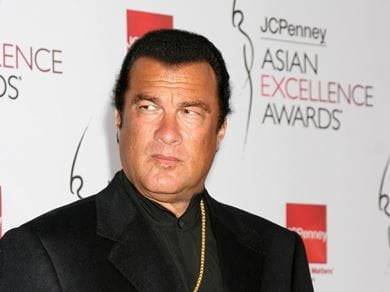
Steven Seagal is an American actor, martial artist, producer and musician best known for his roles in action films during the late 1980s and 1990s. With his calm screen presence, martial arts expertise and trademark ponytail, Seagal became one of Hollywood’s most recognizable action stars through movies such as “Above the Law,” “Hard to Kill,” “Under Siege” and “Marked for Death.” Beyond acting, he has also drawn attention for his spiritual beliefs, particularly his devotion to Tibetan Buddhism.
Seagal was born on April 10, 1952, in Lansing, Michigan, to Patricia and Samuel Seagal. His mother worked as a medical technician, while his father was a high school math teacher. He was raised in Fullerton, California, where he developed an interest in martial arts at a young age. As a teenager, Seagal studied karate and later became deeply involved in aikido, a Japanese martial art focused on defensive movements and redirecting an opponent’s energy.
In his late teens and early twenties, Seagal moved to Japan, where he immersed himself in martial arts training. He studied under several respected instructors and eventually became the first foreigner known to operate an aikido dojo in Japan. During his years overseas, he sharpened both his martial arts skills and his understanding of Eastern philosophy and culture, experiences that would later shape much of his public identity.
Seagal returned to the United States in the early 1980s and worked as a martial arts instructor for celebrities and Hollywood figures. His connections in the entertainment industry eventually led to a film career. In 1988, he made his acting debut in “Above the Law,” playing a former CIA operative with elite fighting skills. The movie’s success immediately positioned Seagal as a new action star.
Throughout the late 1980s and early 1990s, Seagal became one of the era’s most bankable action actors. Films including “Hard to Kill,” “Out for Justice,” “Marked for Death” and “Under Siege” performed well at the box office and helped establish his tough, stoic on-screen persona. “Under Siege” in particular became one of his biggest commercial hits and remains one of his most recognized performances.
As the popularity of theatrical action films shifted in the late 1990s and 2000s, Seagal continued acting primarily in direct-to-video productions. He also explored other entertainment ventures, including music. Seagal released blues-inspired albums and occasionally performed live with his band. In 2009, he starred in the reality television series “Steven Seagal: Lawman,” which followed his work with law enforcement officers in Louisiana.
Outside of entertainment, Seagal has been involved in various international and political activities over the years. He spent time living overseas and developed close ties with Russia, where he was granted citizenship in 2016. His public image has often generated controversy, but his impact on martial arts films remains significant, especially during the peak action-movie era of the 1990s.
Seagal’s personal life has included several marriages and children. He married Japanese aikido instructor Miyako Fujitani in 1975, and the couple had two children before divorcing. He later married actress Adrienne La Russa, though that marriage was annulled. Seagal then married actress and model Kelly LeBrock in 1987. The couple had three children together before divorcing in 1996. He also has additional children from other relationships, including a daughter with Arissa Wolf. Over the years, Seagal has largely kept many aspects of his family life private despite his celebrity status.
Steven Seagal's Religious Beliefs
A major part of Seagal’s identity is his devotion to Tibetan Buddhism. He is a committed follower of the Nyingma tradition, one of the major schools of Tibetan Buddhism. In 1997, His Holiness Penor Rinpoche officially recognized Seagal as a tulku, which in Tibetan Buddhism refers to the reincarnation of a spiritual teacher or lama. Penor Rinpoche identified Seagal as the reincarnation of Chungdrag Dorje, a 17th-century Buddhist treasure revealer.
The recognition attracted worldwide attention because Seagal was one of the first major Hollywood celebrities to receive such an honor. However, Buddhist scholars and traditional religious leaders noted that Seagal did not complete the extensive monastic education or formal enthronement process typically associated with recognized tulkus.
Even so, Seagal has remained outspoken about the role Buddhism plays in his life. He has often connected his martial arts philosophy, healing practices and personal worldview to Buddhist teachings. He has also participated in Buddhist lectures and spoken at Tibetan Buddhist temples, emphasizing ideas such as discipline, compassion and spiritual growth. Throughout his career, Seagal has described Eastern philosophy as a guiding force behind both his professional success and personal beliefs.
Back to the Celebrity Faith Database