- Faith: Catholic
- Career: Politician
- Birthday: March 26, 1940
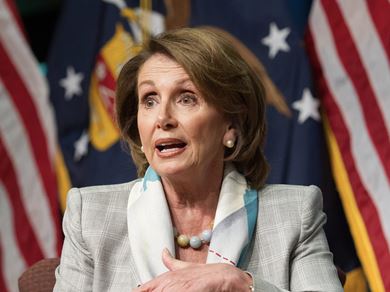
Nancy Pelosi is an American politician who served as the 52nd Speaker of the United States House of Representatives from 2007 to 2011 and again from 2019 to 2023. A longtime member of the Democratic Party, she made history as the first woman to serve as Speaker and the first woman to lead a major political party in either chamber of Congress. Over the course of her two decades in party leadership—one of the longest tenures in House history—Pelosi became one of the most influential figures in American politics.
Pelosi was born in Baltimore, Maryland, to Italian-American parents: Thomas D’Alesandro Jr., a Congressman and later Mayor of Baltimore, and Annunciata “Nancy” (née Lombardi) D’Alesandro, a civic-minded organizer of Democratic women. As the only daughter and youngest of seven children, Pelosi grew up in a household steeped in political engagement and public service. Her father was already active in politics when she was born, and her mother worked alongside him, helping to organize constituents and women’s Democratic clubs.
Raised in the Roman Catholic tradition and educated at all-girls Catholic schools in Baltimore, Pelosi absorbed early lessons about faith, community responsibility, and social justice. She drew inspiration from the speech of President John F. Kennedy and began helping out on her father’s campaigns as a child. After graduating from the Institute of Notre Dame in 1958, she went on to earn a Bachelor of Arts in political science from Trinity College in Washington, D.C., in 1962.
In 1963, she married Paul Francis Pelosi, a businessman, in Baltimore. The couple eventually relocated, first to New York and then in 1969 to San Francisco, where Paul’s brother Ronald was active in city government. There, Pelosi paused her formal political ambitions for a period, focused on raising her five children and volunteering in Democratic circles, yet she remained connected to the political world through her upbringing and faith-inflected worldview.
Pelosi’s formal political career began in California. After years of party work—serving on the Democratic National Committee and leading the California Democratic Party—she ran in a 1987 special election for Congress and won, representing the San Francisco area. Over subsequent elections, she held her seat comfortably, building seniority and influence in the House of Representatives.
In 2001 she was elected Democratic Whip, and in 2002 she became House Democratic Leader, the first woman to lead a major party in either chamber of the U.S. Congress. With the 2006 midterm elections giving Democrats a House majority, Pelosi became Speaker in 2007—the first woman, the first Californian, and the first Italian-American to hold that position.
During her first tenure as Speaker (2007–2011), Pelosi guided landmark legislation including health-care reform efforts, financial reforms, and other major initiatives. After Republicans regained the House in 2010, Pelosi became Minority Leader. In 2019 she again became Speaker and held that role through 2023, navigating the House through impeachment proceedings, major spending bills, and intense partisan polarization.
Under Pelosi’s leadership, the House passed transformational legislation on health care, climate and infrastructure, and civil rights. Her influence extended beyond legislation: she became a symbol of women’s political power, and a figure often cited as one of the most effective and consequential House Speakers in U.S. history.
On November 6, 2025, Pelosi announced she would not seek re-election and retire from Congress in 2027 after serving for 40 years.
Pelosi and her husband Paul have five children and multiple grandchildren. Her experience as a mother and homemaker has intertwined with her political life—she has described how managing her family and home taught her skills of organization, negotiation, and leadership that translated into congressional strategy and governance.
Residing in San Francisco’s Pacific Heights neighborhood and holding substantial family investments and real estate, Pelosi’s financial profile has drawn public attention, yet her personal narrative remains grounded in her early values of duty and public service. While her career has required stamina under pressure and frequent travel, she often speaks of the importance of returning to her family, community, and faith as anchors amid the demands of public office.
In her public persona, Pelosi has been both a trailblazer and a strategist. She is known for her sharp political instincts, disciplined leadership style, and sometimes polarizing presence, yet she also emphasizes mentorship, bipartisanship when possible, and civic responsibility. Her legacy as a woman who reached the highest levels of congressional leadership remains a milestone in American politics.
Nancy Pelosi's Religious Beliefs
Pelosi’s Catholic upbringing in Baltimore laid a lasting foundation for her worldview and political compass. Raised in a devout Catholic household, educated in Catholic schools, she became deeply aware of the intersection of faith, ethics, and public service. She frequently describes herself as a “devout Catholic” and has credited her faith with shaping her sense of purpose and responsibility.
In events and public discussions—such as speaking at Georgetown University on faith and vocation—Pelosi has discussed how her Catholic formation influenced her thinking about justice, human dignity, and collective obligation. She has emphasized that her faith is not merely personal but integrally tied to how she approaches leadership and policy decisions.
However, Pelosi’s faith has also entered public controversy. On certain issues, most notably abortion rights, her positions diverge from the official teaching of the Catholic Church. In May 2022, the Archbishop of San Francisco publicly stated that Pelosi was not to present herself for Holy Communion until she repudiated her advocacy of abortion rights. Pelosi, for her part, said she has received Communion in many churches and is “faithful to the Catholic Church.” She described the Communion dispute as “his problem, not mine.”
This tension highlights one of the enduring complexities of Pelosi’s faith-public life interface: being a faithful Catholic while holding political positions that conflict with some Church teachings. Rather than shy away from the tension, Pelosi has spoken of it openly—acknowledging that faith and politics do not always align perfectly, but that for her, one’s moral and ethical commitments rooted in faith remain foundational.
Pelosi’s guiding principle—often referenced in her speeches—is that of human dignity at every stage of life, a value drawn from Catholic social teaching. She has spoken of her religious convictions in terms of service and stewardship, stating that being rooted in faith means embracing responsibility for those who are marginalized, vulnerable, or voiceless. For her, the public role is not simply about power or policy, but about vocation: to serve the common good.
Back to the Celebrity Faith Database