- Faith: Muslim
- Career: Politician
- Birthday: October 18, 1991
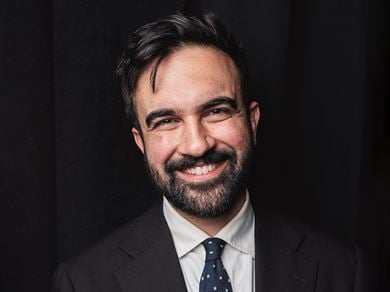
Zohran Mamdani is a politician who has represented New York’s 36th Assembly District—covering the Queens neighborhood of Astoria—since 2021. A member of both the Democratic Party and the Democratic Socialists of America, he is currently the Democratic nominee in the 2025 New York City mayoral race.
Zohran Kwame Mamdani was born on October 18, 1991 in Kampala, Uganda, into a family steeped in intellectual and artistic achievement. His father, Mahmood Mamdani, is a renowned academic—an anthropologist and political scientist who has taught at Columbia University. His mother, Mira Nair, is an acclaimed Indian-filmmaker whose work includes Mississippi Masala and Monsoon Wedding.
When Zohran was five, the family moved to Cape Town, South Africa, where his father taught at the University of Cape Town. Two years later, they relocated to New York City. Growing up in Queens, Mamdani attended the Bronx High School of Science, where he helped start the school’s first cricket team—a nod to his multicultural upbringing.
He went on to study at Bowdoin College in Maine, graduating in 2014 with a degree in Africana Studies. During college, Mamdani became active in social justice causes and student organizing. His global upbringing—spanning Uganda, South Africa, and the United States—instilled in him a deep awareness of inequality and the power of civic engagement.
After graduating, Mamdani returned to Queens, where he worked as a housing counselor assisting low-income homeowners facing foreclosure. This early work with struggling families grounded his commitment to addressing issues like housing insecurity and economic inequality.
His first major political step came in 2020, when he ran for the New York State Assembly in the 36th District, representing Astoria and surrounding neighborhoods. Running as a Democratic Socialist and first-time candidate, Mamdani campaigned on affordable housing, transit reform, and tenant rights. His grassroots campaign—driven largely by volunteers—successfully unseated incumbent Aravella Simotas in the Democratic primary.
When he took office in January 2021, Mamdani became one of the youngest members of the Assembly and quickly gained a reputation for bold, progressive policymaking. He introduced measures to expand public transportation, freeze rents, and invest in community services. He also became a vocal advocate for immigrant communities and working-class New Yorkers.
In 2025, Mamdani announced his candidacy for mayor of New York City. His campaign emphasized equity, housing justice, and a “city for everyone.” Using multilingual outreach—speaking Hindi, Urdu, Bengali, and English—he connected with the city’s diverse communities in a way few candidates had before. His approach resonated with younger voters and immigrant families who felt overlooked by traditional political structures.
In a major upset during the 2025 Democratic primary, Mamdani defeated former Governor Andrew Cuomo, emerging as the Democratic nominee for mayor. If elected, he would become New York City’s first Muslim and first Indian-American mayor, as well as one of its youngest in modern history.
Mamdani’s political philosophy blends progressive ideals with a grassroots approach. He has advocated for rent freezes in regulated apartments, universal child care, expanded free bus service, and higher taxes on the wealthy to fund public programs. He often frames his policies through a moral lens, arguing that compassion and justice must drive governance.
His emphasis on accessible housing, affordable transit, and climate resilience aligns him with a new generation of progressive leaders who see the city as a vehicle for equity rather than privilege. While critics have sometimes labeled his ideas as overly idealistic, supporters see him as a leader unafraid to challenge entrenched systems of power.
Though relatively private about his personal life, Mamdani married Rama Duwaji, a Syrian-American artist, in early 2025. The two met through a dating app and quickly bonded over shared interests in art, culture, and activism. They live in Astoria, Queens—the same neighborhood Mamdani represents in the Assembly.
Astoria’s mix of immigrant communities and working-class families mirrors much of what defines his worldview. Mamdani’s multicultural background—Ugandan, Indian, South African, and American—deeply informs his identity as both a policymaker and citizen. Friends describe him as humble, grounded, and passionate about public service.
Despite his rising profile, he remains close to his parents and credits their work in academia and film for teaching him to think critically and creatively about social systems. His father’s analysis of post-colonial politics and his mother’s storytelling have both shaped his belief that narrative and empathy are essential tools for change.
As Mamdani’s profile has grown, so has the scrutiny. His outspoken stances on global issues, particularly regarding the Middle East, have stirred debate. Some critics have accused him of allowing ideology to drive his policy positions. Supporters counter that his perspective brings moral depth and empathy to public discourse.
He has also faced Islamophobic attacks from opponents who question his background or loyalty—echoes of challenges faced by other Muslim politicians in the United States. Mamdani, however, has responded with composure, reiterating his commitment to unity and the principles of democracy. He often cites his personal faith and family values as anchors amid political storms.
What religion is Zohran Mamdani?
Zohran Mamdani identifies as a Shia Muslim and has spoken openly about how his faith shapes his worldview. He often references the Islamic principles of justice, compassion, and community in describing his approach to public life.
For Mamdani, faith is not merely personal—it informs his understanding of equity and responsibility. He has described Islam as a source of strength in his pursuit of justice, noting that the idea of ummah (community) extends beyond religion to include all who seek dignity and fairness.
Mamdani has also been candid about the challenges of being a Muslim in American politics, acknowledging that Islamophobia remains a real obstacle for public figures. His visibility as a practicing Muslim in high office has drawn both support and criticism. Nonetheless, he embraces his faith as an integral part of his identity and a source of moral clarity.
During his mayoral campaign, Mamdani visited mosques and interfaith gatherings, calling for solidarity among diverse communities. His speeches often highlight shared values across faiths—compassion for the vulnerable, service to others, and the pursuit of justice.
He has also used his platform to advocate for religious freedom and understanding. Mamdani frequently stresses that public service should transcend faith differences while being informed by moral conviction. His willingness to integrate his beliefs into his public mission distinguishes him as part of a growing movement of faith-driven progressives who see religion not as a divider, but as a call to action.
Back to the Celebrity Faith Database