- Faith: Spirituality
- Career: Musician
- Birthday: October 02, 1945
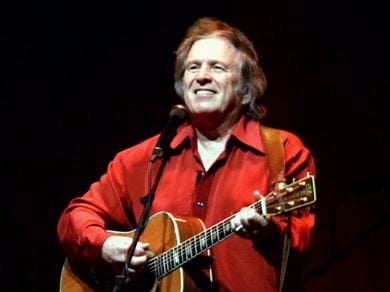
Don McLean is an American singer-songwriter best known for the 1971 classic “American Pie,” an eight-and-a-half-minute folk-rock song that became one of the most recognizable recordings in American popular music. He is also known for songs including “Vincent,” “Castles in the Air” and “And I Love You So,” as well as his successful recording of Roy Orbison’s “Crying.”
Early Life and Upbringing
Donald McLean III was born October 2, 1945, in New Rochelle, New York. His father, Donald McLean Jr., was of Scottish ancestry, while his mother, Elizabeth Bucci, was of Italian descent. As a child, McLean suffered from asthma and frequently missed school, giving him more time to develop an interest in music. His early influences included Frank Sinatra, Buddy Holly and the folk group the Weavers.
McLean’s father died when he was 15, an experience that had a lasting impact on him. By 16, he had purchased his first guitar and begun making connections within the folk music community. He graduated from Iona Preparatory School in 1963 and briefly attended Villanova University before leaving to pursue music. McLean later attended Iona College at night, earning a bachelor’s degree in business administration in 1968. He turned down a scholarship to Columbia University’s graduate school to continue building his career as a singer-songwriter.
During the 1960s, McLean performed in clubs and coffeehouses around the country and became associated with folk singer Pete Seeger, who became an important mentor. McLean joined Seeger’s 1969 Clearwater campaign along the Hudson River, which raised awareness about water pollution.
McLean recorded his debut album, Tapestry, in 1969 after reportedly being rejected dozens of times by record labels. His breakthrough came with his second album, American Pie, released in 1971. Its title track reached No. 1 on the Billboard Hot 100 in early 1972 and turned McLean into an international star. The song was partly inspired by the 1959 plane crash that killed Buddy Holly, Ritchie Valens and J.P. “The Big Bopper” Richardson, an event McLean famously called “the day the music died.”
The album also produced “Vincent,” McLean’s tribute to painter Vincent van Gogh. McLean continued recording and touring for decades, scoring later success with his version of “Crying.” His songs have been recorded by artists including Elvis Presley, Perry Como, Glen Campbell and Madonna. McLean was inducted into the Songwriters Hall of Fame in 2004 and received a star on the Hollywood Walk of Fame in 2021. He was inducted into the Musicians Hall of Fame in 2022.
McLean has been married twice. He married his first wife, Carol Sauvion, in 1969, and the couple divorced in 1972. In 1987, he married Patrisha Shnier McLean. They had two children, Jackie and Wyatt, before divorcing in 2016. Their marriage ended following McLean’s arrest on domestic violence charges. He pleaded guilty to several charges, while a domestic violence assault charge was later dismissed under Maine’s deferred disposition process. McLean has denied physically abusing his former wife. In 2018, he publicly confirmed his relationship with model Paris Dylan.
Is Don McLean Religious?
McLean was raised Catholic, reflecting the faith of his mother, while his father was Protestant. As an adult, however, McLean moved away from organized religion and has said he no longer considers himself Catholic or traditionally religious.
In an interview discussing his song “Sister Fatima,” McLean explained that he still believes in God but described his beliefs as closer to pantheism. He said he sees God in nature, harmony and the world around him rather than through a particular religious institution. “I’m not religious, in that I do not believe in religion, but I do believe in God,” he explained, adding that he considered himself “a pantheist of some sort.”
Religious imagery also appears in McLean’s music. “American Pie” famously references “the Father, Son and the Holy Ghost.” Although many of the song’s lyrics have inspired decades of speculation, McLean has confirmed that this particular line literally refers to the Christian Holy Trinity. He has also described “American Pie” as, in part, a morality song about the loss of innocence and cultural changes he witnessed in America.
Back to the Celebrity Faith Database