- Faith: Atheist
- Career: Comedian
- Birthday: January 20, 1956
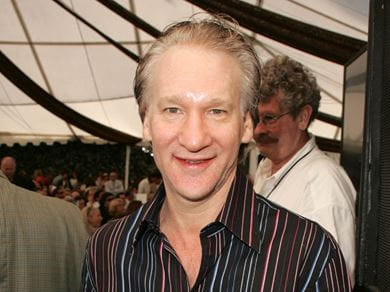
Bill Maher is an American comedian, writer, producer, political commentator, actor, and television host.
Maher was born on January 20, 1956, in New York City. His father, William Maher Jr., was a news editor and radio announcer, and his mother, Julie Maher, worked as a nurse. He was raised in River Vale, New Jersey, and graduated from Pascack Hills High School in 1974.
Raised in the Catholic tradition, Maher attended Mass regularly with his family until around the age of 13, when his father, disillusioned with the Church’s stance on birth control, stopped taking the family to church. It wasn’t until his teenage years that Maher learned his mother was Jewish, a fact she had kept hidden due to cultural tensions.
Maher attended Cornell University, where he majored in English and history. During college, he began dabbling in stand-up comedy and has joked that selling marijuana helped finance his early career. His college years set the stage for his sharp wit and politically charged commentary that would define his future work.
Maher launched his professional comedy career in 1979, performing stand-up and hosting at various comedy clubs in New York City. By the early 1980s, he was making appearances on major late-night shows, where his biting humor and quick thinking made him a favorite guest.
He appeared in a number of TV shows during this period, including “Sara,” “Max Headroom,” “Murder, She Wrote,” “Charlie Hoover,” and “Newhart.” He also took roles in several cult films, such as “D.C. Cab,” “Ratboy,” “House II: The Second Story,” and “Cannibal Women in the Avocado Jungle of Death.” These projects showcased his versatility but didn’t quite make him a household name.
That would soon change.
In 1993, Maher began hosting “Politically Incorrect,” a late-night panel show originally on Comedy Central. The show quickly moved to network television on ABC in 1997 and became known for its unique blend of political debate, pop culture commentary, and humor. Maher moderated spirited conversations between a wide variety of guests, from politicians to celebrities, often pushing the boundaries of what could be said on television.
“Politically Incorrect” was both praised and criticized for its no-holds-barred format. The show earned several award nominations and was a favorite among viewers seeking sharp, alternative political commentary. However, following controversial remarks Maher made after the September 11 attacks—comments that many interpreted as unpatriotic—the show was canceled in 2002. Maher later said the decision stemmed more from advertiser backlash than from actual network disapproval.
In 2003, Maher returned to television with “Real Time with Bill Maher” on HBO. The show retained the panel format of “Politically Incorrect” but allowed for deeper dives into political issues, thanks to the uncensored format of premium cable. “Real Time” became a staple of progressive political commentary and has run for over two decades, featuring guests from across the political spectrum.
In addition to his work in television, Maher has written several best-selling books, including “When You Ride Alone You Ride With Bin Laden,” “New Rules,” and “The New New Rules.” He also starred in the 2008 documentary “Religulous,” a satirical examination of religion that sparked widespread discussion and controversy.
Maher’s influence extends beyond television and books. He has served on the boards of several advocacy organizations, including those focused on animal rights and marijuana legalization. In recognition of his career, he received a star on the Hollywood Walk of Fame in 2010.
In 2022, Maher launched the podcast “Club Random,” where he engages in longer, more personal conversations with guests from entertainment and media. Unlike his TV shows, “Club Random” is designed to be more relaxed and less politically driven.
In 2024, Maher announced plans to retire from stand-up comedy by the end of the year, though he intends to continue his television and podcast work. He cited the physical demands of touring and a desire to focus on other projects as key reasons for stepping back from live performances.
Maher has never married and has often expressed skepticism about the institution of marriage. He has dated several women over the years, including public figures, but has largely kept his personal life private. In interviews, he’s joked that he enjoys being a bachelor and isn’t interested in traditional domestic life.
He describes himself as politically unaffiliated, often expressing views that don’t align neatly with either major political party. Though widely seen as a liberal, Maher frequently criticizes progressive overreach and has defended some conservative positions, especially regarding free speech and political correctness.
Maher has said he values honest conversation and believes it’s important to engage with people across ideological lines. His friendships with individuals who hold differing political views reflect his commitment to open dialogue, even in an increasingly polarized culture.
Bill Maher's Religious Beliefs
One of the most defining aspects of Bill Maher’s public identity is his outspoken atheism. While raised Catholic, Maher rejected religion at a young age and has since become one of its most vocal critics in mainstream media.
Maher has described himself at times as an atheist, agnostic, or apatheist, depending on the context. He often frames his belief system as rooted in reason and skepticism rather than faith. He has frequently stated that religion does more harm than good, arguing that it promotes superstition, intolerance, and division.
In “Religulous,” Maher travels around the world interviewing religious leaders and everyday believers in an attempt to understand—and mock—organized religion. The film ends with a serious warning about the dangers of religious fundamentalism, which Maher sees as one of the greatest threats to global peace and progress.
He has said that belief in God is a form of delusion and has openly questioned the mental soundness of religious believers. Though these statements have earned him backlash from religious communities, Maher has stood by his views, arguing that religion should not be immune from criticism.
At the same time, he acknowledges that faith brings comfort to many people. He has said he understands why someone would believe in heaven or a higher power if it helps them sleep at night, even if he himself cannot.
Maher draws a sharp line between morality and religion. He frequently argues that ethical behavior is not dependent on religious belief and that many secular people live deeply moral lives. He often points to countries with high rates of atheism and low crime as evidence that religion is not necessary for a just society.
While his critiques can be biting, Maher insists they come from a place of intellectual honesty rather than malice. He believes that challenging deeply held beliefs is essential to a healthy society and that open inquiry should be valued above blind faith.
Back to the Celebrity Faith Database