- Faith: Spirituality
- Career: Musician
- Birthday: August 03, 1963
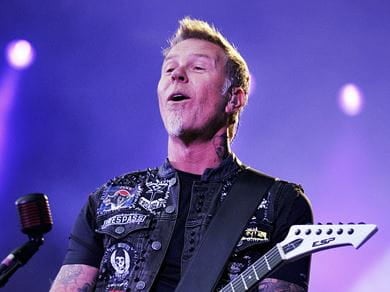
For more than four decades, James Hetfield has been central to Metallica, one of history’s most influential heavy metal bands. Born in Downey, California, on Aug. 3, 1963, he became the band’s lead singer, rhythm guitarist, co-founder and one of its primary songwriters. He co-founded Metallica with drummer Lars Ulrich in 1981.
Hetfield married costume designer Francesca Tomasi on Aug. 17, 1997, and the couple divorced in 2022 after 25 years of marriage. They have three children: Cali, Castor and Marcella. Hetfield is now engaged to Adriana Gillett, a fashion designer and former journalist, to whom he proposed in March 2026.
Hetfield’s life centers on a central tension: childhood pain, the loss of his mother, addiction and a complicated relationship with religion. Faith did not give him easy answers. At times, religion became part of the questions he wrestled with, and that struggle eventually appeared in his songwriting. His public comments do not neatly place him in a specific Christian denomination or church tradition. His story isn’t a simple conversion story. It’s a story of suffering, belief, recovery and the search for meaning.
The band helped bring thrash metal to a much larger audience.Metallica has won nine Grammy Awards and produced 11 studio albums.Hetfield’s rhythm guitar work, powerful riffs and aggressive vocal style became central parts of Metallica’s sound. The band’s early albums established that identity. “Kill ’Em All” arrived in 1983, followed by “Ride the Lightning” in 1984 and “Master of Puppets” in 1986. Metallica was inducted into the Rock and Roll Hall of Fame in 2009.
Metallica did more than play fast, heavy music. Hetfield’s writing often addressed difficult subjects. He explored fear, anger, control, loss, isolation and other personal and social struggles. The band’s 1991 self-titled album, commonly called the Black Album, propelled Metallica to even greater mainstream success. In that broader context, his songwriting also became a place to express what he struggled to communicate elsewhere. His strongest questions about religion, pain and trust emerged through music.
Hetfield grew up in a Christian Science household. His parents followed that religious tradition strictly, including its approach to sickness and healing. That childhood environmentdeeply shaped his later understanding of religion. But as an adult, Hetfield’s spiritual outlook is not simply a continuation of his childhood religion.
In a 2023 radio conversation with Rolling Stone’s David Fricke marking the release of “72 Seasons,” as reported byLoudwire, Hetfield was asked about the album’s apocalyptic themes. He said he didn’t want to bring religion into his answer, but added that he studies the Bible “somewhat” and is part of Bible groups. He said humanity has faced hard times before and that he has faith people will get through this one. Those comments matter, but they should not be read beyond what Hetfield actually said. Still, his interest in the Bible does not, by itself, establish a particular denominational identity or a traditional Christian profession of faith.
Hetfield has been more direct about God in recent years than his early lyrics might suggest. In a January 2017 interview with France’s Clique, reported by Blabbermouth, he was asked whether he believes in God. “I believe in a higher power, yes,” he answered, adding that he does not know whether to call it he, she or it. He said he sees it everywhere and that it sometimes shows up as a voice of correction from his then-wife, his late parents or Metallica bassist Cliff Burton.
His story shows an ongoing engagement with spiritual questions. Hetfield has spent much of his life wrestling with religion rather than presenting himself as a religious person. His lyrics often contain biblical and religious themes, but they also contain anger, questions and criticism. Hetfield has a tattoo of Jesus on his arm. In a November 2022 interview with Abbe Davis, he said it reminds him that there is “a higher power always looking out for all of us.” He added that he doesn’t idolize Jesus, reinforcing that same tension.
To understand Hetfield’s complicated relationship with God and religion, we must return to his childhood. His parents’beliefs emphasized prayer over conventional medical treatment. Hetfield later described that upbringing as alienating, including its effect on his experience at school. Hetfield’s mother, Cynthia, developed cancer. She remained committed to the family’s religious beliefs and did not pursue conventional medical treatment. She died from cancer in February 1980, when Hetfield was 16. The experience left a lasting mark.
Years later, Hetfield expressed some of that pain through Metallica’s music. His Christian Science upbringing and his mother’s death influenced songs, including “The God That Failed.”
In the Davis interview, Hetfield said his father never changed his view of Christian Science. As an adult, Hetfield came to see that getting medical care does not conflict with belief in a higher power, and he credited surgery after his 1992 burn injuries with saving his career.
His adult life brought other struggles, too. His public journey has included addiction and recovery, adding another dimension to his search for healing and stability. Hetfield said in the Davis interview that he was sober for more than 15 years before entering rehab in 2019 and that recovery is a daily effort. He said meditation, yoga and woodworking have helped. Even so, suffering did not remove spiritual questions from Hetfield’s life. The questions remained.
Is James Hetfield Religious?
James Hetfield’s story doesn’t fit comfortably into a simple “believer versus unbeliever” debate. The more useful question is how his life shows ongoing struggle with religious belief. He grew up surrounded by religious belief. He experienced terrible loss connected to the way his family practiced that belief. He expressed his anger through music. And decades later, he publicly acknowledged that he had studied the Bible and participated in Bible groups.
Christians don’t need to turn Hetfield into something he has never publicly claimed to be. His story already raises powerful questions about suffering, religious wounds, recovery, forgiveness and the human desire for meaning. James Hetfield built his career by giving a voice to the struggle, and his spiritual journey appears to carry that same honesty. Instead of offering easy answers, his life reminds us that the search for faith can continue even after disappointment, anger and loss.
Back to the Celebrity Faith Database