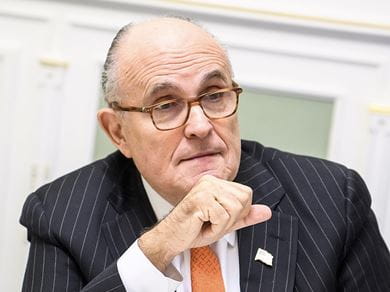
- Faith: Christian - Catholic
- Career: Politician
- Birthday: May 28, 1944
Few political figures in modern American history have experienced as dramatic a rise—and as complicated a public legacy—as Rudy Giuliani. Best known for serving as New York City’s 108th mayor from 1994 to 2001, Giuliani first built his reputation as a hard-charging federal prosecutor, taking on organized crime and political corruption in the 1980s. His law-and-order approach carried into City Hall, where he championed aggressive policing strategies and led a sweeping effort to reshape the image of a struggling New York.
Giuliani’s leadership following the September 11, 2001 terrorist attacks elevated him to global prominence, earning him the nickname “America’s mayor” and widespread praise for his steady public presence during a time of crisis. But the years that followed have painted a far more complex picture. From presidential ambitions and private business ventures to his high-profile role as a legal advisor to President Donald Trump, Giuliani has remained a central—and often controversial—figure in American public life.
Rudolph William Louis Giuliani was born on May 28, 1944, in the borough of Brooklyn, New York City. Raised in a working-class Italian American family, Giuliani grew up in East Flatbush. His father, Harold Giuliani, had a complicated past that included time in prison, while his mother, Helen, worked as a secretary. Despite challenges at home, Giuliani was strongly influenced by discipline, education, and faith during his upbringing.
He attended Catholic schools throughout his youth, including Bishop Loughlin Memorial High School. Giuliani went on to earn a bachelor’s degree in political science from Manhattan College before attending New York University School of Law, where he graduated in 1968. Early on, he considered entering the priesthood, reflecting the strong religious foundation of his upbringing.
Giuliani began his legal career in public service, working as a clerk and later joining the U.S. Attorney’s Office. His reputation as a tough, detail-oriented prosecutor grew during his tenure as Associate Attorney General under President Ronald Reagan in the early 1980s. He later served as the U.S. Attorney for the Southern District of New York, where he gained national attention for aggressively prosecuting organized crime figures, white-collar criminals, and corrupt public officials. His use of the Racketeer Influenced and Corrupt Organizations (RICO) Act helped dismantle powerful Mafia families and cemented his image as a law-and-order reformer.
In 1993, Giuliani was elected mayor of New York City, defeating incumbent David Dinkins. He served two terms, from 1994 to 2001. His mayoralty is most often associated with a significant drop in crime rates and a controversial but widely discussed “broken windows” policing strategy aimed at cracking down on minor offenses to prevent larger crimes. Giuliani also focused on welfare reform, economic revitalization, and reshaping the city’s public image.
His leadership during the terrorist attacks on September 11, 2001, became a defining moment of his career. As mayor during the attacks, Giuliani was widely praised for his visible presence, communication, and efforts to coordinate emergency response. He was later named Time magazine’s “Person of the Year” in 2001 and became known internationally as “America’s Mayor.”
After leaving office, Giuliani transitioned into private consulting and legal work, founding a security consulting firm. He remained active in politics, including a run for the Republican presidential nomination in 2008, though his campaign ultimately did not succeed. In later years, he served as a personal attorney to President Donald Trump and became a prominent and controversial political figure, particularly surrounding the 2020 U.S. presidential election and its aftermath. His legal challenges and public scrutiny increased during this period, marking a complex and often polarizing chapter in his career.
Giuliani’s personal life has been marked by high-profile relationships and public scrutiny. He has been married three times. His first marriage, to Regina Peruggi, was annulled by the Catholic Church in 1982. He later married television personality Donna Hanover, with whom he had two children before their widely publicized divorce in 2002. That same year, he married Judith Nathan; the couple divorced in 2019.
Known for his intense work ethic and public persona, Giuliani has balanced his professional ambitions with a life often lived in the public eye. His personal relationships, like his political career, have frequently drawn media attention.
Rudy Giuliani's Religious Beliefs
Rudy Giuliani was raised in the Roman Catholic tradition and has consistently identified as Catholic throughout his life. His early education in parochial schools and his brief consideration of the priesthood reflect a deep connection to the faith during his formative years.
However, Giuliani has described his religious beliefs as largely private. He has stated that faith is a “matter of individual conscience” and has often declined to discuss specifics such as how frequently he attends church. This approach has led to a somewhat opaque public understanding of his personal religious practice.
His relationship with the Catholic Church has not been without complexity. The annulment of his first marriage in 1982 was recognized by the Church, but his later political positions—particularly on issues like abortion rights—sparked criticism from some conservative Catholic and Christian leaders. During his 2008 presidential campaign, questions about the alignment between his policy views and Church teachings became a point of public debate.
Despite these tensions, Giuliani has continued to identify with Catholicism as a central part of his background and identity, even as he has maintained a personal and private approach to expressing his faith.
Back to the Celebrity Faith Database