- Faith: Christian
- Career: Zoologist
- Birthday: April 03, 1934
- Date of Death: October 01, 2025
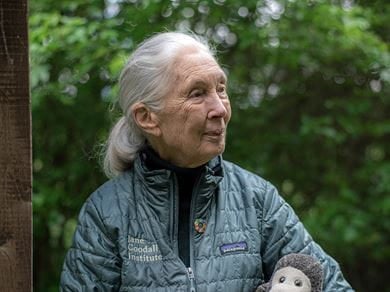
Jane Goodall was an English zoologist, primatologist, and anthropologist, widely regarded as the world’s leading expert on chimpanzees. Beginning in 1960, she traveled to Gombe Stream National Park in Tanzania, where she spent more than six decades studying the social and family behaviors of wild chimpanzees.
Jane Goodall was born on April 3, 1934, in London, England, and raised in the seaside town of Bournemouth. From an early age, she displayed a deep fascination with animals. Encouraged by her mother, Vanne, she spent countless hours observing birds, insects, and family pets. She famously carried a toy chimpanzee named “Jubilee” everywhere she went, a gift that foreshadowed her future career.
Although her family lived modestly, they nurtured her inquisitive spirit. Her mother’s encouragement was particularly significant—rather than scolding young Jane for disappearing into the henhouse for hours to observe how chickens laid eggs, she praised her curiosity. This supportive upbringing instilled in Jane both resilience and an openness to follow her passions, qualities that would later define her groundbreaking work.
Jane Goodall’s career took a defining turn in 1960 when, at the age of 26, she traveled to Gombe Stream National Park in what is now Tanzania. With the support of famed anthropologist Louis Leakey, she set out to study wild chimpanzees, despite having no formal university training in zoology at the time.
Her observations revolutionized science. She documented chimpanzees making and using tools—an ability once thought to be uniquely human. She noted their complex social hierarchies, emotional depth, and capacity for both tenderness and aggression. These findings challenged long-standing assumptions about the divide between humans and other animals.
Over the years, Goodall earned advanced degrees, wrote scientific papers and bestselling books, and became a global voice for conservation. In 1977, she founded the Jane Goodall Institute, which continues to promote wildlife research, habitat protection, and community-centered conservation initiatives. She also launched “Roots & Shoots,” a youth program active in more than 100 countries, encouraging young people to take action for people, animals, and the environment.
Her dedication to public outreach kept her on the road for much of her life. Even into her nineties, Goodall gave lectures, wrote articles, and urged international leaders to adopt sustainable practices. “Dr. Goodall’s discoveries as an ethologist revolutionized science, and she was a tireless advocate for the protection and restoration of our natural world,” the Jane Goodall Institute said in announcing her death.
Though her career often placed her in the public eye, Jane Goodall’s personal life was more private. She married twice. Her first marriage, in 1964, was to Dutch wildlife photographer Baron Hugo van Lawick, who had been assigned by National Geographic to document her work in Gombe. The marriage lasted until 1974, and together they had one son, Hugo Eric Louis van Lawick, affectionately known as “Grub.”
In 1975, Goodall married Derek Bryceson, a Tanzanian parliamentarian and director of the country’s national parks. Their union ended with his death from cancer in 1980. Goodall did not remarry after Bryceson’s passing, choosing instead to dedicate her life fully to her work and global advocacy.
Her son, Grub, has largely avoided the public spotlight, preferring a life connected to nature and farming, though Goodall often spoke warmly of him and her pride in the family she raised amid her demanding career.
In her later years, Goodall became not just a scientist but a global symbol of conservation and hope. She spoke frequently about the interconnectedness of all living things and the urgent need for humanity to protect the planet.
Even in her nineties, she maintained a grueling travel schedule, delivering lectures and inspiring audiences around the globe. She was in California, actively engaged in a speaking tour, when she passed away at the age of 91 on October 1, 2025.
Jane Goodall's Religious Beliefs
While Jane Goodall is often remembered for her scientific achievements, her Christian faith was also an important part of her life. Raised in a Christian household in England, Goodall grew up attending church and learning the stories of Scripture. Her early admiration for her local pastor shaped her view of Christianity as a faith rooted in compassion, humility, and reverence for creation.
As she grew older, her spirituality evolved into something broader and more inclusive. Goodall often spoke of a “Great Spirit in Whom ‘we live and move and have our being,’” reflecting a panentheistic view that God is both within and beyond creation. She described her faith as a blend of traditional Christianity and a deep spiritual connection with nature, shaped by her years of living among chimpanzees and observing the intricate web of life.
Goodall firmly believed that science and faith were not at odds. For her, the theory of evolution and her Christian worldview were compatible, each offering insights into the mystery of life. “There is no conflict between science and religion—only when people interpret religious texts too literally,” she often remarked.
Her belief in a divine purpose infused her conservation work. She frequently said she felt called to protect the Earth not just as a scientist but as a Christian steward of creation. In this way, her faith provided both a moral compass and a sense of hope, even in the face of environmental crises.
Back to the Celebrity Faith Database