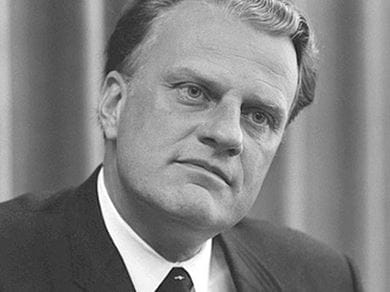
- Faith: Christian
- Career: Pastor
- Birthday: November 07, 1918
- Date of Death: February 21, 2018
Billy Graham was born William Franklin Graham Jr. on November 7, 1918, in a farmhouse near Charlotte, North Carolina. Raised on a dairy farm by his parents, William Franklin Graham Sr. and Morrow Coffey Graham, he was the eldest of four children. The family attended the Associate Reformed Presbyterian Church, and Graham's early life was marked by a strong work ethic and religious devotion. As a child, he enjoyed reading and was particularly fond of Tarzan novels, often mimicking the character's jungle calls, which his father believed contributed to his strong voice—a trait that would later become instrumental in his preaching career.
In 1934, at the age of 16, Graham attended a series of revival meetings led by evangelist Mordecai Ham. It was during these meetings that he made a personal commitment to Christ, a decision that profoundly influenced his life's direction. After graduating from Sharon High School in 1936, he enrolled at Bob Jones College but found its strict atmosphere challenging. He transferred to the Florida Bible Institute (now Trinity College of Florida) in 1937, where he graduated with a Bachelor of Theology degree in 1940. While still a student, Graham preached his first sermon at Bostwick Baptist Church near Palatka, Florida, and was ordained by a group of Southern Baptist clergy in 1939.
Seeking further education, Graham attended Wheaton College in Illinois, earning a degree in anthropology in 1943. It was at Wheaton that he met Ruth McCue Bell, the daughter of missionaries to China. They married in 1943 and had five children: Virginia, Anne, Ruth, Franklin, and Nelson. Ruth Graham was a significant influence on Billy's ministry, often providing counsel and support throughout his career.
Graham's early ministry included pastoring the Village Church of Western Springs in Illinois and working with Youth for Christ, focusing on evangelizing youth and military personnel. His national breakthrough came in 1949 during a Los Angeles crusade, which gained widespread attention and propelled him into the national spotlight. The event ran for eight weeks, five weeks longer than originally planned, and attracted national media coverage, including from the Hearst newspaper chain.
In 1950, Graham founded the Billy Graham Evangelistic Association (BGEA), launching the "Hour of Decision" radio program and publishing "Decision" magazine. Over six decades, he preached to over 215 million people in more than 185 countries, utilizing media platforms like radio, television, and satellite broadcasts to spread his message. His crusades attracted massive audiences, including a 1973 event in Seoul, South Korea, attended by over a million people. Graham also advised multiple U.S. presidents, earning the moniker "America's Pastor."
Graham's ministry was marked by a commitment to racial integration and social justice. In 1953, he insisted on integrated seating at his crusades, a stance that was controversial at the time. He also openly denounced apartheid during a 1973 rally in Durban, South Africa, declaring that "apartheid is a sin." His efforts contributed to the broader civil rights movement and demonstrated his commitment to equality and inclusion.
Throughout his career, Graham received numerous awards and honors. In 1983, he was awarded the Presidential Medal of Freedom by President Ronald Reagan. He also received the Congressional Gold Medal in 1996 and was made an Honorary Knight Commander of the Order of the British Empire (KBE) in 2001. Despite his fame, Graham maintained a reputation for humility and integrity, avoiding the scandals that plagued other televangelists.
Graham's personal life was characterized by his deep devotion to his family and faith. His marriage to Ruth lasted over 60 years until her passing in 2007. Their children continued his legacy, with Franklin Graham leading the BGEA and Samaritan's Purse, and Anne Graham Lotz becoming a noted evangelist. At the time of his death in 2018, Graham was survived by five children, 19 grandchildren, 44 great-grandchildren, and nine great-great-grandchildren.
Billy Graham's Religious Beliefs
Billy Graham's theology was firmly rooted in evangelical Christianity, emphasizing the necessity of a personal relationship with Jesus Christ for salvation. He preached the message of the Gospel with simplicity and urgency, consistently focusing on the biblical truth that humanity is separated from God by sin, and reconciliation comes only through faith in Jesus. Graham believed that Jesus’ death on the cross and subsequent resurrection provided the only means of salvation and eternal life.
Throughout his ministry, Graham remained unwavering in his commitment to biblical authority. He often stated that the Bible is the infallible Word of God, and his sermons frequently included the phrase, "The Bible says..." to underscore the scriptural basis for his teachings. This approach resonated with millions, as Graham presented complex theological concepts in a straightforward, relatable manner. His message was consistent: repentance from sin, faith in Christ, and the hope of eternal life.
Graham was known for his inclusive approach to Christian unity, advocating for cooperation among various denominations as long as they adhered to the core tenets of the Gospel. He remained nonpartisan in his public ministry, choosing to focus on spiritual rather than political issues. Although he occasionally addressed social and moral challenges, his primary focus was always on the transformative power of Christ.
One of Graham's most defining spiritual practices was the "invitation" at the end of his sermons, where he would call individuals to step forward as a public declaration of their faith. This practice became a hallmark of his crusades, where thousands would respond to the call, signifying their commitment to follow Jesus. Graham maintained that this public confession was a vital step in acknowledging one's need for a Savior.
Graham’s belief in the transformative power of prayer was evident in his personal life and public ministry. He encouraged believers to develop a daily prayer habit, emphasizing that prayer was essential to maintaining a close relationship with God. He once said, "Prayer is the Christian's greatest weapon." Even during his later years, Graham continued to speak about the power of prayer, urging Christians to seek God earnestly and persistently.
Throughout his career, Graham held a clear eschatological perspective, focusing on the promise of eternal life for believers and the reality of eternal separation from God for those who reject the Gospel. He stressed the importance of readiness for Christ's return, reminding audiences that life is fleeting and salvation is urgent. His message consistently centered on the love of God and the assurance that salvation is available to all who believe.
In his final years, Graham often reflected on the legacy of faith he hoped to leave behind. He expressed gratitude for God's guidance throughout his ministry and remained hopeful that the seeds planted through his preaching would continue to bear fruit long after his passing. Graham's desire was not for personal acclaim but for the name of Jesus to be exalted, and his life's work reflected that commitment.
At the time of his death in 2018, many Christian leaders hailed Graham as one of the most influential evangelists of the 20th century. His sermons, books, and public addresses continue to inspire believers worldwide, and his unwavering faith serves as a model for Christians striving to live out the Great Commission. Billy Graham’s legacy as a faithful servant of Christ remains a powerful testament to the impact one life, wholly surrendered to God, can have on the world.
Back to the Celebrity Faith Database