- Faith: Judaism
- Career: Economist
- Birthday: March 06, 1926
- Date of Death: June 22, 2026
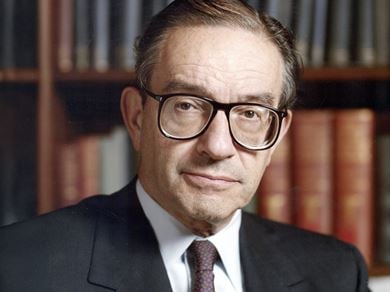
Alan Greenspan was one of the most influential economists in modern American history, best known for serving as chairman of the U.S. Federal Reserve from 1987 to 2006. During nearly two decades at the helm of the nation’s central bank, he guided monetary policy through stock market crashes, recessions, periods of extraordinary growth and major global financial disruptions. Admired by many as “The Maestro” during his tenure, Greenspan became one of the most recognizable economic figures in the world.
Alan Greenspan was born on March 6, 1926, in the Washington Heights neighborhood of New York City. His father, Herbert Greenspan, was of Romanian Jewish descent, while his mother, Rose Goldsmith, was of Hungarian Jewish descent. After his parents divorced, Greenspan was largely raised by his mother and maternal grandparents in New York.
As a young man, Greenspan showed an aptitude for mathematics and music. He attended the Juilliard School briefly and played clarinet and saxophone professionally before ultimately pursuing economics. He earned a bachelor’s degree and master’s degree in economics from New York University and later completed doctoral studies there. His fascination with numbers, statistics and financial markets would shape the course of his life and career.
Greenspan began his professional career as an economic consultant and eventually founded the consulting firm Townsend-Greenspan & Co. His reputation as a sharp economic analyst grew steadily throughout the 1950s and 1960s. He also became associated with novelist and philosopher Ayn Rand, whose free-market philosophy influenced many of his economic views.
His entry into government service came during the administration of President Gerald Ford, when he served as chairman of the Council of Economic Advisers from 1974 to 1977. The role elevated his national profile and established him as a respected voice on economic policy.
In 1987, President Ronald Reagan appointed Greenspan as chairman of the Federal Reserve. Only weeks after taking office, he faced the stock market crash known as “Black Monday.” His swift actions to stabilize financial markets earned widespread praise and helped establish his reputation as a steady hand during times of uncertainty.
Over the next 18 and a half years, Greenspan served under Presidents Reagan, George H.W. Bush, Bill Clinton and George W. Bush. He oversaw monetary policy through the 1990–91 recession, the technology boom of the 1990s, the Asian financial crisis, the bursting of the dot-com bubble and the economic aftermath of the September 11 attacks. His tenure became associated with a long period of economic growth and relatively low inflation.
After leaving the Federal Reserve in 2006, Greenspan continued working as an economic consultant, author and commentator. However, following the 2008 financial crisis, some critics blamed his support for deregulation and low-interest-rate policies for contributing to conditions that preceded the housing market collapse. Greenspan later acknowledged flaws in some of his assumptions regarding the ability of financial institutions to regulate themselves.
Greenspan was married twice. His first marriage was to Canadian artist Joan Mitchell in 1952, though the union ended in annulment less than a year later.
In 1997, he married journalist and longtime NBC News correspondent Andrea Mitchell. The couple remained together for nearly three decades and became one of Washington’s most prominent power couples. Mitchell frequently spoke of her husband’s intellect, curiosity and lifelong passion for economics, sports and jazz music.
On June 22, 2026, Alan Greenspan died at his Washington, D.C., home from complications related to Parkinson’s disease. He was 100 years old. His death was announced by his wife, Andrea Mitchell, who said he passed away peacefully at home. His passing marked the end of a remarkable century-long life that left a lasting imprint on American economic policy and global finance.
Alan Greenspan's Religious Beliefs
Greenspan was born into a Jewish family with Romanian and Hungarian roots and was raised within the broader traditions and culture of American Judaism. His maternal grandparents were Jewish immigrants from Russia, and his heritage remained an important part of his identity throughout his life.
Although Greenspan was not known for public displays of religious devotion and rarely spoke extensively about theology, he was widely recognized as one of the most prominent Jewish figures in American public life. Jewish organizations and publications frequently highlighted his achievements as an example of Jewish influence in economics, government and public service.
His legacy rests not only on his economic influence but also on his role as a distinguished Jewish American leader whose career spanned nearly a century of dramatic political, financial and social change.
Back to the Celebrity Faith Database