- Faith: Christian - Catholic
- Career: Actor
- Birthday: October 31, 1950
- Date of Death: March 04, 1994
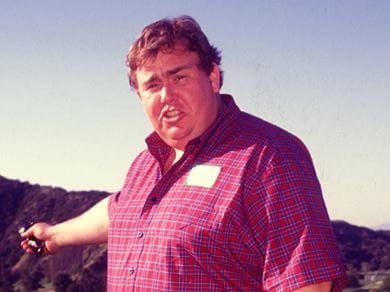
John Candy was celebrated as one of Canada’s most beloved and funniest character actors. His signature portrayal of the warm-hearted buffoon made him unforgettable in classic films like “Uncle Buck” and “Planes, Trains & Automobiles."
Candy was born on October 31, 1950, in Newmarket, Ontario, Canada, to Sidney James Candy and Evangeline Aker. Raised in a working-class neighborhood of Toronto, Candy’s early years were shaped by both joy and hardship. His father died of heart disease when John was only five years old, a tragedy that deeply affected him but also brought him closer to his Roman Catholic upbringing.
Candy’s mother worked hard to provide for him, instilling a sense of resilience and humility that would stay with him throughout his life. Despite the loss of his father, Candy grew up in a supportive Catholic household that gave him structure and comfort. He remained connected to his faith throughout his life, and it became a quiet yet steady influence behind his public career as one of comedy’s brightest stars.
Candy attended Neil McNeil Catholic High School in Toronto, where he became a popular student. His charisma and humor were evident early on, and the school later honored him by naming its arts studio after him. Originally, Candy dreamed of a career in football and had hopes of playing professionally, but a knee injury ended those ambitions. Turning instead toward acting, he enrolled at Centennial College and McMaster University, studying journalism and drama, where he discovered his true calling.
John Candy’s first taste of professional acting came in Canadian television. He joined the Toronto branch of The Second City comedy troupe in 1972, which proved to be a launching pad for his career. His natural comedic timing, lovable persona, and ability to shift seamlessly between slapstick and heartfelt performances quickly made him a standout.
In 1976, Candy became a cast member on the Canadian sketch comedy show “Second City Television” (SCTV). The show earned a devoted following and critical acclaim, eventually winning two Emmy Awards for writing. Candy’s characters, such as the clueless news anchor Johnny LaRue and the over-the-top game show host William B. Williams, showcased his wide comedic range. “SCTV” cemented his reputation as one of the most versatile comedic actors of his generation.
Hollywood soon took notice. Candy made appearances in films like “The Clown Murders” (1976) and “Lost and Found” (1979), but his first breakthrough role came with a supporting part in Steven Spielberg’s war comedy “1941” (1979). He followed this with memorable roles in “Stripes” (1981) alongside Bill Murray and “National Lampoon’s Vacation” (1983), where he played the unlucky security guard at Walley World.
By the mid-1980s, Candy had become a household name thanks to scene-stealing roles in films like “Splash” (1984), where he played Tom Hanks’ fun-loving brother, and “Brewster’s Millions” (1985). His mix of humor and warmth made him a favorite among audiences, and his career was poised for even greater success.
Candy’s career hit its peak in the late 1980s and early 1990s. He transitioned from supporting comic roles to starring parts, proving he could carry films with both humor and heart. In “Uncle Buck” (1989), Candy starred as the bumbling but big-hearted Uncle Buck Russell, whose unconventional approach to babysitting won over audiences and critics alike. Perhaps his most beloved role came in “Planes, Trains and Automobiles” (1987), where he played Del Griffith, a shower-curtain-ring salesman whose unlikely friendship with Steve Martin’s character led to both hilarity and heartfelt moments. The film remains a holiday classic.
Candy also brought his charm to films such as “The Great Outdoors” (1988), where he played an everyman vacationing with his family in the wilderness, and “Spaceballs” (1987), Mel Brooks’ satirical take on science fiction, in which Candy portrayed the half-man, half-dog character Barf. He headlined “Who’s Harry Crumb?” (1989), a slapstick comedy about a bumbling private detective, and gave a touching performance in “Only the Lonely” (1991), a romantic comedy about a man balancing love and family obligations.
One of Candy’s final roles was in “Cool Runnings” (1993), where he played coach Irving Blitzer, inspired by the real-life coach who helped the Jamaican bobsled team compete in the Olympics. The film, released after Candy’s death, became one of his most enduring works, balancing humor with heart and cementing his reputation as a performer who could make audiences both laugh and tear up.
While John Candy’s professional life was high-energy and public, his personal life was marked by devotion and love. In 1979, he married Rosemary Margaret Hobor, a ceramicist and artist. Together, they had two children: Jennifer, born in 1980, and Christopher, born in 1984.
Candy was known as a loving and attentive husband and father. Despite his busy Hollywood schedule, he made family his top priority, often bringing his children on film sets and ensuring he was present for milestones in their lives. His colleagues frequently remarked on his humility and kindness, describing him as someone who never let fame overshadow his commitment to his loved ones.
Tragically, John Candy’s life was cut short at the age of 43. On March 4, 1994, while filming the comedy “Wagons East” in Durango, Mexico, Candy died in his sleep from a heart attack. His death shocked the entertainment world and left millions of fans grieving.
John Candy's Religious Beliefs
Though Candy rarely spoke publicly about his faith, his Catholicism was a steady, grounding presence in his life. Raised in a Catholic household, his early experiences in the Church helped provide stability after his father’s death.
At Neil McNeil Catholic High School, where he was a popular student, Candy received a Catholic education that left a lasting mark. The school would later name its arts studio in his honor, a recognition of both his career and his roots.
Candy was privately devout, and those close to him said he “stuck very close to his Catholic roots.” His humility, generosity, and compassion for others reflected values instilled through his faith. While he entertained millions on screen, he remained deeply connected to his religious background behind the scenes.
After his sudden passing in 1994, his funeral was held at St. Martin of Tours Catholic Church in Los Angeles, a parish with deep ties to the entertainment community. He was buried at Holy Cross Cemetery in Culver City, California, a Catholic cemetery that is also the resting place of many other Hollywood legends. His Catholic funeral and burial underscored his lifelong connection to the Church and his enduring faith.Back to the Celebrity Faith Database