
St. Rose Philippine Duchesne (1769-1852)
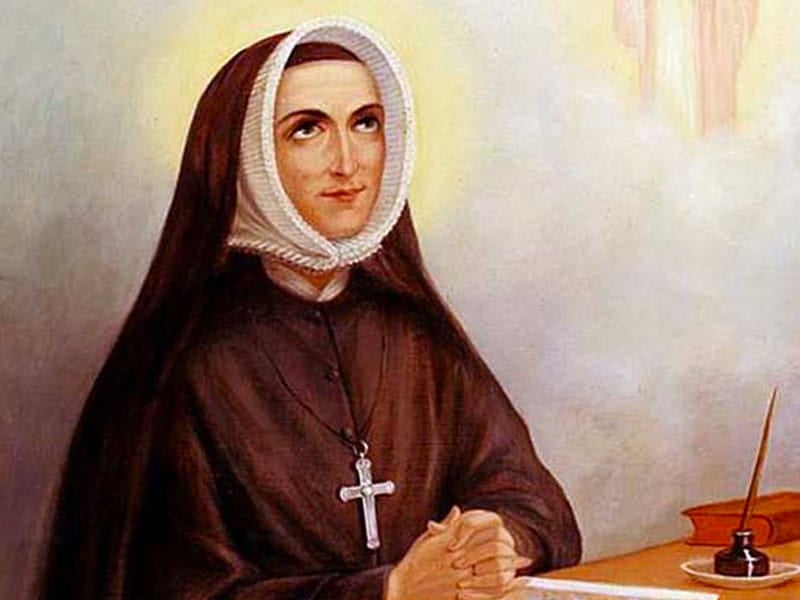
Born in Grenoble, France, of a family that was among the new rich, Philippine learned political skills from her father and a love of the poor from her mother. The dominant feature of her temperament was a strong and dauntless will, which became the material—and the battlefield—of her holiness. She entered the convent at 19 without telling her parents and remained despite their opposition. As the French Revolution broke, the convent was closed, and she began taking care of the poor and sick, opened a school for street urchins and risked her life helping priests in the underground.
When the situation cooled, she personally rented her old convent, now a shambles, and tried to revive its religious life. The spirit was gone, and soon there were only four nuns left. They joined the infant Society of the Sacred Heart, whose young superior, St. Madeleine Sophie Barat, would be her lifelong friend. In a short time Philippine was a superior and supervisor of the novitiate and a school. But her ambition, since hearing tales of missionary work in Louisiana as a little girl, was to go to America and work among the Indians. At 49, she thought this would be her work. With four nuns, she spent 11 weeks at sea en route to New Orleans, and seven weeks more on the Mississippi to St. Louis. She then met one of the many disappointments of her life. The bishop had no place for them to live and work among Native Americans. Instead, he sent her to what she sadly called "the remotest village in the U.S.," St. Charles, Missouri. With characteristic drive and courage, she founded the first free school for girls west of the Mississippi.
It was a mistake. Though she was as hardy as any of the pioneer women in the wagons rolling west, cold and hunger drove them out—to Florissant, Missouri, where she founded the first Catholic Indian school, adding others in the territory. "In her first decade in America Mother Duchesne suffered practically every hardship the frontier had to offer, except the threat of Indian massacre—poor lodging, shortages of food, drinking water, fuel and money, forest fires and blazing chimneys, the vagaries of the Missouri climate, cramped living quarters and the privation of all privacy, and the crude manners of children reared in rough surroundings and with only the slightest training in courtesy" (Louise Callan, R.S.C.J., Philippine Duchesne).
Finally, at 72, in poor health and retired, she got her lifelong wish. A mission was founded at Sugar Creek, Kansas, among the Potawatomi. She was taken along. Though she could not learn their language, they soon named her "Woman-Who-Prays-Always." While others taught, she prayed. Legend has it that Native American children sneaked behind her as she knelt and sprinkled bits of paper on her habit, and came back hours later to find them undisturbed. She died in 1852 at the age of 83.
