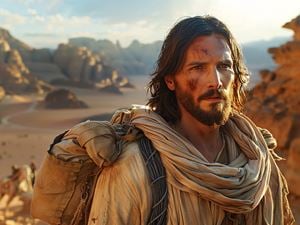
There is much division over whether Jesus was a refugee at some point in his life on earth. One problem is that people sometimes confuse the word "refugee" with "immigrant" and "migrant." They use the three words interchangeably even though there are differences in their meanings.
Some people believe "refugee," "immigrant," and "migrant" all apply to Jesus. Others believe that one or two of the words apply, and others say that none of them apply. So, which is it?
Defining the Terms
One of the responsibilities of the United Nations (UN) is to protect and help displaced people throughout the world. The UN defines refugee, immigrant and migrant in the following ways:
-
A refugee is someone who has been forced to leave their native country because of persecution, violence or war. This definition did not exist 2,000 years ago, of course, but it describes how Jesus lived during his earliest years. If one accepts the UN's definitions, he was a refugee as well as a migrant.
-
According to the UN, an immigrant is someone who has moved from their native country to another country with the intention of permanently settling in their new country. Some people consider Jesus an immigrant because he and his family fled to Egypt to escape persecution by King Herod. Others argue that Mary and Joseph were not immigrants because they did not plan to stay in Egypt permanently.
-
The UN defines a migrant as anyone who has moved or is moving across an international border or within a country to find a new home. This definition applies regardless of a person's legal status and does not matter whether the move was voluntary or not. Many people believe that the holy family's escape to Egypt made them migrants.
Refugees and other displaced people often leave their homeland to find a safer place to live. They have well-founded fears of persecution because of their race, religion, nationality, political beliefs or association with a particular social group, the UN says.
How Jesus Fits the Definition of a Refugee
Using the UN's definition of refugee, Jesus became a refugee when he was quite young. The Bible explains that King Herod, the despotic ruler of Jesus' homeland, Judea, learned about the Savior's birth from several wise men who were looking for the Christ child to worship him.
In modern times, people usually refer to three men because the Bible mentions three gifts they brought to the Christ child. Even so, scripture does not specify the number of wise men. Whatever it was, these men were guided by an exceedingly bright star that led them toward Jesus' location.
Herod told the wise men that he, too, wanted to worship the Christ child. In truth, the king feared that Jesus would one day become a threat to his power and authority. The appearance of the wise men only fueled Herod's paranoia. Rather than wait for Jesus to become a threat, King Herod ordered the slaughter of all little boys aged two and under in Bethlehem.
Jesus was spared because an angel appeared to Joseph in a dream soon after the wise men talked to King Herod. The angel told Joseph to take Mary and Jesus to Egypt as quickly as possible. Thus, Jesus became a refugee rather than a victim of Herod's genocide.
Faith-Based Reflections on Jesus as a Refugee
"With Herod's henchmen bearing down on Bethlehem, Joseph and Mary fled with their young child to Egypt," He Gets Us says. He Gets Us is a faith-based advertising campaign that focuses on making Jesus more relatable to people regardless of their beliefs. It's affiliated with the Christian faith but doesn't exclude non-Christians from learning more about Christ.
In describing the story of Herod, He Gets Us says, "Imagine the circumstances. Two young parents grab their toddler and whatever they can carry on their backs and flee the country. There was no safety for them in their homeland, so the only option was to seek foreign soil."
Life in Egypt: The Unknown Years
The Bible does not describe the holy family's daily life in Egypt. However, Mary and Joseph were fairly young and probably poor. They may have looked for help from other Jews who lived in a land that was quite different from their homeland. But whatever the case, the Bible says they remained in Egypt until Herod died.
Scripture also suggests that Jesus' experiences as a refugee affected his life and ministry. One example is the compassion He felt towards marginalized people… the Jewish tax collectors who were hated because they collected money from other Jews on behalf of their Roman oppressors… the lepers who everyone feared… and the Samaritans who were enemies of the Israelites, somewhat like today's Catholics and Protestants in Northern Ireland are political and religious adversaries.
Modern Objections to Calling Jesus a Refugee
Yet some people in modern times insist that Jesus was not a refugee, immigrant or migrant. World Relief, a global Christian humanitarian organization, says these people may feel defensive about using any of the three terms when referring to Jesus.
One reason may be that they support government policies that keep most or all refugees out of their countries. World Relief says they may be uncomfortable with the idea that such policies—had they existed in the first century—might have been detrimental to the Christ child.
What the Bible Says About Welcoming Strangers
The Bible strongly describes how people should treat strangers, including refugees and other displaced people. It recalls that the Israelites were oppressed foreigners when they lived in Egypt during Old Testament times. In the New Testament, Christ tells people to love theirneighbors as themselves. He means to love everyone because everyone is a child of God.
Some of the scriptures about people's treatment of others include the following:
-
"The same law applies both to the native-born and to the foreigner residing among you" (Exodus 12:49).
-
"You shall not wrong or oppress a stranger, for you were strangers in the land of Egypt" (Exodus 22:21).
-
"The stranger who resides with you shall be to you as the native-born among you. You shall love him as yourself" (Leviticus 19:34).
-
"If one of your fellow Israelites becomes poor and cannot support himself among you, help him as you would a foreigner or a sojourner, so he can continue to live among you" (Leviticus 25:35).
-
"Cursed is anyone who withholds justice from the foreigner, the fatherless or the widow" (Deuteronomy 27:19).
Whether we call Jesus a refugee, immigrant, or migrant, the story of His early life reminds us that He experienced displacement, danger, and the need for refuge. These are not just political categories—they are human realities. His journey challenges us to reflect on how we treat the vulnerable in our communities, especially those fleeing persecution or poverty.
The Bible is clear: followers of God are called to love the stranger, show compassion, and extend justice to all. If Jesus once fled for safety, then no act of mercy toward today's displaced is ever misplaced.