
The Catholic Church is trying to get influencers — women with fashion accounts and “hot priests” — to serve as its digital missionaries.
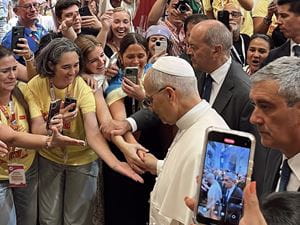
In a first, the Vatican gathered more than 1,000 content creators last week in an auditorium near St. Peter’s Basilica. They danced, took selfies and filmed the stage, which flashed in neon pink and blue. Pope Leo made an appearance, sparking a photo frenzy. “I’m high off this experience,” said Mackenzie Hunter, a 26-year-old from St. Paul, Minn. Her Instagram account, “acaffeinatedcatholic,” has about 25,000 followers.
Christianity has a branding problem. Over the past 25 years, tens of millions of Americans left the faith. While that has stalled recently, no one wants to go to a party that seems to be winding down.
So churches are turning to influencers to build hype. The summit is an example of a broader trend: Religious institutions and leaders are increasingly relying on digital evangelism, leveraging social media to spread their message to new generations. Influencers say it’s working, and it may be part of why churches in the United States have seen some people return to the pews after decades of declining attendance.
What’s Happening?
Churches are turning to the internet to reach new audiences. Evangelical pastors are bringing their famously high-production sermons into vertical video. The Church of Jesus Christ of Latter-day Saints is presenting a diverse, younger image to its 1.4 million Instagram followers.
Some Christian influencers see their mission as inspiring people — especially young people — to attend church services and Bible studies. Others say they simply aim to help religion seem less cloistered and more accessible. “Making Catholicism feel normal is really important to me,” explained Eliza Monts, who is 26, lives in Charleston, S.C., and mostly posts videos of her life with her husband.
One study found that among Gen Z in the U.S., men are more likely to be religious than women. Perhaps that explains the celebrity of Father Rafael Capo, 57, a bodybuilding priest in Miami who fuses fitness with faith for his 112,000 Instagram followers. He often posts photos of himself lifting weights and consecrating communion. “I have so many beautiful stories of conversions,” he told me.
Capo said the number of young people in his congregation is double what it was before the pandemic. Attending the Vatican’s influencer summit, he felt his own reach in a new way. “I’ve had young people from all over the world stopping me here in the streets of Rome,” he said.
Why Does This Matter?
Digital evangelism isn’t new. But the Vatican’s conference was significant for a few reasons.
First, it signaled institutional approval. While many clergy members have turned to social media to profess their faith personally, the Vatican is now formally training young people to be missionaries online.
Second, it shows Leo’s commitment to modernizing the church. And because he is the most famous Christian on earth, that can reverberate beyond Catholicism. “Instead of just saying, ‘Oh my gosh, social media is trash, A.I. is a danger,’” noted Raúl Zegarra, a professor of Catholicism at Harvard, “the attitude is: ‘This is real, this is happening, this is a new transformation of culture. Let’s face it as a church.’”
The summit comes after a big year of viral news for Catholicism. There was the death of a pope and the surprise election of the first American to fill the role. “Conclave,” a film about the church’s inner workings, was nominated for eight Oscars and won one (best adapted screenplay). Viral memes turned cardinals into celebrities, and fashion houses glamorized Catholic aesthetics. (Dolce & Gabbana recently put bishops on its runway.)
By inviting influencers to Rome, the church is trying to capitalize on the momentum.
This article was originally published on The New York Times.

