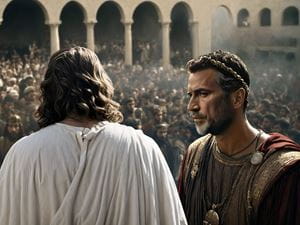
As the Roman governor of Judea, Pontius Pilate played a major role in the New Testament account of Jesus' trial and crucifixion. But he disappears from the Bible story after he sentences Christ to die and then allows a man named Joseph of Arimathea to claim the body for burial.
People are left to wonder what happened to Pontius Pilate after the crucifixion.
Was He Condemned as a Sinner, Praised as a Saint or Both?
The first four books of the Old Testament – Matthew, Mark, Luke, and John – give detailed accounts of Christ's death and Pilate's involvement in it. The Book of Acts, which appears later in the New Testament, mentions Pilate's role in several related incidents:
-
The Israelites denied Christ at a time when Pilate was ready to release him (Acts 3:13).
-
King Herod, Pilate, the Gentiles and the Israelites feared Christ and conspired against him (Acts 4:27).
-
The Israelites pressured Pilate into executing Jesus even though Pilate had decided Christ was an innocent man (Acts 13:28).
Pontius Pilate hesitated as he thought about Jesus' fate. He asked the man standing before him whether He was the king of the Jews, and Jesus' reply was puzzling.
According to some translations, Christ said, "You say so," "It is as you say," or "So you say."
Some religious scholars believe Pilate was caught between his own conscience and the people who wanted to kill Jesus. Some say he was disturbed by a note from his wife that said, "Have nothing to do with that just Man, for I have suffered many things today in a dream because of Him."
A crowd had gathered to watch Jesus' trial, and Pilate decided to give the people a choice between releasing Christ or releasing a notorious criminal named Barabbas. The crowd chose Barabbas.
Pilate then asked the people what he should do with Christ, and they said, "Crucify Him!" Fearing the crowd might riot, Pilate took some water and washed his hands, saying, "I am innocent of this man's blood; see to it yourselves" (Matthew 27:24).
The people responded, "His blood (will) be on us and on our children."
Pilate then released Barabbas and ordered the flogging and crucifixion of Jesus. The Roman soldiers stripped Christ of His clothes and placed a red robe on Him, made a crown of thorns and put it on His head, and placed a reed in His hand. They mocked Him as the "King of the Jews," spat at Him, beat Him, and replaced the robe with His own clothes before taking Him to be crucified.
The following day, the chief priests and other Jewish leaders asked Pilate to have Christ's tomb guarded until the third day after His death. They were afraid that Christ's followers would steal the body and say He had risen from the dead, as some had prophesied. Pilate sent a guard to watch the tomb and told the Jewish leaders to make it as secure as they could.
The biblical story of Pilate ends there, but others wrote about him later. A man named Philo, who lived at the same time as Pilate, wrote that Pilate was cruel and stubborn. The Roman historian Tacitus also mentioned Pilate and Christ's execution in his writings, and about 60 years after Christ's death and resurrection, the first-century Jewish historian Josephus wrote about an incident involving Pilate.
Apparently, the Roman emperor Tiberius sent for Pilate to answer charges that he had violently suppressed a peaceful religious gathering of Samaritans. He ordered Pilate to travel to Rome for a hearing, but Tiberius died before Pilate reached the city.
The new emperor was a man named Caligula. Religious scholars don't know whether Caligula held the hearing, postponed it or forgot about it. Whatever the case, Pontius Pilate died in 39 AD, and the mystery of what happened to him continues.
Theories About Pilate's Later Life
There are numerous theories about Pilate's fate:
-
Some people believe that Emperor Caligula ordered Pilate's execution.
-
Others say the emperor ordered him to commit suicide.
-
Still others believe Pilate decided on his own to kill himself.
-
Some people believe Pilate was forced into exile.
-
Some say Pilate's body was thrown into the Tiber River.
-
Some think he converted to Christianity and became a saint in the Ethiopian Orthodox Church.
-
Some scholars wonder whether Pontius Pilate even existed.
One piece of evidence supporting Pilate's existence is the "Pilate Stone," discovered by an Italian archaeologist in 1961. It was found alongside Roman coins and writings by the 1st-century historian Josephus. The stone is inscribed with the words "Pilate… prefect (or governor) of Judea". His name was also linked to the Roman emperor Tiberius, who ruled when Christ lived. An ancient ring that may have belonged to Pilate was also found near Jerusalem more recently.
Some Christians, such as Augustine, and historians, such as Eusebius, wrote that Pontius Pilate became a Christian after learning about several miraculous events that occurred following Jesus' death.
These events are also reported in the Bible:
-
Darkness fell from noon until 3 p.m. the day Jesus died.
-
The thick curtain that separated the holiest part of the Jewish Temple from other areas was torn in half.
-
A powerful earthquake struck the area.
-
Tombs opened.
-
Some Old Testament saints rose from their graves and appeared in Jerusalem.
Most modern Christians condemn Pontius Pilate for sentencing Jesus to death. Yet the Ethiopian Orthodox Tewahedo Church and ancient Coptic churches considered him a martyr who converted to Christianity. The Ethiopian church continues to revere Pilate as a saint.
In the end, Pontius Pilate remains one of the most complex and controversial figures associated with Jesus' crucifixion. Scripture presents him as a man who recognized Jesus' innocence yet yielded to political pressure and fear of unrest. History outside the Bible offers fragments, accusations, legends, and theories—but no definitive account of his final years or ultimate spiritual state.
For Christians, Pilate's story serves as a sobering reminder of the danger of moral compromise and the weight of decisions made in moments of fear and convenience. Whether Pilate died in disgrace, in exile, in repentance, or in quiet obscurity, his legacy is forever tied to the question he asked Jesus during the trial: "What is truth?"
That question continues to echo through history, inviting readers to reflect not only on Pilate's fate, but on their own response to Christ when conviction collides with pressure.