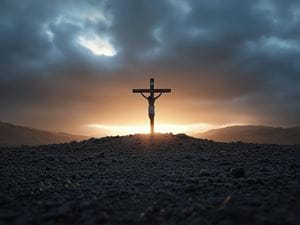
Most Christians focus on the resurrection when they think about the miracle of Christ's crucifixion. But what other miracles took place in connection with the crucifixion?
Jesus Foretells Peter's Denial (Matthew 26:31-35)
On the night of His arrest, Jesus predicted that Judas would betray Him. After Judas left, Jesus established the Last Supper, giving His disciples a sacrament with which to remember His death and resurrection. As they prepared to leave for the Mount of Olives, Jesus warned the disciples that they would all fall away that night (Matthew 26:31). When Peter declared that he would never fall away,
Jesus foretold Peter's denial: "Truly I say to you that this very night, before a rooster crows, you will deny Me three times" (Matthew 26:34). Just a few hours later, this prediction was fulfilled (Matthew 26:69-75) - not because Peter "wanted to" fulfill it, but because Jesus miraculously foresaw what would happen.
While other people in the Bible were also able to foresee the future (at times) accurately, that ability was always the result of divine inspiration – the power of God at work in supernatural ways.
Jesus Heals the Ear of the High Priest's Servant (Luke 22:50-51)
Matthew (26:51), Mark (14:47), and Luke (22:50) all relate that when the crowd came to arrest Jesus, one of His followers drew a sword and cut off the ear of the High Priest's servant. Only Luke tells us that Jesus healed that servant: "He touched his ear and healed him" (Luke 22:51).
To be able to heal this man whose ear had been cut off immediately was clearly a miracle – the sort of miracle that Jesus had regularly performed throughout His ministry.
Darkness Falls Upon the Land (Matthew 27:45)
During Jesus' crucifixion, several miracles took place. The first one occurred from the sixth to the ninth hour – from noon until three p.m. During this period, the sky became dark all across the land. The fact that the sky became dark during the middle of the day – when the sun would be highest in the sky – suggests that this was not a "normal" darkening, as at twilight. The fact that
Matthew mentions that "darkness fell upon the land" signifies that it was not dark before that time.
Additionally, the darkness ended at three p.m. – the ninth hour; this implies that daylight resumed at that time and lasted until sunset. This darkening of the skies for the final three hours that Jesus was on the cross was clearly connected to His suffering and death, not to some quirk of the weather. Jesus confirmed this when He cried out at the ninth hour, "My God, My God, why have You forsaken Me?" (Matthew 27:46). Jesus was quoting Psalm 22:1- a cry of anguish and a declaration of trust in God.
The fact that Jesus connected His suffering and the darkness with God "forsaking" Him is powerful evidence that the darkness was not merely a natural event.
The Veil of the Temple Torn From Top to Bottom (Matthew 27:51)
"And Jesus cried out again with a loud voice, and gave up His spirit. And behold, the veil of the temple was torn in two from top to bottom" (Matthew 27:50-51a). The "veil of the temple" was the curtain that separated the Most Holy Place from the remainder of the temple. Most scholars suggest that the curtain was approximately 60 feet high and 4 inches thick. The fact that it was "torn in two from top to bottom" points to a divine rather than a human action. No one could reach the top of the veil without ladders or other assistance. The fact that the curtain was four inches thick also demonstrates that it would take great strength and effort to tear it at all.
Another factor that suggests a divine cause for the torn curtain is what that curtain represented. The veil separated the Most Holy Place from the rest of the temple. The Most Holy Place (also known as the Holy of Holies) was believed to be the place where God dwelt among His people. Only the high priest could enter it, and he could enter only once a year – on the Day of Atonement. The veil represented a separation between God and His people; through His crucifixion, Christ removed that veil of separation, enabling God's people to enter His presence (see Hebrews 10:19-22).
The Earth Shook and the Rocks Split (Matthew 27:51b)
At the same time that the veil was torn in the temple, Jerusalem experienced an earthquake so strong that it split rocks. Earthquakes on their own are not necessarily miraculous, but the fact that this earthquake coincided with Jesus' death and the tearing of the veil points to a direct divine cause. The world that God had created in goodness had been polluted and degraded by sin.
The earthquake that occurred at Jesus' death could be seen as a catharsis – a cleansing, as though the earth was ejecting the sin and evil that had held sway for so long.
The Tombs Were Opened, and Many Saints Were Raised (Matthew 27:52)
The earthquake, in turn, triggered another miraculous event: "the tombs were opened, and many bodies of the saints who had fallen asleep were raised" (Matthew 27:52). People had been raised from the dead before; both Elijah and Elisha did it in the Old Testament. Jesus performed this act on several occasions during His ministry.
The most famous example is the raising of Lazarus, who had been in the tomb for four days before Jesus raised him (see John 11:39). "Four days" was important because in Jewish thought of that day, the spirit left the body after three days. At that point, any hope of reviving the deceased was gone. When Jesus raised Lazarus, all the multitudes understood that it was a miracle.
Clearly, the saints who were raised at Jesus' crucifixion had been dead longer than three days. Their resurrection was also miraculous, and not just a momentary phenomenon – they emerged from the tombs after Jesus' resurrection and appeared to many people in Jerusalem (see Matthew 27:53).
Jesus Dies Quickly and Without Having His Legs Broken (Mark 15:44; John 19:31-37)
It may seem strange to claim that Jesus' quick death without having His legs broken was a miracle. However, several facts point to divine intervention in this process. First, the Romans devised crucifixion as a slow, painful death. The most common cause of death for victims of crucifixion was suffocation; as they hung on the cross, their body weight pulled them down toward the ground. This, in turn, made their lungs collapse. When their strength dwindled and they could no longer hold themselves up, they would be unable to breathe and would suffocate. This process could take days, not hours. That's why, in Mark 15:44, Pilate was surprised that Jesus was already dead – because He had only been on the cross for hours, not days.
John 19 indicates that the Jewish leaders went to Pilate and asked him to have the soldiers break the legs of the three men being crucified that day. The next day was a "High Sabbath" (see John 19:31), and it was inappropriate to have dead bodies hanging out in public. The leaders asked that the legs be broken to speed their deaths, and then to have the bodies taken away. However, "after they came to Jesus, when they saw that He was already dead, they did not break His legs" (John 19:33).
Another factor that points to the miraculous nature of this is the fulfillment of prophecy. Psalm 34:19-20 states: "The afflictions of the righteous are many, but the Lord rescues him from them all. He protects all his bones; not one of them is broken." This was recognized as a messianic prophecy; the fact that Jesus' bones were not broken fulfilled that prophecy. Although Jesus clearly suffered, God acted so He could die without having His bones broken – the last miracle of His crucifixion.
The crucifixion of Jesus was surrounded by extraordinary events that revealed God's power and purpose. From fulfilled prophecies to supernatural signs—the darkness, the torn temple veil, the earthquake, and even the resurrection of saints—each miracle underscored that Christ's death was no ordinary execution. These wonders point to a divine plan of redemption, reminding us that through the cross, the barrier between God and humanity was removed.