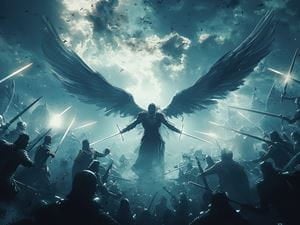
One of the names for God in the Bible is "Lord of Hosts." This title refers to God's status as the Commander of the Armies ("Hosts") of Heaven. Here are four prominent instances in scripture where the Armies of Heaven are referred to.
Joshua 5: Meeting the Commander of Heaven's Armies
In Joshua 5, Joshua and the Israelites have crossed the Jordan River and are now ready to begin their conquest of the Promised Land. The first battle they would fight would be Jericho – a large, walled city that was very old even in Joshua's day.
"Now it came about when Joshua was by Jericho, he raised his eyes and looked, and behold, a man was standing opposite him with his sword drawn in his hand, and Joshua went to him and said to him, 'Are you for us or for our enemies?' He said, 'No; rather I have come now as captain of the army of the Lord.'" (Joshua 5:13-14a).
We do not see God's "whole" army in this instance; just one "soldier" who identifies himself as captain of the army of the Lord. Joshua didn't see him coming; he just "appeared." It wasn't obvious to Joshua from his appearance that this was a heavenly soldier; but when he identified himself as a captain of the army of the Lord, Joshua knew what to do: "Joshua fell on his face to the ground, and bowed down, and said, 'What has my lord to say to his servant?" (Joshua 5:14).
The most important thing to remember is that God's armies are not "for us or for our enemies"; they focus on doing God's bidding. Joshua and the Israelites may have reasonably expected that God's armies were on "their" side. After all, God had given them victory over their enemies along the way. But the captain's answer reminds us that God is not on our side; we need to be on His side. As Abraham Lincoln famously stated during the American Civil War: "Sir, my concern is not whether God is on our side; my greatest concern is to be on God's side, for God is always right."
2 Kings 6: Seeing the Invisible Army of God
Elisha was "the" prophet of the Lord during the times of the kings of Israel and Judah. He was the successor to the great prophet Elijah; he asked Elijah to receive a double portion of Elijah's spirit. Immediately after Elijah was carried off to heaven, Elisha began to demonstrate God's power. He healed Naaman, the general of the king of Aram, of leprosy. He miraculously provided oil to save a widow and her son. He promised that God would give the Shunammite woman a son; later, when the boy died, Elisha brought him back to life.
In 2 Kings 6, the king of Aram was planning to attack Israel. God revealed the king's plans to Elisha, who passed them on to the Israelites. The king grew angry; he wanted to know who the traitor was in his inner circle. One of his servants told him that Elisha, the prophet, "tells the king of Israel the words that you speak in your bedroom" (2 Kings 6:12). So the king sent troops to capture Elisha.
The next morning, Elisha's servant got up and saw the armies and chariots of Aram surrounding the city where Elisha was. He was understandably afraid: "This is hopeless, my master! What are we to do?" (2 Kings 6:15). Elisha answered, "Do not be afraid, for those who are with us are greater than those who are with them." Elisha then prayed that God would open his servant's eyes. "And the Lord opened the servant's eyes, and he saw; and behold, the mountain was full of horses and chariots of fire all around Elisha" (2 Kings 6:16-17).
God's armies will always be the superior force in any conflict! Elisha understood that "those who are with us are greater than those who are with them." But the servant wasn't able to see that until God opened his eyes. Like Elisha's servant, we need to take heart and trust that God's armies are on the scene!
Matthew 26: Jesus Reveals His Heavenly Legions
Much of the Old Testament narrative involves the battles that the Israelites fight. The overall story of the Old Testament reminds us that we need to be on God's side, instead of expecting Him to be on our side. When the Israelites assumed that God would always take care of them, they turned away from Him and failed to walk in obedience to Him. That led them to disaster, time after time – just as it does today.
But the armies of heaven are not just an "Old Testament thing." In Matthew 26, Judas Iscariot came with an armed mob from the religious leaders of the Jews. As they came to arrest Jesus, one of his followers drew a sword and cut off the ear of the high priest's servant. Jesus condemned this violence: "Put your sword back into its place; for all those who take up the sword will perish by the sword" (Matthew 26:52).
Jesus' focus was not on earthly conflict and powers; He was not concerned about what men could do to Him. But Jesus reassured His disciples: "Or do you think that I cannot appeal to My Father, and He will at once put at My disposal more than twelve legions of angels?" (Matthew 26:53). A "legion" in Roman times consisted of 6,000 troops; Jesus thus indicated that He could immediately have 72,000 heavenly troops at His disposal. What is important is not the number of "troops." Rather, it is the fact that God's armies are always greater than the enemy.
Revelation 19: The Final Victory Led by Christ
"And I saw heaven opened, and behold, a white horse, and He who sat on it is called Faithful and True, and in righteousness He judges and wages war…And the armies which are in heaven, clothed in fine linen, white and clean, were following Him on white horses." (Revelation 19:11, 14).
At this final battle, Jesus will lead the armies of heaven against "the beast and the kings of the earth and their armies" (Revelation 19:19). What is interesting is that almost nothing is said about the battle itself; the beast and the false prophet are seized and thrown into the lake of fire, "and the rest were killed with the sword which came from the mouth of Him who sat on the horse" (Revelation 19:20-21).
This reminds us that in the final battle, as in every battle God fights, when God's armies appear, God wins!