The U.S. Supreme Court has declined to hear Cambridge Christian School’s challenge to a Florida rule barring pregame prayers over the loudspeaker at a state football championship, leaving intact lower‑court rulings that classified the PA system as government speech.
The decision highlights the delicate balance between the right to free exercise and the Establishment Clause in public school settings.
Earlier this week, the Supreme Court declined to hear an appeal by Cambridge Christian School of a court ruling against the school, arising from a 2015 Florida state football championship game.
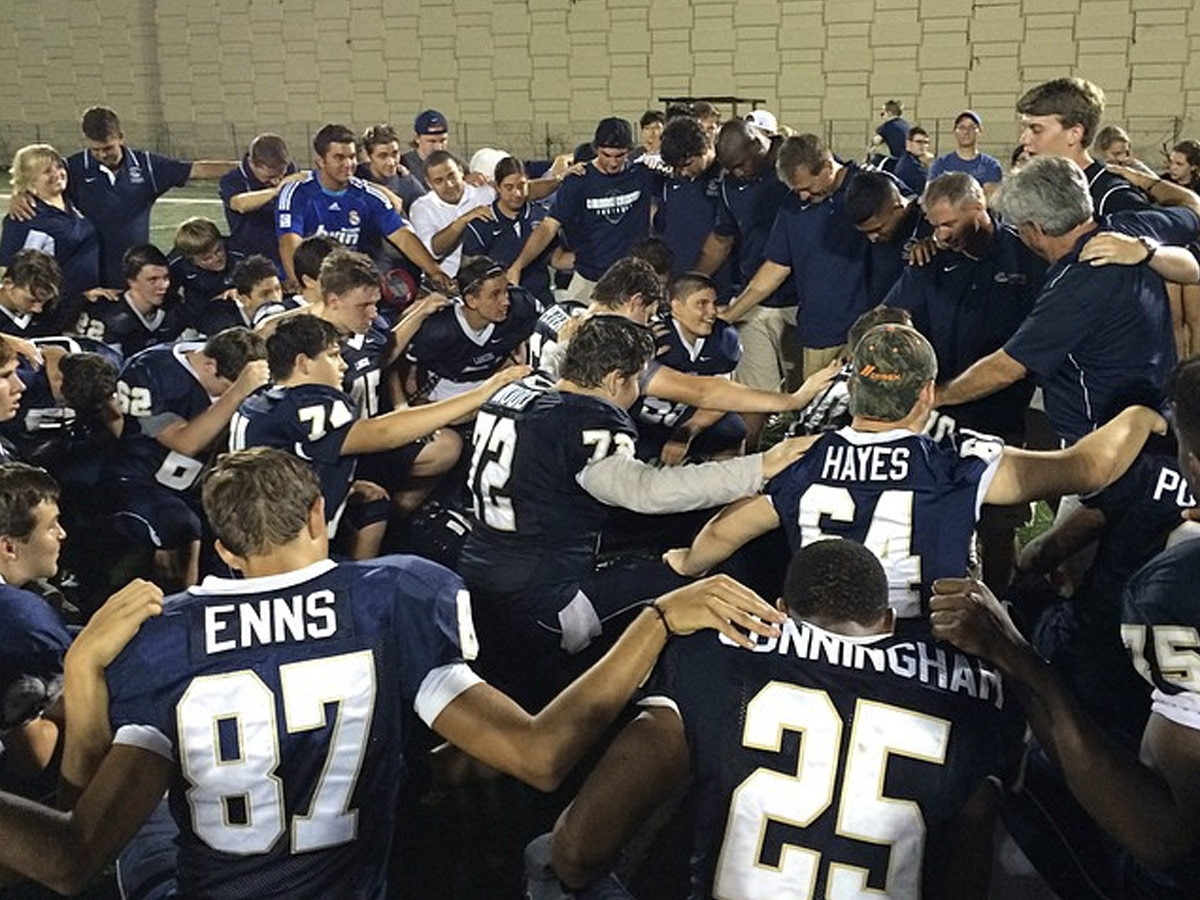
Cambridge Christian (and its opponent, University Christian School) requested that a prayer be said over the loudspeaker before the two schools played in the state championship. The Florida High School Athletic Association (FHSAA) denied the request on the grounds that the game was being played at a public facility; thus, the prayer could be deemed “government speech” and thus impermissible governmental establishment of religion.
Following the denial, Cambridge Christian filed suit against the FHSAA in 2016, claiming that its rights had been infringed. In 2017, the U.S. District Court ruled against Cambridge Christian, holding that the use of the loudspeaker would have constituted government speech in violation of the Establishment Clause.
In 2019, a three-judge panel of the Eleventh Circuit Court of Appeals affirmed part of the ruling and reversed the rest. Specifically, the Court of Appeals held that while the loudspeaker was a “nonpublic forum” (and thus would constitute government speech), Cambridge Christian had at least properly alleged that it was improperly denied access to that forum.
When the case was returned to the district court, the court ruled against Cambridge Christian, finding that no constitutional violation had occurred. Cambridge Christian again appealed to the U.S. Court of Appeals for the Eleventh Circuit. This time, the Court of Appeals upheld the trial court ruling, stating: “Because we conclude that the FHSAA was regulating its own expression when it restricted pregame speech over the PA system at the 2015 football championships… Cambridge Christian’s free exercise claims fail.”
Cambridge Christian then appealed to the U.S. Supreme Court. On Monday, November 17, the Supreme Court’s orders list indicated that Cambridge Christian’s appeal was denied without comment, thereby bringing the case to a close.
But what does this case mean in the larger sphere of religious rights?
The question of “religious rights” under the First Amendment is largely the product of the tug-of-war between the Establishment Clause and the Free Exercise Clause of the First Amendment to the Constitution. The Establishment Clause states that Congress shall not pass any law establishing a religion; the Free Exercise Clause states that Congress shall not pass any law prohibiting the free exercise of religion. (These First Amendment prohibitions against government action also apply to state and local governments as a result of the Fourteenth Amendment and Supreme Court cases interpreting it.)
The interplay between the Free Exercise Clause and the Establishment Clause was on full display in the Cambridge Christian case. Cambridge Christian sought to portray its complaint as a Free Exercise claim, while the FHSAA viewed it as an Establishment Clause case. Ultimately, the courts agreed with FHSAA.
What does this mean for issues like school prayer? Probably not much. The courts’ rulings were based on the specific situation at hand – namely, a state championship game hosted by a state agency in Florida. Because the game was hosted by the state at a state-operated facility (the Citrus Bowl in Orlando), rather than by either of the schools, pregame “announcements” over the public address system could be viewed as “government speech.” That particular set of circumstances clearly applies only to a very small number of situations out of the thousands of high school sporting events each year.
The seminal Supreme Court case dealing with school prayer was Engel v. Vitale, decided in 1962. The next year, the Supreme Court decided School District of Abington Township v. Schempp, which further clarified that school-mandated religious practices (primarily prayer and Bible reading) constituted an impermissible establishment of religion.
Since the Supreme Court’s rulings in these “School Prayer Cases,” the Court has clarified some of the boundaries for religious expression in school. For instance, student-initiated and student-led prayer is acceptable because it lacks the element of compulsion that triggers the Establishment Clause. And more recently, the Supreme Court held in Kennedy v. Bremerton School Dist. that a coach’s private prayer following a game did not violate the Establishment Clause. In fact, the Court found that the school district’s discipline of the coach violated his free speech and free exercise rights.
It is therefore important not to read too much into the Supreme Court’s refusal to accept the appeal from Cambridge Christian. The current 6-3 “conservative majority” on the Supreme Court is unlikely to walk back from decisions like Kennedy v. Bremerton School Dist. and impose further restrictions on religious rights.
Students have the right to pray together at school and to study the Bible together. It’s popular among some Christians to discuss “prayer taken out of schools,” but students are still allowed to pray at school. Events like “See You at the Pole” demonstrate that students are allowed to pray and that many students want to do so.
The Establishment Clause simply prohibits public school teachers and administrators from forcing students to pray or study the Bible. Private schools, like Cambridge Christian, are not subject to those prohibitions. They can start their football games with prayers – even over the loudspeaker. All in all, religious rights are probably as healthy as they have been in quite some time.
School prayer is an area where the law must carefully balance conflicting rights. Allowing students to pray is one thing; compelling them to pray is something else entirely. Religious freedom must also include the right not to believe; otherwise, religious belief is being “established” in comparison with non-belief.
While it is tempting to wish that the government supported religion, that may be a case of “be careful what you wish for.” If the government supports Christianity today, what might it choose to support tomorrow? The shifting winds of political thought and our never-ending election cycle demonstrate that beliefs that seem well-established today may be outlawed tomorrow.
The Founding Fathers clearly understood that the government should neither establish religion nor prohibit it. They believed that religious beliefs and practices were a personal matter and that the government should not interfere with them. Having experienced state-sponsored churches in Europe, they specifically decided that the United States would not follow that path.
The United States is probably in a pretty good place in regard to the balance between the Free Exercise Clause and the Establishment Clause. Particularly, with regard to public schools, students are free to practice their faith without compulsion from teachers and administrators, so long as no particular belief is favored over others. That’s a good balance for everyone, no matter what beliefs they may hold.
 Read Previous Post