
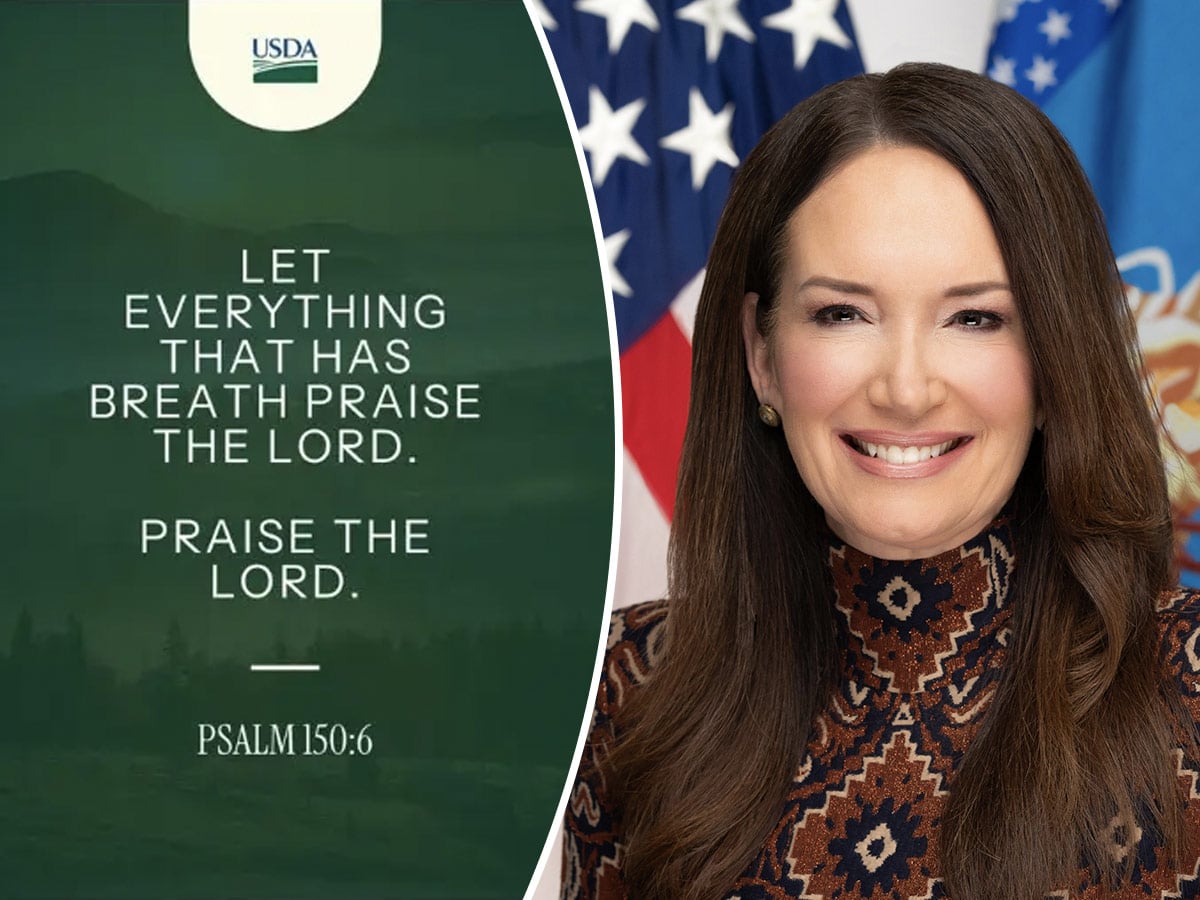
A federal judge has ruled that Agriculture Secretary Brooke Rollins likely crossed a constitutional line when she sent Christian-themed Christmas and Easter messages to thousands of federal employees. The ruling raised new questions about religious expression in the workplace.
U.S. District Judge Trina Thompson issued a preliminary injunction Thursday, finding that Rollins’ messages may have violated the First Amendment’s Establishment Clause by placing pressure on employees who do not share her Christian beliefs and by testing the boundary between faith and authority in the workplace.
“The April 5, 2026, and December 23, 2025, messages go too far,” Thompson, a Biden appointee, wrote in her 21-page ruling. “They suggest acquiescence that amounts to coercive pressure; a pressure of conformity sufficient to raise an Establishment Clause violation.”
The controversy centers on holiday greetings Rollins sent to U.S. Department of Agriculture employees. Those messages included explicit references to Jesus Christ, salvation and the resurrection.
In a Christmas message sent on December 23, 2025, Rollins shared a video celebrating the birth of Christ and explaining the holiday’s religious significance.
“The spirit of generosity flows from the very first Christmas when God gave us the greatest gift possible, the gift of his Son and our Savior Jesus Christ, who came to free us from our sins and open the door to eternal life,” Rollins said. “This is the reason for the season.”
Her Easter message, sent April 5, 2026, was similarly rooted in her Christian faith.
“Team USDA, Happy Easter – He is Risen indeed!” Rollins wrote. “Today we celebrate the greatest story ever told, the foundation of our faith, and the abiding hope of all mankind.”
She continued by describing Christ’s crucifixion and resurrection, declaring that “sin has been destroyed” and that God had granted “each of us victory and new life.”
Those messages prompted a lawsuit filed in May by the National Federation of Federal Employees and six USDA workers. They argued that Rollins’ religious communications made them feel excluded and pressured to conform to Christianity.
According to the complaint, some employees feared professional consequences for openly disagreeing with the secretary’s religious views, underscoring the practical stakes of the dispute.
One employee, who practices Buddhism, said she no longer felt comfortable discussing her religious holidays. Another, an atheist, reported feeling silenced, while a Pagan employee expressed concerns that appearing Christian could affect her opportunities for advancement.
The lawsuit also alleges that supervisors warned employees they could face “trouble” for objecting to the messages, deepening fears of retaliation.
However, Thompson emphasized that the court was not attempting to restrict Rollins’ personal faith. It also was not trying to prevent her from discussing Christianity altogether.
Instead, the judge pointed to religious expression guidelines Rollins herself issued in November 2025, which recognize employees’ rights to discuss their beliefs while prohibiting the use of official authority to pressure subordinates.
Under those guidelines, federal employees may share why their faith matters to them, discuss religious beliefs with interested colleagues and invite coworkers to religious events.
But they cannot create a hostile workplace through persistent, unwelcome religious advances or use their positions of authority to pressure others.
The preliminary ruling does not represent a final decision on whether Rollins violated the Constitution. It does, however, immediately restrict how she communicates religious messages to employees while the lawsuit continues, keeping the dispute active and unresolved.
The case highlights an ongoing debate over where personal religious freedom ends and government authority begins. That issue becomes especially clear when expressions of faith come from senior officials overseeing employees with diverse religious beliefs.
 Read Previous Post