
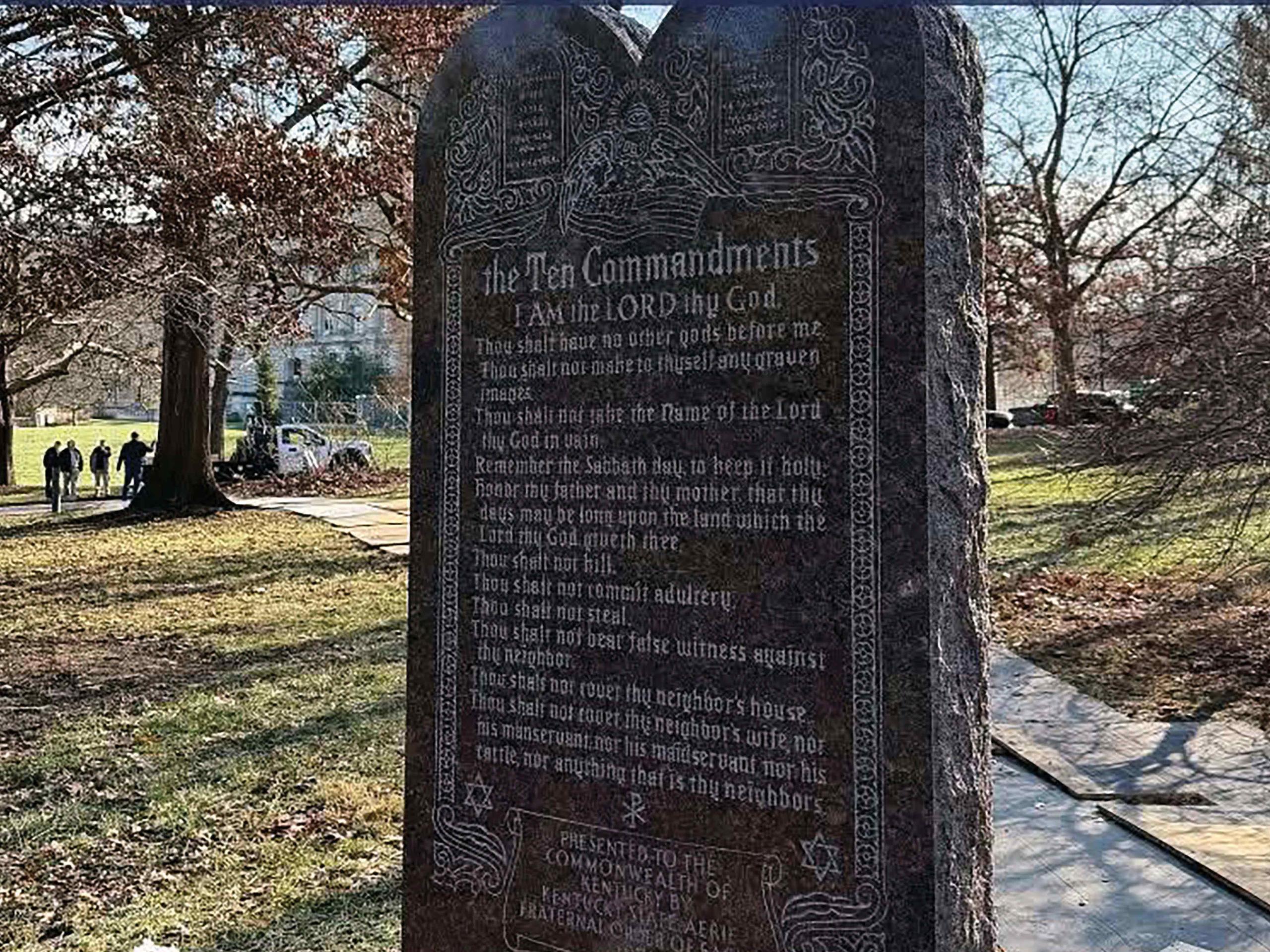
After more than 40 years of absence, a Ten Commandments monument has officially returned to the grounds of the Kentucky state Capitol, a move supporters say restores a meaningful piece of both the Commonwealth’s history and America’s moral foundation.
The granite monument was permanently reinstalled this week following the passage of House Joint Resolution 15, which cleared the Kentucky House by a 79–13 vote on February 19 and passed the Senate 32–6 on March 13. The resolution directed the state to return the monument to the Capitol grounds, where it originally stood for nearly a decade.
“I am pleased to see this historic Ten Commandments monument returned to its rightful place,” said Rep. Shane Baker, R-Somerset, the sponsor of the resolution. “The Ten Commandments have widely recognized historical significance in the history of the Commonwealth of Kentucky and the nation.”
Kentucky Attorney General Russell Coleman echoed that sentiment, framing the monument’s return as both symbolic and historically appropriate. “The Ten Commandments are at the heart of America’s history and founding, so it is only right that they also sit at the heart of our Commonwealth’s Capitol grounds,” Coleman said. “After several decades, we have returned this monument to its rightful place, and I’m grateful to Representative Baker and the entire General Assembly for taking this important step to uphold our history.”
The monument was originally donated to the state in 1971 by the Fraternal Order of Eagles, a civic organization that has placed more than 100 similar monuments nationwide. It remained on permanent display until around 1980, when it was removed due to a construction project. Although efforts were later made to reinstall it, those plans stalled in 2000 after the American Civil Liberties Union filed a lawsuit. A federal district court ruled at the time that the monument violated the Establishment Clause, applying the Lemon test, a legal framework that had governed church-state cases for decades.
That legal landscape shifted in 2022, when the U.S. Supreme Court ruled in Kennedy v. Bremerton School District that the Lemon test had been “long ago abandoned,” instructing courts instead to evaluate Establishment Clause disputes based on “historical practices and understandings.” Supporters say that the ruling cleared the way for Kentucky’s decision.
First Liberty Institute, a religious-liberty law firm that represented the Fraternal Order of Eagles, praised the monument’s return. “We congratulate the people of Kentucky for restoring a part of their history,” said senior counsel Roger Byron. “There is a long tradition of public monuments like this one that recognize the unique and important role the Ten Commandments have played in state and national history.”
Vic Jeffries, a trustee with Fraternal Order of Eagles Aerie 3423 in Hopkinsville, Kentucky, called the moment deeply meaningful. “We are thrilled to return the Ten Commandments monument to the Commonwealth and have it back where it belongs,” he said.
Not all lawmakers were fully at ease with the decision. Some expressed concerns about church-state separation and whether the Capitol grounds should include representations from other faiths. Rep. Joshua Watkins said the issue gave him “a little heartburn,” while State Sen. Keturah Herron questioned whether other religions would also be allowed similar displays.
Baker responded by emphasizing that the resolution was not about promoting religion, but about acknowledging history. For many Christians in Kentucky, however, the monument’s return represents more than stone and scripture—it is a reminder that faith and moral law have long shaped the nation’s story, and still matter today.
 Read Previous Post