
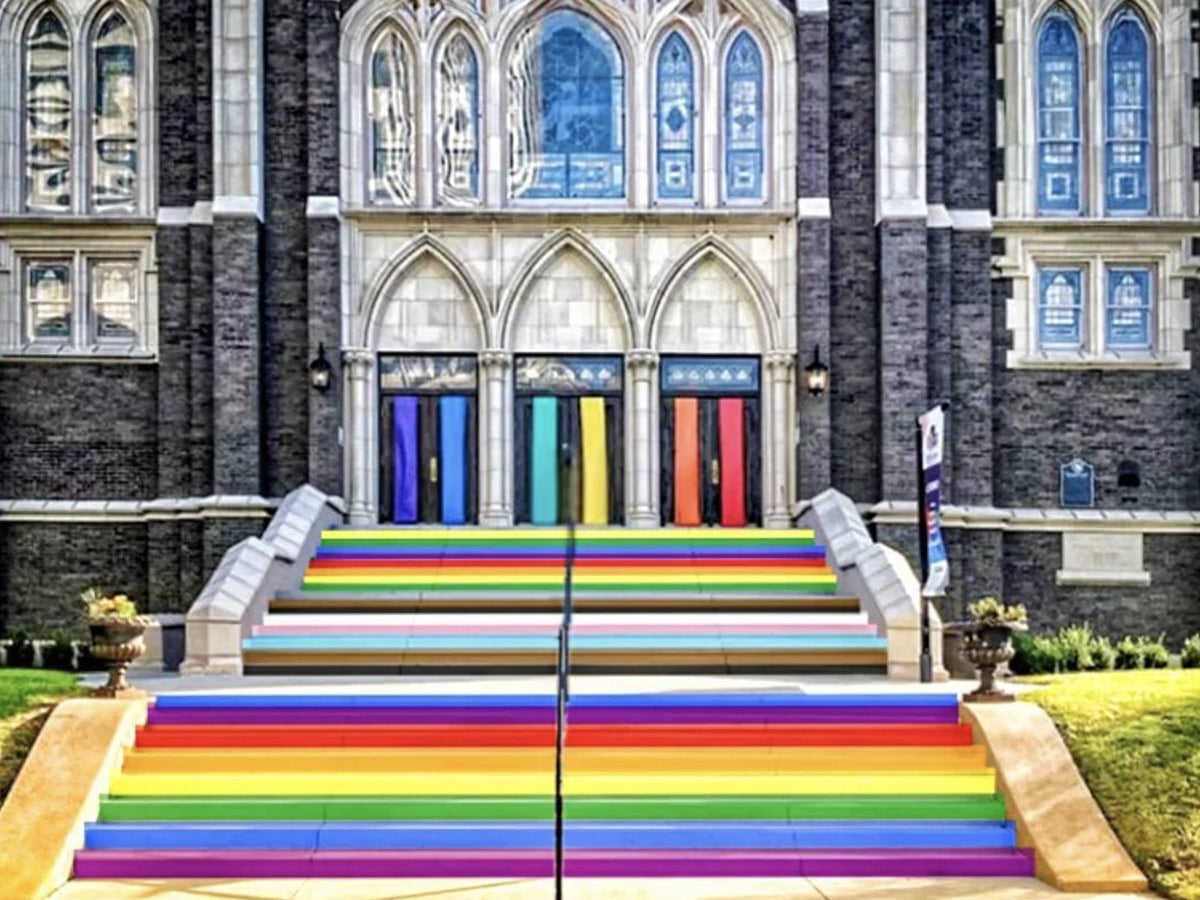
A United Methodist congregation in Dallas that painted its front steps in rainbow colors in defiance of an executive order from Texas Gov. Greg Abbott will now be allowed to keep the installation in place for the next three years after receiving an unexpected approval from city planners.
Oak Lawn United Methodist Church first painted its entrance steps last October as what the congregation called an act of “sacred resistance” after Abbott ordered cities to remove political or activist symbols from public spaces, including artwork on crosswalks and streets. In a statement at the time, the church argued that faith requires speaking out: “The governor may remove a rainbow from a roadway — but he cannot erase the image of God in God’s people.”
The rainbow steps quickly became a visual rallying point for members of the local LGBT community and progressive Methodists. The church, which describes itself as a “Reconciling congregation,” affirms LGBT-identified people and their families and says it is committed to values of inclusion, social justice, and hospitality.
On January 5th, the Dallas Landmark Commission voted to approve a Certificate of Appropriateness, clearing the way for the church to retain the rainbow steps as a temporary art installation for three years. City staff recommended approval, noting the work is temporary, reversible, and widely viewed as a source of community pride. A task force subcommittee had previously recommended denial based on historic district code requiring matching paint colors.
The move was significant because Oak Lawn UMC’s building is a historic landmark. With more than a century of worship at its current site, the Gothic-influenced brick church was recognized with a State Historic Marker in 1974, listed on the National Register of Historic Places in 1988, and formally designated a Dallas Landmark in 1984. Exterior alterations on such buildings normally require rigorous review.
Ahead of the January 5th hearing, Rev. Rachel Griffin-Allison reiterated the church’s theological rationale for the display. “Silence is not neutral,” she said. “Painting our steps in the colors of the rainbow is a visible witness to the gospel we preach — that every person is created in the image of God and worthy of safety, dignity, and belonging.”
The church’s decision to publicly challenge the governor’s order was consistent with its broader advocacy. Oak Lawn UMC operates what it calls a Sacred Resistance ministry and is currently led by three LGBT-identified pastors. The church also provides community outreach services including meals for the homeless, food pantry access, and a clothing closet that supplies free garments, including so-called “gender-affirming” clothing for individuals who identify as the opposite sex.
In recent years, the congregation has also clashed with denominational leadership. In 2022, Oak Lawn UMC made headlines after appointing two LGBT-identified pastors without authorization from the North Texas Conference of the UMC, an act of protest amid wider denominational disputes over sexuality and clergy ordination.
For now, however, the rainbow installation will remain — a symbolic victory for the church and its supporters. And while Abbott’s directive sparked the original confrontation, Oak Lawn’s pastors insist the deeper issue is theological rather than political.
“Faith is not silent in the face of harm,” the church’s statement declared last fall. With the city’s approval now secured, those steps — and that message — are not going anywhere anytime soon.
 Read Previous Post