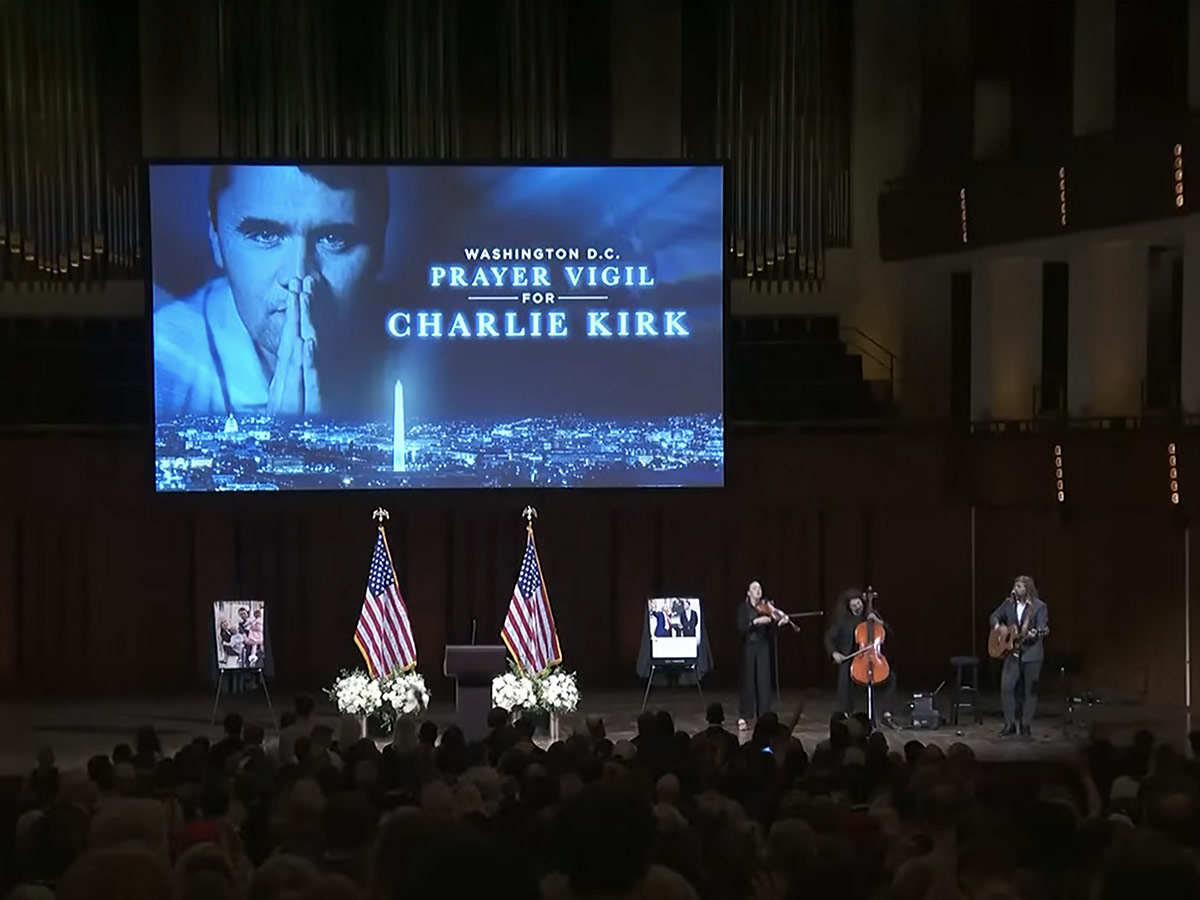
Thousands packed the John F. Kennedy Center for the Performing Arts to honor Charlie Kirk — friends, allies, White House cabinet officials, and more than 85 members of Congress gathered shoulder to shoulder in a scene that many described as both somber and resolute. What began as a vigil quickly took on the tenor of a spiritual rally: mourners spoke of revival, of a dividing line between right and wrong, and of a calling to carry forward the work and faith of a man they said was unafraid to stand for Christ.
An orderly line had already wrapped through the Kennedy Center courtyard more than an hour before the event, despite the location being announced only hours earlier. “I think it’s just absolutely incredible, and this is just a very small portion of our country,” one woman in line told onlookers, echoing the sense of stunned grief and steadfast resolve that filled the crowd.
For many who traveled long distances, the vigil was an opportunity to grieve and to recommit. Hilary Jackson, chapter chair of Moms For Liberty in Cuyahoga County, Ohio, told The Christian Post she had driven more than five hours to be there. Dressed in a shirt emblazoned with the word “freedom” — a tribute to the shirt Kirk was wearing when he was shot — Jackson said Kirk’s death could mark a turning point. “I think that there is a revival happening in this country, where we are clearly seeing not a difference of Right or Left, or red or blue, but a difference between good and evil,” she said, even as nearby protesters shouted through a megaphone.
Others echoed that belief. Dawn Erckenbrack, who said she came to honor Kirk for “the influence he’s had on young people and people my age as well,” told CP that Kirk “was never rude to anyone. He was always courteous. He never attacked the person.” Trevor McKay, a Christian in his early 20s, said he admired Kirk because he was “unafraid and unashamed of who he was,” and hoped that young men would emulate that courage.
Speakers at the vigil made faith the centerpiece of their remembrances. House Speaker Mike Johnson called the moment one of spiritual reckoning, saying, “It’s as if a dark shadow was cast over our country… It’s as if the ground was shifted beneath us.” He urged mourners not to be overcome by despair but to honor Kirk by living as he did — steadfast, hopeful, and committed to training the next generation.
HHS Secretary Robert F. Kennedy Jr. brought both passion and a reminder of grace, describing Kirk’s mission as bound up with “Jesus and also free speech.” He shared a personal memory: his 17-year-old niece had tucked a Bible into her suitcase and told her mother, “I want to live like Charlie Kirk.” Kennedy, who lost his father to assassination in 1968, spoke of grief turned into resolve and quoted a conversation with Kirk about the risk they both faced in challenging entrenched powers. “Sometimes our only consolation is that we can die with our boots on,” he recalled saying, words that drew raucous applause from the crowd.
The vigil came in the wake of a violent act that had left a nation wrestling with questions of political and spiritual violence. Attendees insisted their response would not be retaliation but revival — a call to courage, mercy, and a renewed witness. “Charlie gave his life so that the rest of us would not have to suffer those fates worse than death,” Kennedy said. “Now it’s our job… to rush in and fill the breach and win this battle for our country, for God and for our families.”
Across the Kennedy Center that night, thousands shared the same mixture of sorrow and determination. For many, the vigil was more than a farewell; it was a summons — to pray, to stand, and to continue a legacy they believe was rooted in the conviction that faith must be lived boldly in a troubled age.
 Read Previous Post