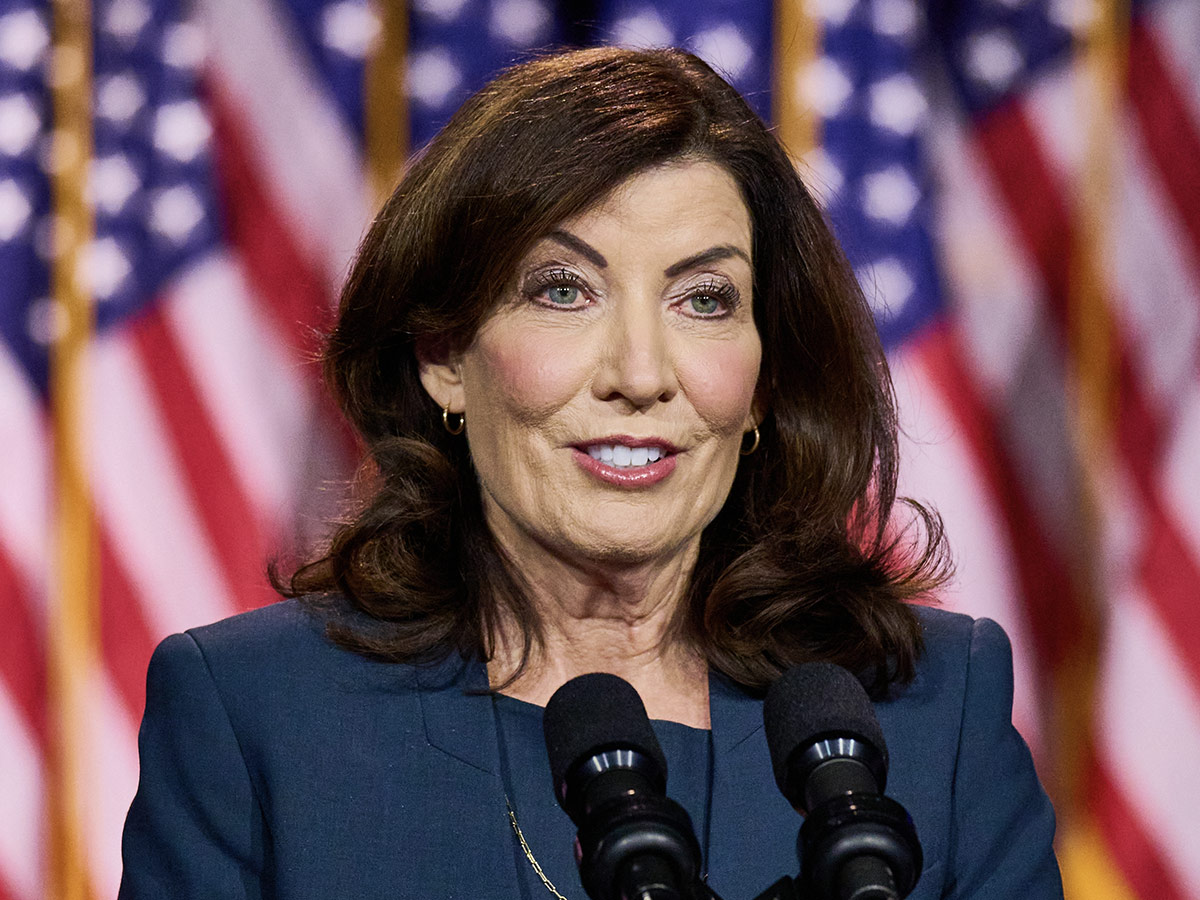
Earlier this month, New York Governor Kathy Hochul spoke at True Bethel Baptist Church in Buffalo. As she talked about putting money back in people’s pockets, she also said, “Don’t stop by the liquor store, okay? Buy something for the kids – buy them some food.”
Not surprisingly, some people pushed back against these comments. Did her comments further racial stereotypes? Were they too condescending? And more broadly, what does this situation say about politicians speaking in churches?
Not surprisingly, much of the backlash against Gov. Hochul’s comments was politically motivated. Her lieutenant governor, Antonio Delgado, who is running against her in next year’s primary, said that her comment “reduces whole communities to harmful stereotypes and strips away the dignity of parents and children alike.”
Congresswoman Elise Stefanik, who is considering a run for the Republican nomination for governor, likewise criticized Hochul’s remarks: “This is not the first time Kathy Hochul has insulted the black community and spoken in a condescending, lecturing tone toward African-Americans.”
However, the pastor who preached in the service that morning defended Hochul’s remarks, noting that her comments fit with the theme of the sermon he had just preached. That pastor, Darius Pridgen, indicated that his sermon was titled, “Before You Crash Out,” and Hochul’s remarks fit right in with his sermon. He said that Hochul “was commenting on not crashing out and not making bad decisions, which I had just preached.”
It’s not surprising that competing politicians would take advantage of an opportunity to attack each other. The broader issue, though, relates to politicians speaking in churches. What guidelines should churches have for those who come to speak?
The first aspect of the issue relates to churches and political advocacy. If churches invite candidates to speak, should they offer “equal time” to opposing candidates? For years, churches and church leaders have been concerned about political advocacy that might impact their tax-exempt status. However, it has generally been accepted that churches and pastors can talk about issues, even if they don’t endorse candidates. But does inviting a candidate to speak – without inviting their opponent – constitute an endorsement?
The second aspect of the issue deals more with churches and their purposes. Is the politician coming to talk about politics, or about faith? Certainly, candidates are entitled to express their religious or spiritual beliefs (regardless of what some people believe about “separation of church and state”). But how far should a candidate go in speaking on political issues in church? Should a church offer its pulpit for a campaign speech, as opposed to a sermon?
Gov. Hochul’s remarks at True Bethel Baptist Church demonstrate the potential pitfalls for both candidate and church. It would certainly be appropriate for anyone – pastor or layperson – to speak in church about making good decisions and living according to Biblical standards. However, Hochul’s remarks were not limited to that subject; she also talked about the tax rebate checks which would be coming soon (courtesy of her administration). Should politicians limit themselves to strictly biblical or spiritual issues when speaking in church, or can they also talk about themselves, their policies and their record?
In the same vein, another concern is whether inviting certain politicians to speak – and not inviting others – deepens divisions in both culture and the church. Should churches open their pulpits to people who stoke fear and division through their campaigns? Do they welcome people who challenge their members, or do they “preach to the choir”?
Jesus prayed for unity among His followers, so that the world might believe. Does inviting politicians to speak in church foster that unity? Does it bring unity among all believers, or just among those who agree politically?
There is still another level to this issue, which may not be recognized immediately. What is the purpose of the church? Is it to proclaim the Gospel? Help people in their discipleship journey? Influence society? Function as a community of believers? Or some combination of all of these?
Clearly, without the Gospel, there is no “Church.” Also, Scripture sets out a picture of the early Church which emphasizes prayer, worship, fellowship, and instruction (see Acts 2:42). These foundational functions “make” a church.
The church should certainly influence its community in positive ways. Building connections with people and serving the community are important ways that the church can be “salt and light.” But the Church should not weaken its ability to proclaim the Gospel in a search for “influence.” Instead of furthering division in the broader culture, the Church should strive to both model and foster unity through the message of Jesus. Whether the speaker is a pastor or a politician (or anyone else for that matter), churches should work to ensure that whatever message is proclaimed from the pulpit is biblical, and that it serves to bring people together.
 Read Previous Post