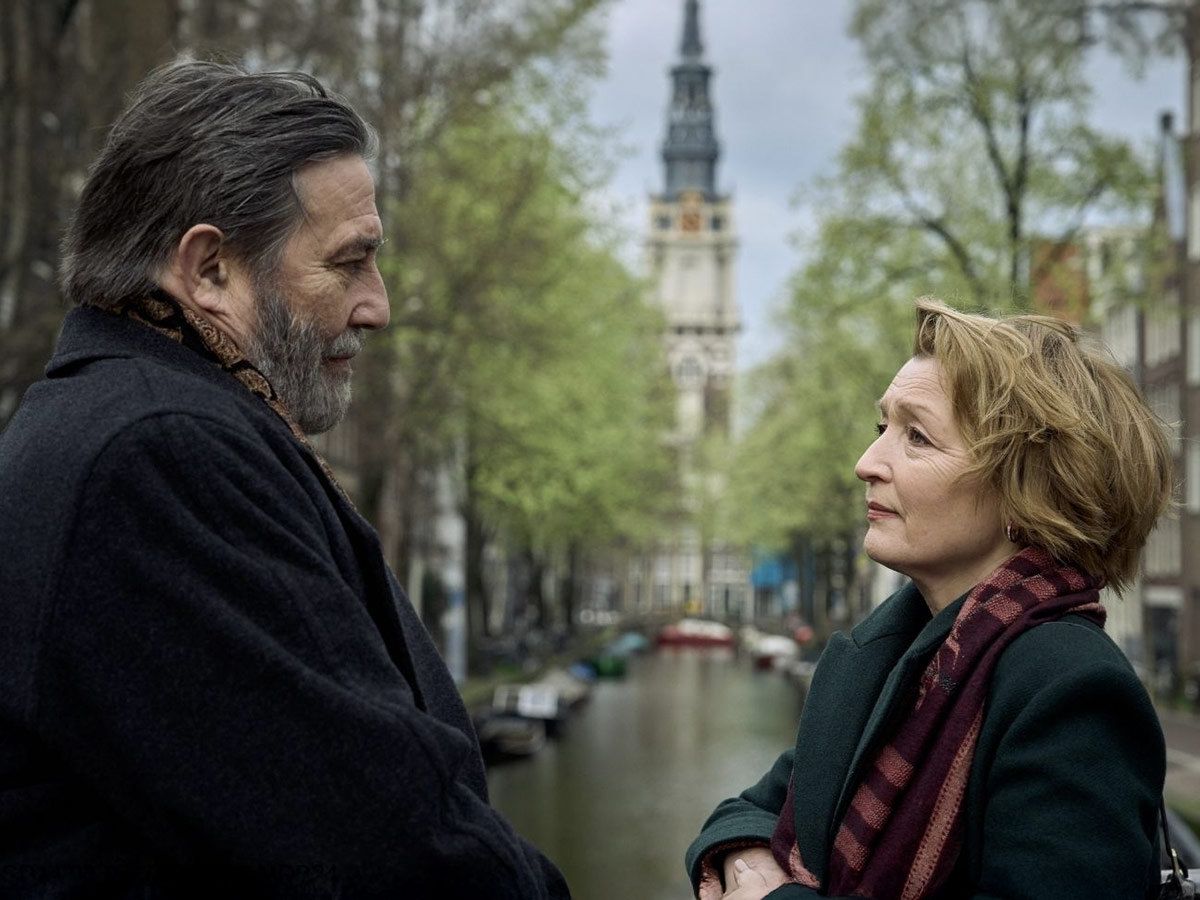
In the new film “Mindwinter Break,” director Polly Findlay and actors Lesley Manville and Ciarán Hinds deliver a study of marriage, faith and the small, subtle moments that define a relationship. The film, adapted from the bestselling novel by Bernard MacLaverty, relies on intimate performances and an emphasis on the actors’ craft rather than spectacle.
The story’s dramatic tension unravels when Stella (Manville) and Jerry (Hinds) embark on a trip to Amsterdam. Stella is quietly tuned in to the supernatural, reeling from a near tragedy in her youth, while Jerry is practical and detached. The trip forces the two to look inward to decide if their futures are intertwined or not.
Findlay, making her feature debut after a lengthy career in theater, called the project a kind of “gateway drug” coming from her theater work.
“It is a film that is very much about the acting and about the performance,” she said. “And we were really aware going in that the quality of the film was going to kind of like live and die on on, whether or not we gave these two fantastic actors the space and the time to do the thing that they do so brilliantly. So, in some respects, that felt like something that I was quite familiar with from theater, because it felt like a big part of the challenge of it was creating a set that was reactive and responsive and like genuinely engaged and interested in.”
Findlay said she and the cast were guided by an appreciation for the source material’s language and emotional precision. She recalled being drawn to passages that could “move in a blink to the mystical,” and she wanted that sensibility to “live under the film.”
Hinds, who has built a career on both large-scale epics such as “Game of Thrones” and “Justice League” and quiet character work such as “Belfast” and “Silence,” described his preparation with Manville and Findlay as a collaborative process.
“We were very fortunate in this day and age to have Leslie and I two days with Polly just reading the piece,” he said.
That freedom is central to what the film achieves. Hinds said the rehearsal period enabled the actors to “play the scene as truthfully,” whether that meant “being emotionally honest or hiding emotions.” The result, he suggested, is a performance style focused on immediacy and human fallibility rather than melodrama.
“It was a great experience,” he said. “I really meant a lot to me, actually be able to be able to play like this, because it’s very rare one gets that kind of opportunity to be so personal and so connected in the search for truth and honesty.”
Although there is a moment of confrontation in the film regarding the spiritual versus secular outlooks, Findlay emphasized that faith in the film is less about doctrine than about perception. The director explained that Stella “spots miracles in places,” and that the film’s spirituality is embodied in “the sense of being live to the world and each other.”
Hinds described Jerry as “quite a needy person,” and likened him to “a child who’s … has a deep-seated fear of being abandoned.” The actor said Jerry’s struggle is not merely ideological but profoundly emotional—he loves his partner and fears losing the bond that has sustained him.
“He’s ashamed of himself. He loves this woman so deeply, and he needs her so in between that he’s a bit of a mess, but he will try and hold her up,” Hinds said.
Certain sentences from the book felt essential to the film’s tone, Findlay explained, and she worked to preserve their quality. One memorable line from her reflection compares sensitivity to the world to an allergic reaction:
“Bernard talks about pollen sensitizing your nose to sneezing, so that you have the pollen in your nose. And there’s a sort of sense of like, ‘Oh, I’m just about like that.’ You feel super sensitive.” That heightened awareness, she said, is shared by both characters over the course of the weekend, giving them a sharpened “liveness to the world.”
“Mindwinter Break” stakes everything on two performances and a director’s trust in subtlety. Findlay embraced that challenge, acknowledging that “the quality of the film was going to kind of like live and die on, whether or not we gave these two fantastic actors the space and the time to do the thing that they do so brilliantly.”
Findlay framed the closing moments as a kind of leap—an act of faith within the relationship rather than toward any outwardly religious overtones.
“There is a decision to have faith in each other, to find a moment of sort of chapter change and trust, and to take a leap into what feels like the unknown,” she said, calling that choice “an amazing thing to do at that stage in a relationship.”
“Midwinter Break,” directed by Polly Findlay and starring Lesley Manville and Ciarán Hinds, releases February 20 from Focus Features.
 Read Previous Post