The roar that once echoed across college basketball returned to Provo this weekend — and at the center of it all was a familiar name that still stirs deep affection among fans: Jimmer Fredette.
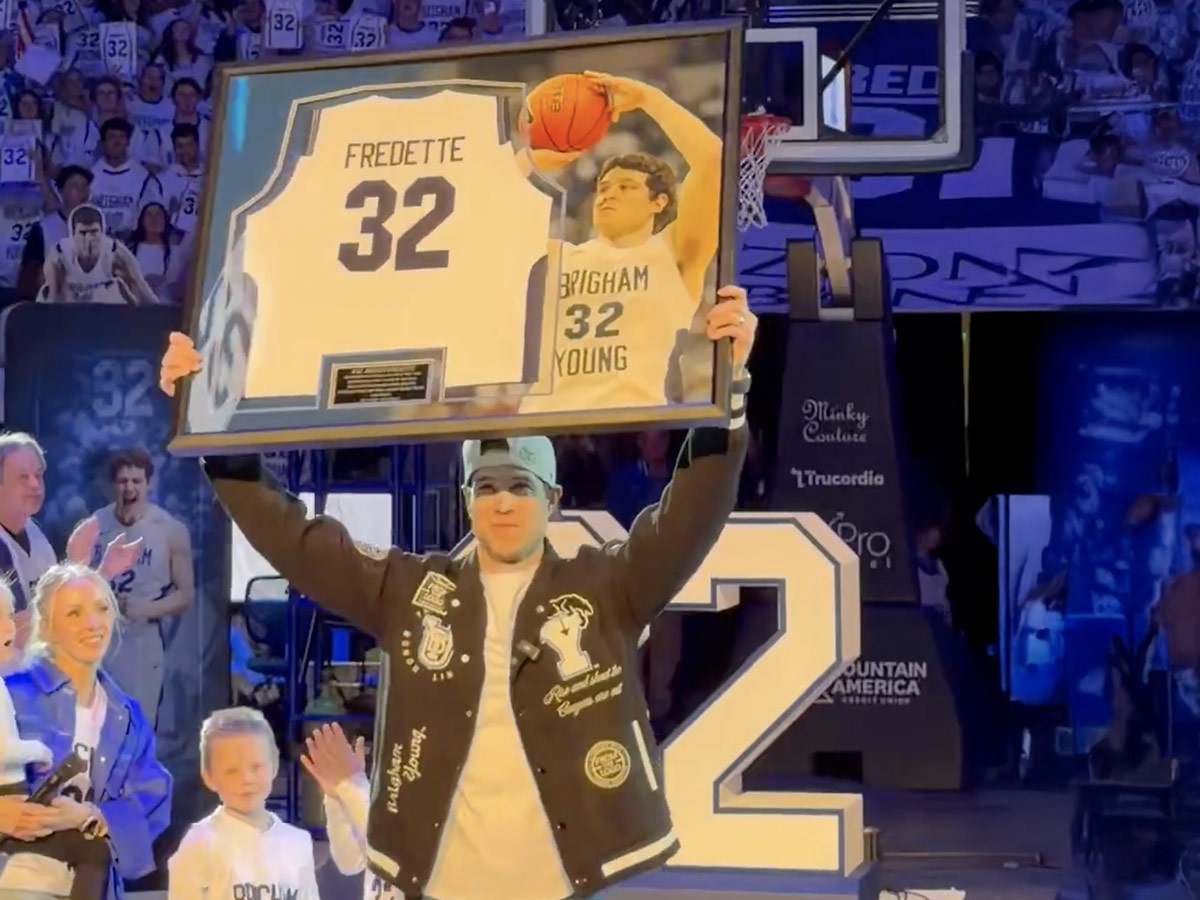
Fifteen years after his final game in a BYU uniform, the Cougars’ legend watched his iconic No. 32 jersey rise into the rafters of the Marriott Center during halftime of Saturday’s matchup against Colorado. For many, the ceremony was a celebration of one of the most electrifying careers in college basketball history. For Fredette, it was something more personal — a moment to reflect on how faith has shaped both his journey and his purpose.
Jimmer Fredette. Forever in the Marriott Center rafters. pic.twitter.com/yynxE4PJRC
— Jackson Payne (@jackson5payne) February 14, 2026
“I’ve had some of the greatest memories of my life, literally, right here inside of this court,” Fredette said during the ceremony. “It has been an absolute privilege to be able to play at Brigham Young University.”
The 2011 consensus National Player of the Year becomes just the fifth BYU men’s basketball player to have his jersey retired, joining program greats Danny Ainge, Kresimir Cosic, Mel Hutchins and Roland Minson. The honor carries strict requirements at BYU, making the distinction especially meaningful.
“It’s pretty wild. It’s hard to put into words, right?” Fredette told reporters afterward. “You see the few jerseys that are up there — it’s not easy to get your jersey retired at Brigham Young University with a lot of the requirements that they have. So it’s a special thing to be able to have that.”
But what moved him most wasn’t the banner or the applause. It was sharing the moment with his wife and three children — something he couldn’t have experienced earlier in his career.
“To be here and do this with my family now, right, with my kids, I’m glad (BYU) waited the 15 years, honestly,” he said. “Now I get to have all my three kids there. So to be able to have that experience with my family, I’ve been speechless, honestly.”
The sold-out arena, where fans found white replica Fredette jerseys draped across every seat, erupted into chants of “Jimmer! Jimmer! Jimmer!” as the banner rose. It was a scene that revived memories of “Jimmermania,” the national phenomenon sparked during his senior season when he averaged a program-record 28.9 points per game and led BYU to its first Sweet 16 in three decades.
BYU athletic director Brian Santiago captured the impact of that run in his tribute during the ceremony.
“You, almost single-handedly, captivated an entire country, an entire world of basketball,” Santiago said. “We’re so grateful that you left your blood, sweat and tears on this very floor, and you inspired dreams in all of us. We love you, and you’re part of our family forever.”
Yet for Fredette, the enduring connection to BYU goes far beyond basketball success. He spoke candidly about how representing the university — and by extension, his faith — has shaped his identity around the world.
“I know that my name, wherever I have gone in this world to play basketball, which has been far and wide, I am always known as ‘Jimmer from BYU.’ Always,” he said. “I love that, and I take that responsibility very seriously.”
That responsibility, he explained, is rooted in discipleship.
“I am so grateful to be able to have brought that with me, to be a disciple of Christ, to be someone who’s trying to bring people to Christ,” Fredette said. “That has been a huge mission (of mine) because of this university.”
Fredette’s comments resonated deeply with the faith-centered crowd. BYU president Shane Reese, former head coach Dave Rose, former athletic director Tom Holmoe and numerous church leaders — including four members of the Quorum of the Twelve Apostles — attended the ceremony, underscoring the spiritual dimension of the moment.
Fredette reflected on how BYU’s global fan base, tied closely to The Church of Jesus Christ of Latter-day Saints, amplified the reach of his career.
“This school is truly a worldwide school,” he said. “There’s BYU fans all over the country, all over the world, because of the Church. … It kind of just resonated with the rest of the country. So it was a really unique and special time.”
Even as he acknowledged his basketball achievements, Fredette emphasized that character and faith ultimately outlast athletic fame.
“Obviously, I love basketball,” he said. “I worked really hard at it to be able to get to where I am in this position. But that fades eventually, especially if you don’t treat people the right way.”
He added that his deepest hope is simply to reflect Christ in how he treats others.
“I try to be a good person and someone who’s kind to people,” Fredette said. “I hope that when people at least see me or talk to me or are around me, feel like I try to treat them the right way. … I think (faith) has been a huge part of it.”
As the ceremony concluded and the banner settled into its permanent place above the court, the moment seemed to crystallize what Fredette’s legacy has become. Yes, he is remembered for dazzling scoring runs and unforgettable games. But he is also remembered as a man who never separated his platform from his beliefs.
In an era when athletic success often defines identity, Fredette’s message at BYU offered a different perspective: that the greatest legacy is not points scored or banners raised, but lives influenced.
And as chants of his name echoed once more through the Marriott Center, the newly retired No. 32 stood not only as a symbol of basketball greatness — but of a career and calling he believes was meant to point beyond himself.
 Read Previous Post