
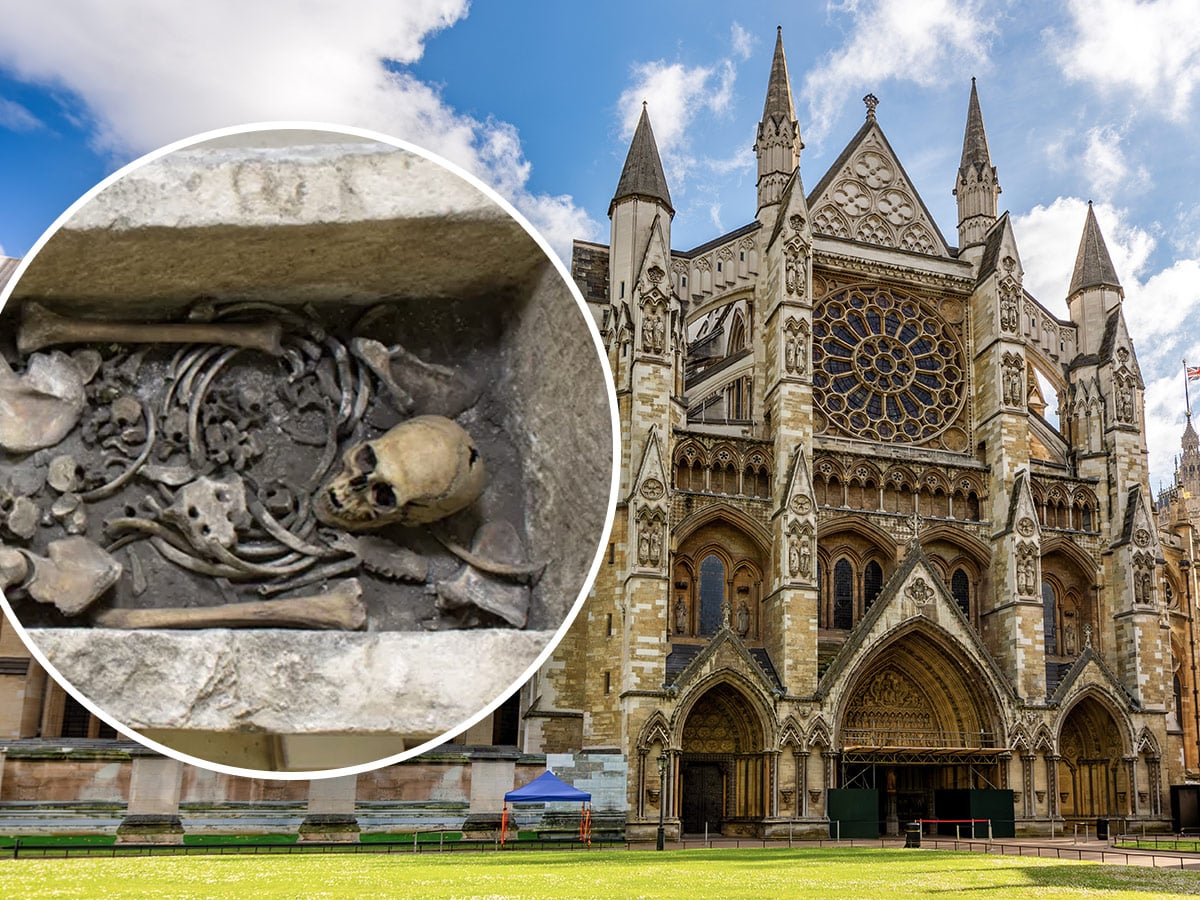
For more than 150 years, an unidentified skeleton buried at London’s historic Westminster Abbey has puzzled archaeologists. Now, a new discovery may finally reveal who was laid to rest inside an ancient stone coffin, and the answer could date back nearly 1,000 years.
The mystery began in 1869 when workers uncovered a skeleton inside a Roman limestone sarcophagus on the grounds of Westminster Abbey, one of England’s most famous religious landmarks.
The coffin bore an inscription identifying Valerius Amandinus, a wealthy Briton who lived during the fourth century. But researchers quickly realized something didn’t add up.
Carved into the lid was a distinctive early medieval Latin cross, suggesting the coffin had been reused centuries after its original owner was buried.
For generations, archaeologists struggled to explain who the mysterious occupant might have been.
Now, Warwick Rodwell, a consultant archaeologist at Westminster Abbey, believes he has narrowed the possibilities to two prominent Christian monks who lived during the 11th century.
According to research published in the Journal of the British Archaeological Association, the remains may belong to Aelfwig, a monk who died around 1020, or his successor, Wulnoth, who died in 1049.
Both men held important positions within the religious community associated with Westminster Abbey.
The breakthrough came after researchers examined evidence from a 2025 excavation of the Abbey’s vestry, conducted ahead of construction of the new King Charles III Sacristy, scheduled to open in 2027.
Radiocarbon dating placed the skeleton’s death between 987 and 1052 A.D., directly supporting the monks’ lifetimes.
“We do not know the date of birth of either,” Rodwell explained, according to SWNS.
“But either would fit equally well if we assume the Abbot was in his early twenties when the appointment was made and close to 50 when he died.”
Further examination revealed that the man was approximately 35 to 49 years old when he died and stood about 5 feet, 9 inches tall.
Researchers also discovered traces of white lime inside the sarcophagus, outlining where a wooden coffin had once rested before deteriorating over the centuries.
The elaborate burial suggests the individual held considerable religious or social importance. Although the Roman coffin was centuries old, its reuse may have been a deliberate act of honoring a respected Christian leader.
The discovery offers another fascinating glimpse into Westminster Abbey’s long religious history, which stretches back to the early medieval period.
While researchers have not definitively identified the skeleton, the new evidence brings them closer than ever to solving a mystery that has endured since the Victorian era. The discovery leaves the Abbey’s long-unsolved puzzle closer to a resolution than at any time before.
Today, visitors can see the ancient sarcophagus on display in Westminster Abbey’s Queen’s Diamond Jubilee Galleries, where a centuries-old burial continues to tell the story of England’s Christian past.
 Read Previous Post