

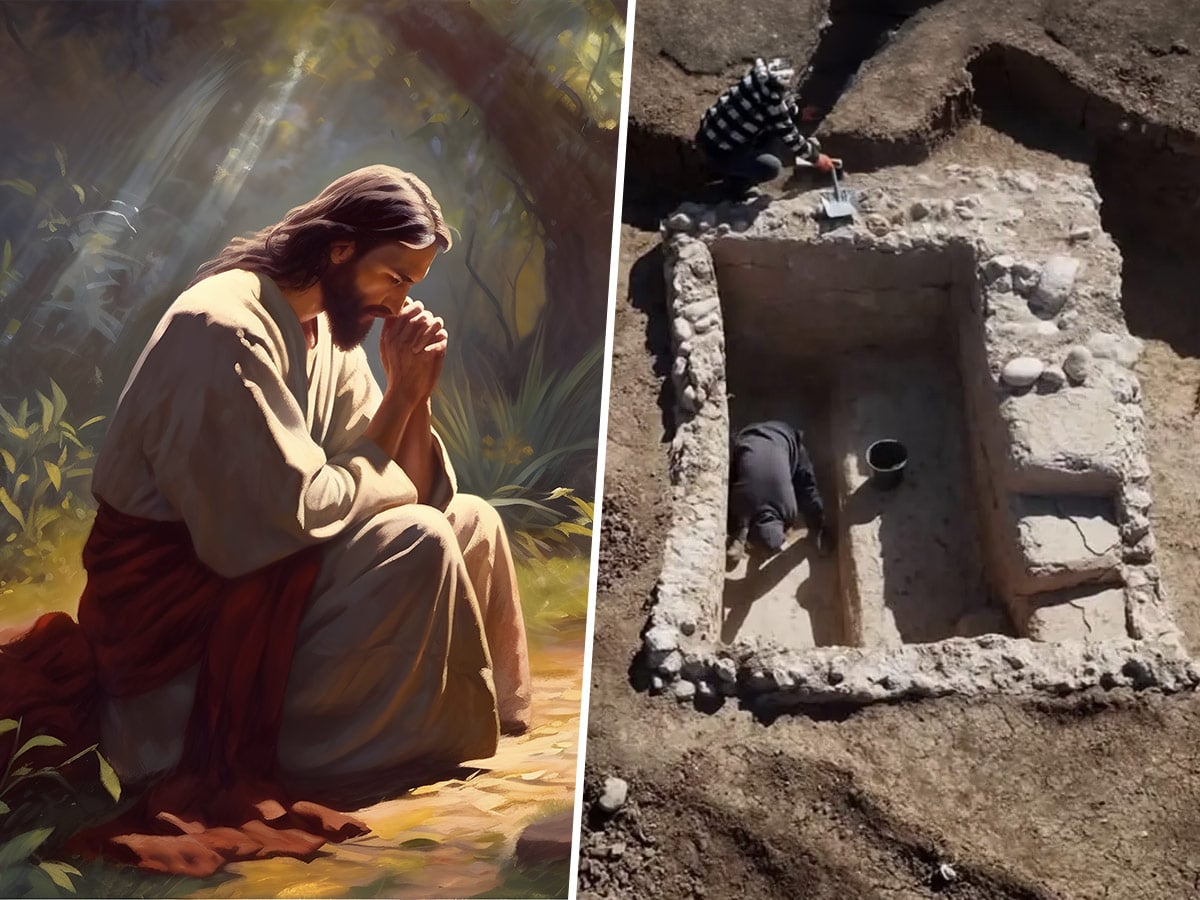
Archeologists from the Israel Antiquities Authority (IAA) announced the discovery of a 2,000-year-old ritual bath in the city of Kiryat Gat. Known as a mikveh, the bath dates to the Second Temple era of Israel’s history, during the time Jesus walked the earth. It was uncovered during salvage excavations. Archaeologists had the 25-ton bath lifted from the site by a crane and taken to the IAA’s National Treasures Department in Beit Guvrin. There it will remain safe during continued construction in the Carmei Gat neighborhood, with plans to return it to Carmei Gat in an open public space when construction has ceased. “”he operation was carried out with the aim of protecting the ancient structure from damage during the neighborhood’s development work. When construction is completed, the mikveh will be returned to the site, and integrated into an open public space that will stand at the heart of the new neighborhood,” said the IAA in a statement.
Such a massive undertaking required weeks of planning, with members of IAA’s Conservation Administration prepping the site for two weeks in order to be lifted. The bath had to be supported with metal beams underneath the structure to keep it from buckling while being lifted up. For transportation, the structure was covered with gauze and adhesives to protect it dfrom vibrations during transportation. The size of the bath itself made the 20-minute drive to Beit Guvrin a real challenge. The road was closed to traffic during the bath’s move, with escort vehicles in both the front and back. “Once you lift up a structure like this, there is no going back. If it falls apart, we’ve lost the mikveh. Therefore, every detail must be considered in advance,” said Eyal Kaho, who led the operation.
The discovery reveals evidence of a previously unknown Jewish settlement in the area. “The Jewish settlement we discovered here is the first and the only known one in this area. In the Judean Lowlands, many Jewish settlements from the Roman period are known, but in the seam between the Judean Lowlands and the northern Negev — no Jewish settlement was known until now,” said the IAA excavation directors, Elena Kogan-Zahavi, Maayan Margulis and Shira Lifshitz. Mikvehs were used for purification rituals. Stone measuring vessels were also found at the site, which were used because Jewish law declared they were not susceptible to impurity. While it is not mentioned in the Bible whether Jesus himself would have used such baths, it is possible that he wouldencountered similar ritual baths during His lifetime. The discovery offers a glimpse into the religious practices of Jewish communities during the Second Temple period, when ritual purity was an important part of daily life.
For Christians, the find provides another connection to the world of the New Testament. Although the Bible does not specifically mention Jesus using a mikveh, ritual washing was a familiar practice in Jewish society. Archaeological discoveries like this one help bring the historical setting of Jesus’ life into clearer focus, offering a tangible reminder of the people, traditions, and communities that existed in Israel 2,000 years ago.
 Read Previous Post