
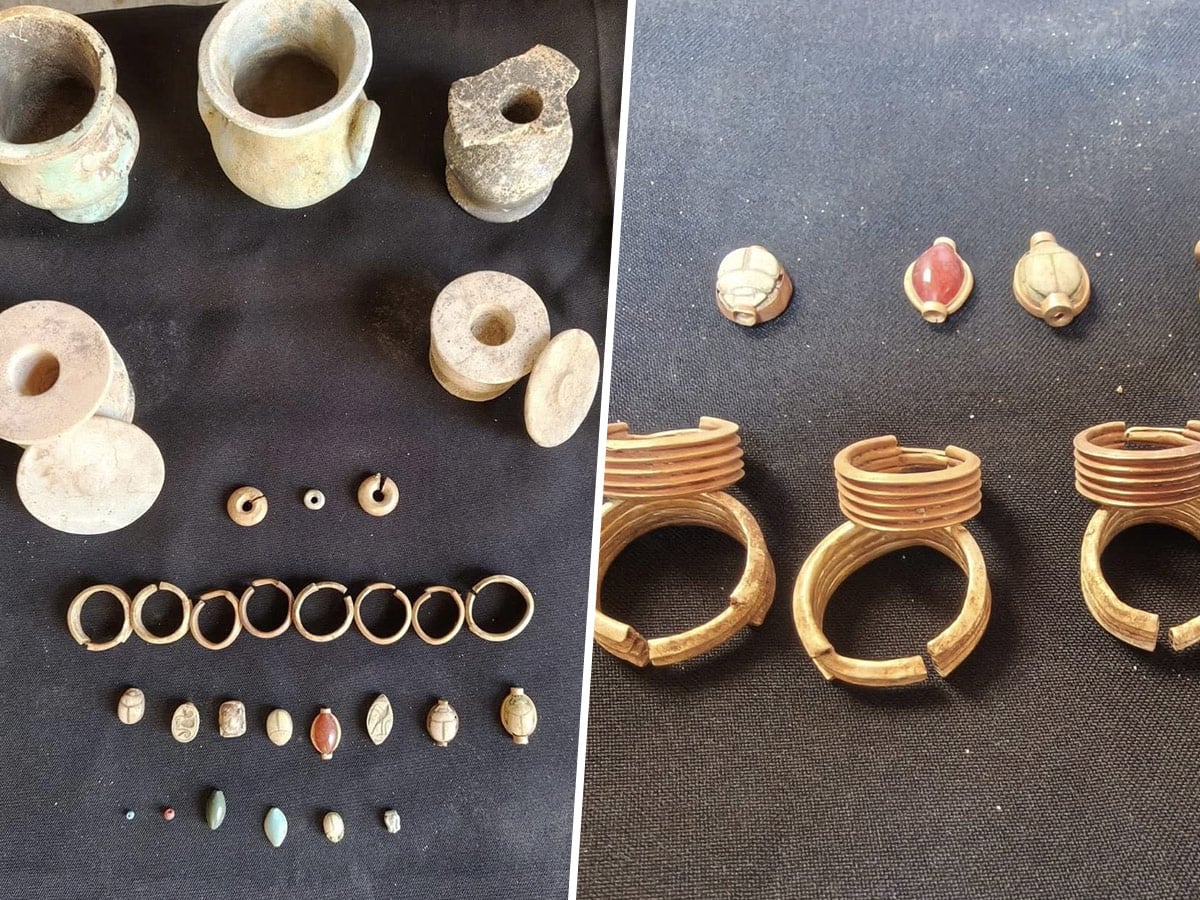
Archaeologists have uncovered a huge burial cache beneath an ancient city mentioned in the Bible. Egyptian scientists from the Supreme Council of Antiquities, led by Kotb Fawzy Kotb, Head of the Central Administration of Cairo and Giza Antiquities, were digging at the Banshi Cemetery, which is found in the ancient city of Heliopolis. The city is mentioned in the Bible, referred to as “On” in the books of Genesis, Jeremiah, and Ezekiel. The city was a primary religious center for the worship of Ra, the god of the sun. In Genesis, Joseph’s wife, Asenath, was the daughter of Potipherah, a priest of the city. The cemetery itself dates from the late Egyptian period into the Christian period.
The burial cache revealed a near-complete funerary set, which was found beneath a mud-brick burial that also had human remains, according to Dr. Hisham El-Leithy, Secretary-General of Egypt’s Supreme Council of Antiquities. The findings included five pairs of earrings believed to be made from gold, a copper mirror, alabaster kohl containers with ancient eye makeup, and amulets. One amulet was in the form of a duck at the Atef Crown. Archaeologists also uncovered two blue faience vessels, with one containing six ritual jars. Faience refers to a type of sintered-quartz ceramic that gave objects a bright luster and was often in shades of blue or green. Objects made with faience were considered to have magical properties.
Mohamed Abdel-Badie, Head of the Egyptian Antiquities Sector at Egypt’s Supreme Council of Antiquities, shared that prior to this find, excavations had uncovered two coffins and the remains of mud-brick and limestone funerary structures. One of the coffins might have belonged to a military figure, as indicated by the coffin’s red inscriptions and a coin dating to the Roman period. “Additional limestone blocks bearing hieroglyphic inscriptions were also uncovered, further enhancing the archaeological significance of the site and supporting efforts to better understand its chronological and cultural development,” he said.
“The newly discovered artefacts provide a clearer picture of the daily life and funerary practices of the area’s inhabitants throughout different historical eras,” said Sherif Fathy, Minister of Tourism and Antiquities. The site is unique in that it maintains a historic record of periods of occupation and use of the land, offering insight to archaeologists about the changing habits and culture of ancient Egypt, particularly as it came under Roman rule and experienced the beginning of Christianity. Archaeologists continue to excavate the area in the hopes of further insight into ancient history.
 Read Previous Post