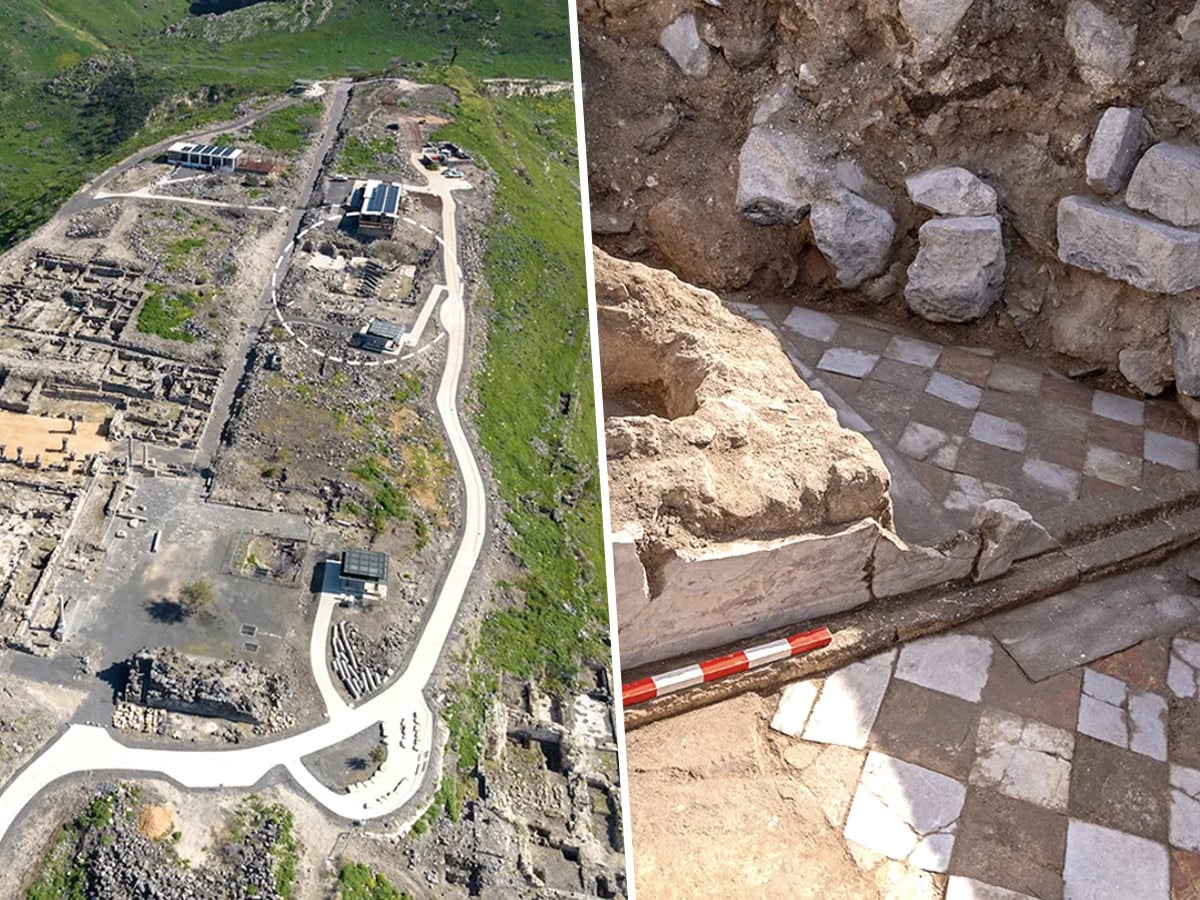
Archaeologists have uncovered a 1,400-year-old artifact near the Sea of Galilee that is being declared as having “no known parallel.” The discovery was made in the ancient city of Hippos, which had once been the only Christian city around the Sea of Galilee. The city of Hippos had at least seven churches in the Byzantine period from the fifth and sixth century AD. The artifact, described as a marble block, was located in the “photisterion,” or a hall of baptism in one of the churches, the Cathedral of Hippos. The Cathedral contains two halls, one used for baptism of adults, the other for infants and children. The artifact was found in the hall for infants and children. “We shouldn’t be surprised by the coexistence of at least seven Byzantine churches – Hippos was the sole Christian proper city around the lake, with a dominant Christian community. The city’s bishop not only controlled the city and his cathedral, but also all the city’s territory,” excavation director Michael Eisenberg told Haaretz. “We should imagine people arriving from farms and villages in the territory, asking to be baptized in the magnificent cathedral, in a city overlooking all Jesus’ ministry, just below.”
The marble slab contains three identical cups etched into its top which may indicate “a stage of the early Christian baptismal rite that has until now gone unrecorded,” according to experts. None of the experts during the dig could describe having found anything similar to the object, increasing its mystery. “At first glance, the block resembles a mensa ponderaria (public measuring table). However, the cavities are identical and have no outlets at their bottoms,” researchers wrote. “Baptismal rites involved threefold immersions, and anointing was often made before and after the immersion,” they added. The site is already unusual because of its two baptismal halls, with the site for adults appearing to have been built first and the space for infants and children being built later. The cathedral complex itself appears to measure around 1,600 square meters. The artifacts owe their preservation to a partial collapse of the building. “The collapse buried the marble and bronze artifacts beneath the rubble, preserving them until their recent discovery. After extensive examination and comparison, the scholars concluded that no known parallels to the artifact exist,” stated officials. Eisenberg told Fox News that at first glance, the artifact seemed like “nothing special at first glance.” “Realizing that it is a one-of-a-kind artifact that may fill unknown regional and perhaps wider lacunae in one of the most ancient and sacred Christian ceremonies was a complete surprise.”
 Read Previous Post