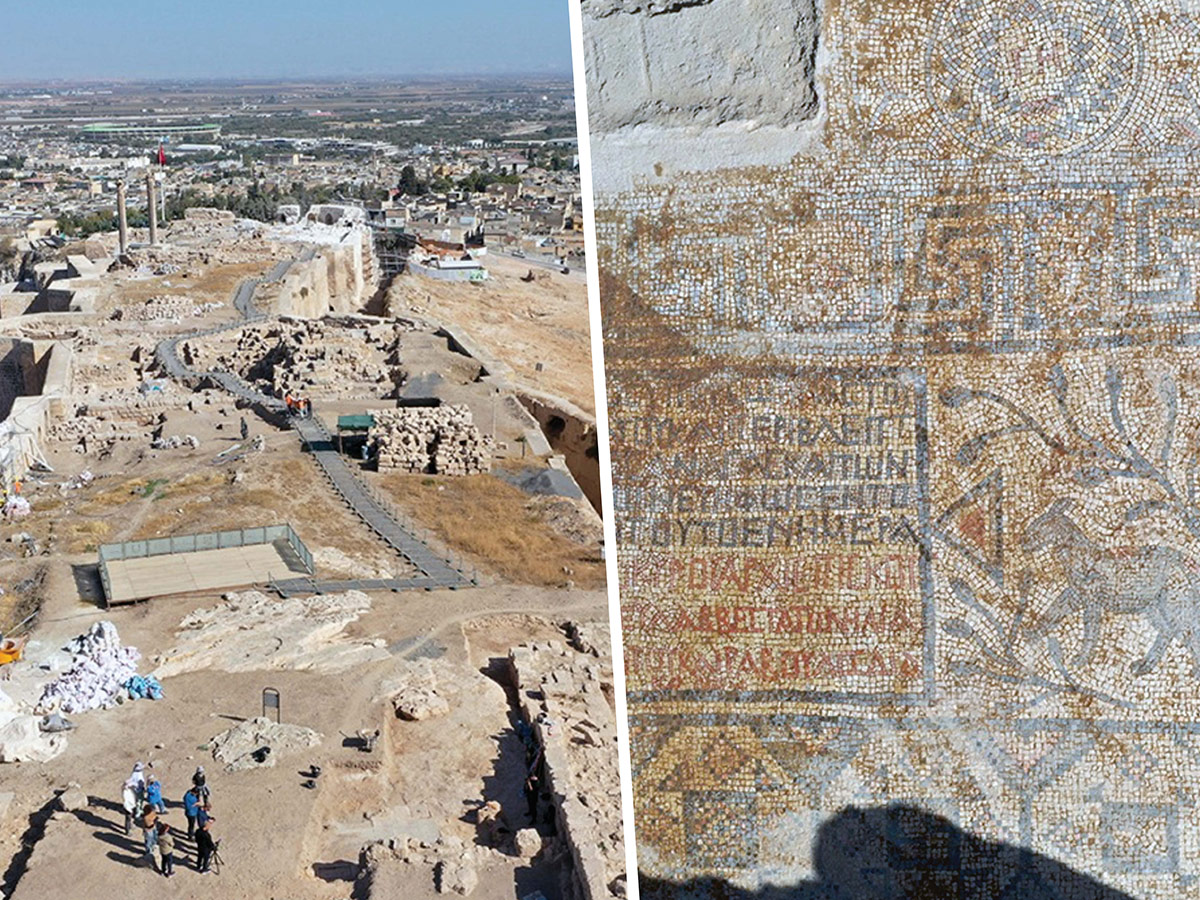
Archaeologists announced the discovery of a 1,500-year-old mosaic floor tile in Urfa Castle, which is located in what is officially known as Şanlıurfa, Turkey. The mosaic dates to around the 5th century, between 490 and 495 AD. It is made up of black, white, and red stones in various shapes, including animal figures, geometric shapes, as well as botanical imagery. The mosaic also includes a Greek inscription that follows a Byzantine epigraphic formula framework. The inscription shows that the floor was commissioned “for the protection of Count Anakas and his family.”
The excavation was part of the “Legacy for the Future” project by the Culture and Tourism Ministry, with Professor Gulriz Kozbe of Batman University serving as Excavation Director. The current excavation is the last one scheduled this year, with more planned next year. “Initial examinations indicate the mosaic likely served as the floor of either a church, a chapel, or what we call a martyrium, a shrine to a martyr,” Kozbe told Anadolu Agency (AA). The inscription also mentions Bishop Kyros of the region, Chief Priest Elias, and Rabulus, who held the rank of deacon. “This helps us identify who oversaw the area’s religious duties at the time,” said Kozbe.
The are was formerly known as Edessa in ancient Mesopotamia, which has drawn in pilgrims of both Islam and Christianity. Traditionally it has been looked at as the birthplace of Abraham, an important patriarch to both faiths as well as the Jewish faith. Some archaeologists believe the city of Ur in Iraq is a more likely candidate for the site of Abraham’s origin, but Urfa’s significance remains. Kozbe theorized the mosaic might have served as part of a church or shrine to martyrs. The excavation uncovered four medallion-shaped mosaics representing air, water, earth and fire. “These medallions likely appear at all four corners of the floor. This provides important clues about religious practices, but we will need to conduct more literature research and evaluate parallels to reach more definitive conclusions,” said Kozbe.
There also appear to be religious personnel buried at the site, with
Religious personnel who served in the structure appear to have been buried at the site, with several tombs being uncovered. “Similar to the rock-cut tombs we found both on the southern slope of the castle and in the Kizilkoyun necropolis, we see evidence of burials here. We have found at least three, but work on these will continue next year,” said Kozbe. “This is an important discovery. Similar floor examples exist in the southeast and other regions of Anatolia. These names provide important clues about who held religious responsibility in this area and about the religious practices and rituals of the elite class, including a local commander.”
Sanliurfa Governor Hasan Sildak lauded the discovery’s significance. “This is very important for tourism and for restoring and promoting an important cultural link. Currently, the mosaic is under protection,” said Sildak. “These excellent works will continue and will make important contributions to Sanliurfa’s tourism, and we consider them very important developments for illuminating Sanliurfa’s history and human history from a scientific perspective.”
 Read Previous Post