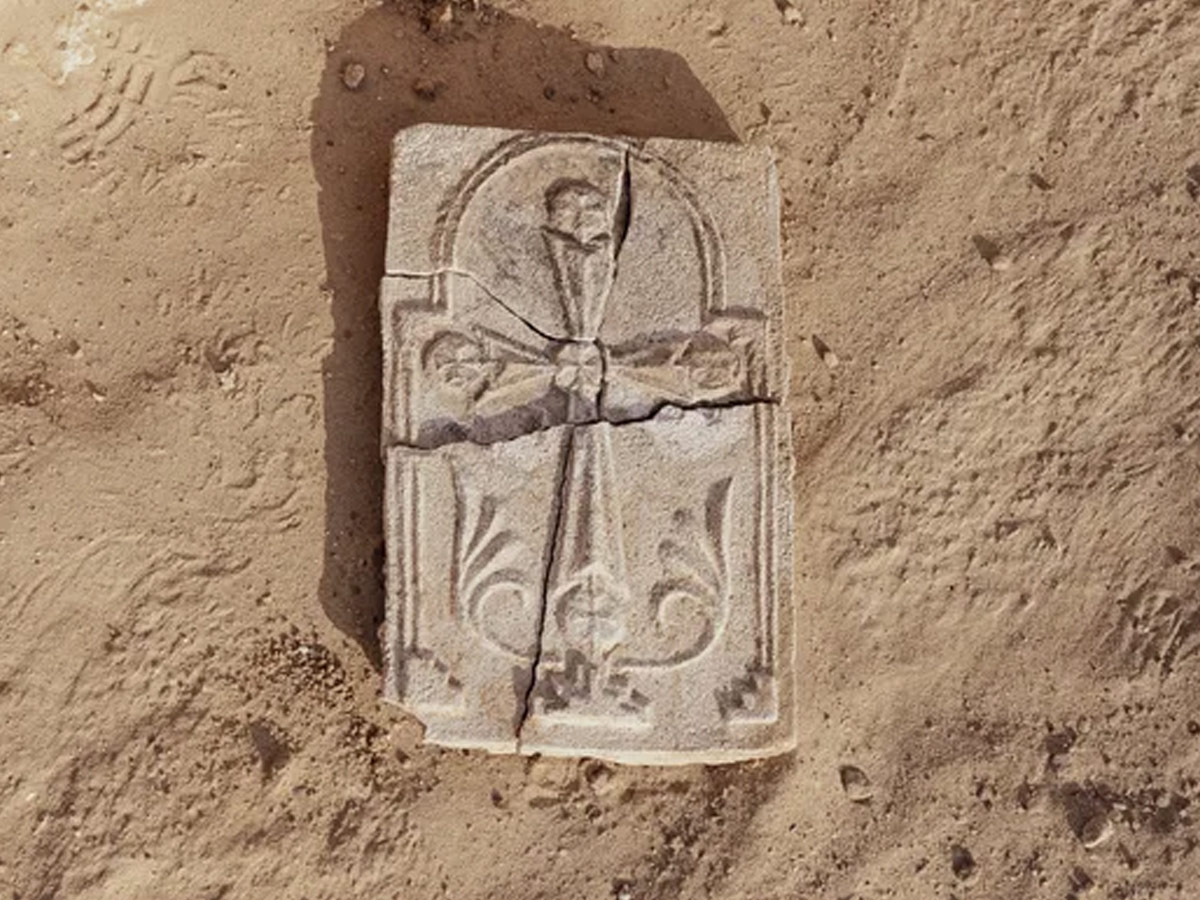
Archaeologists have discovered a 1,400-year-old plaster cross that could offer some interesting clues about how Christianity spread through the ancient world. The cross was discovered on Sir Bani Yas Island and features a stepped pyramid with foliage around its base. The image may represent Golgotha, which is the site the Bible states Jesus was crucified. The cross’s decorative appearance shares similarities with the Church of the East. Archaeologists had previously uncovered evidence of a Christian community in the region in the 1990s after excavating a church and a monastery, but the cross, which was found in one of the courtyard houses near the monastery, reveals the community might have been bigger than previously believed.
“The discovery of the ancient plaster cross on Sir Bani Yas Island is powerful new evidence of the centuries-old values of peaceful coexistence and cultural openness that have shaped the history of the United Arab Emirates,” Mohamed Khalifa Al Mubarak, the chairman of Abu Dhabi’s culture and tourism department, said in a statement. The cross could have been hung up on a wall to be used for contemplation by the monks. Archaeologists believe the monastery could have housed as many as 40 monks.
Christianity’s spread in the Arabian Peninsula reached its height between the 4th and 6th centuries, declining after the spread of Islam in the region. The site, however, reveals a peaceful co-existence between the Christian community and its Muslim neighbors. Al Mubarak said the find shows the areas commitment to peace for centuries. “The discovery of this ancient Christian cross on Sir Bani Yas Island is a powerful testament to the UAE’s profound and enduring values of coexistence and cultural openness. It stirs within us a deep sense of pride and honor and reminds us that peaceful coexistence is not a modern construct but a principle woven into the very fabric of our region’s history,” he said. “Every element of the cross incorporates regional motifs. It tells us that Christianity in this region was not only present but also flourished, adapting visually to its local context. We had settlements of Christians that were not just existing but were clearly flourishing,” lead archaeologist Maria Gajewska told The National. “This was just lying there telling us, yes, they were Christian.” Hager Al Menhali, an Emirati archaeologist with the Department of Culture and Tourism, said that the cross might bear a fingerprint, which could have belonged to its owner. The site appears to have been abandoned around the 8th century, with archaeologists hoping further digs could give more clues.
 Read Previous Post