
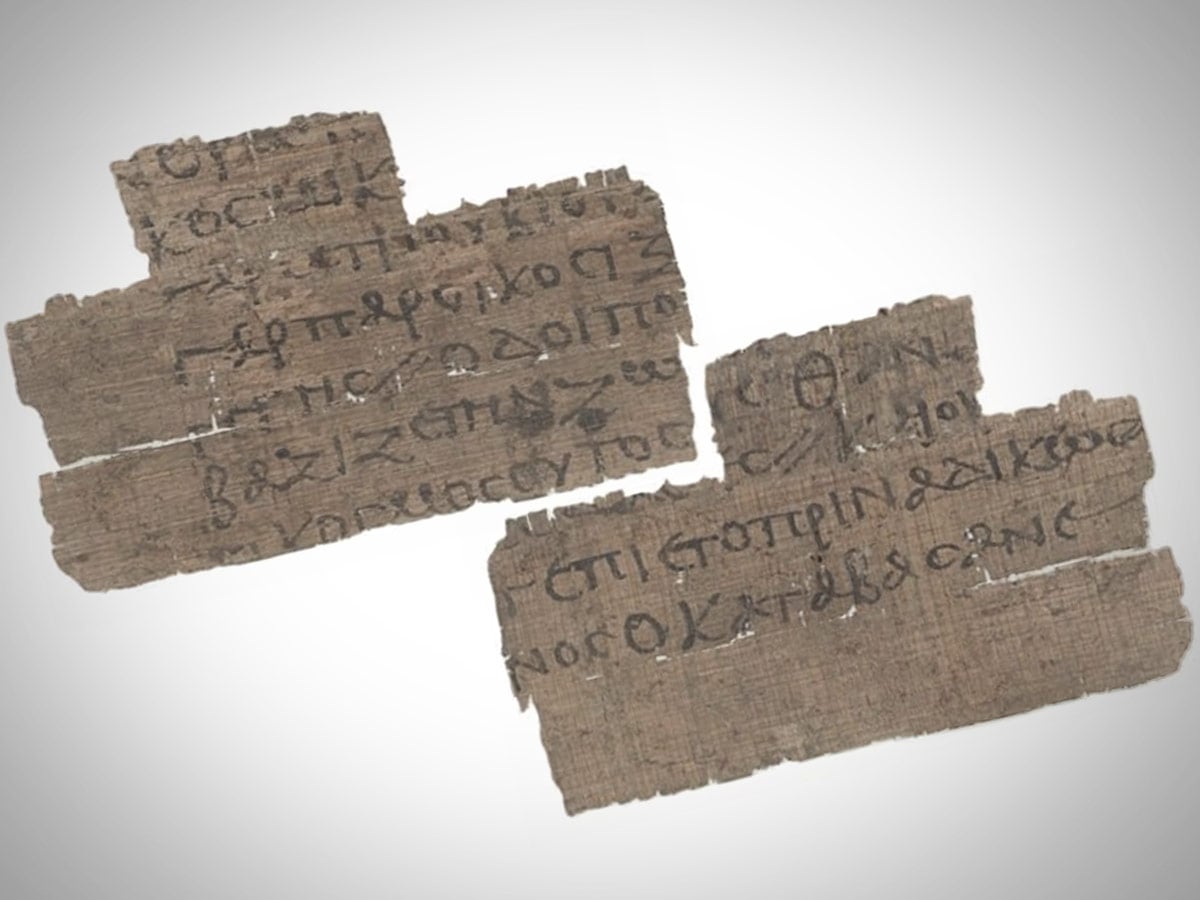
A tiny piece of ancient papyrus is raising big questions about what early Christians believed happened between Jesus’ crucifixion and His resurrection.
Researchers have deciphered portions of a roughly 1,600-year-old Greek manuscript that may contain a previously unknown account of Jesus descending into the realm of the dead before rising again.
The fragment, measuring just 2 by 3 inches, was discovered among a collection of unpublished papyri at the Austrian National Library in Vienna. Despite its small size and damaged condition, researchers believe it could be part of a lost Christian sermon, hymn or other religious text.
According to the Daily Mail, researchers Marianna Thoma and Amphilochios Papathomas of the University of Athens examined the fragment and identified language that appears to describe someone descending into Hades, the ancient Greek term for the realm of the dead, before ascending again.
“The sense of the passage is probably that only Jesus and no one else went into Hades and returned through his resurrection,” the researchers wrote, according to the Daily Mail’s translation of their findings.
One portion of the text may read, “…alone (?) he who descended (into Hades) ascended again (?)…”
The findings, published in the academic journal Tyche, suggest the fragment could reflect an early Christian understanding of Christ’s victory over death.
The idea that Jesus descended to the dead before His resurrection is not new. It has been part of Christian teaching for centuries and is often referred to as the “Harrowing of Hell.”
Several Bible passages have been connected to this belief. In 1 Peter 3:18-20, Scripture describes Christ proclaiming to the spirits in prison. Ephesians 4:8-10 speaks of Christ descending before ascending, while Revelation 1:18 records the risen Jesus declaring that He holds the keys of death and Hades.
However, researchers caution that much of the ancient manuscript is missing, making it difficult to determine exactly what the original text said or how it was used.
The discovery does not provide a new eyewitness account of the resurrection or change what the Bible teaches. Instead, it may offer another glimpse into how Christians expressed their beliefs about Jesus’ death and resurrection more than 1,500 years ago.
For believers today, the fragment points back to a central message of Christianity: Jesus’ resurrection represents His victory over sin and death, a promise of hope that has endured for centuries.
 Read Previous Post