
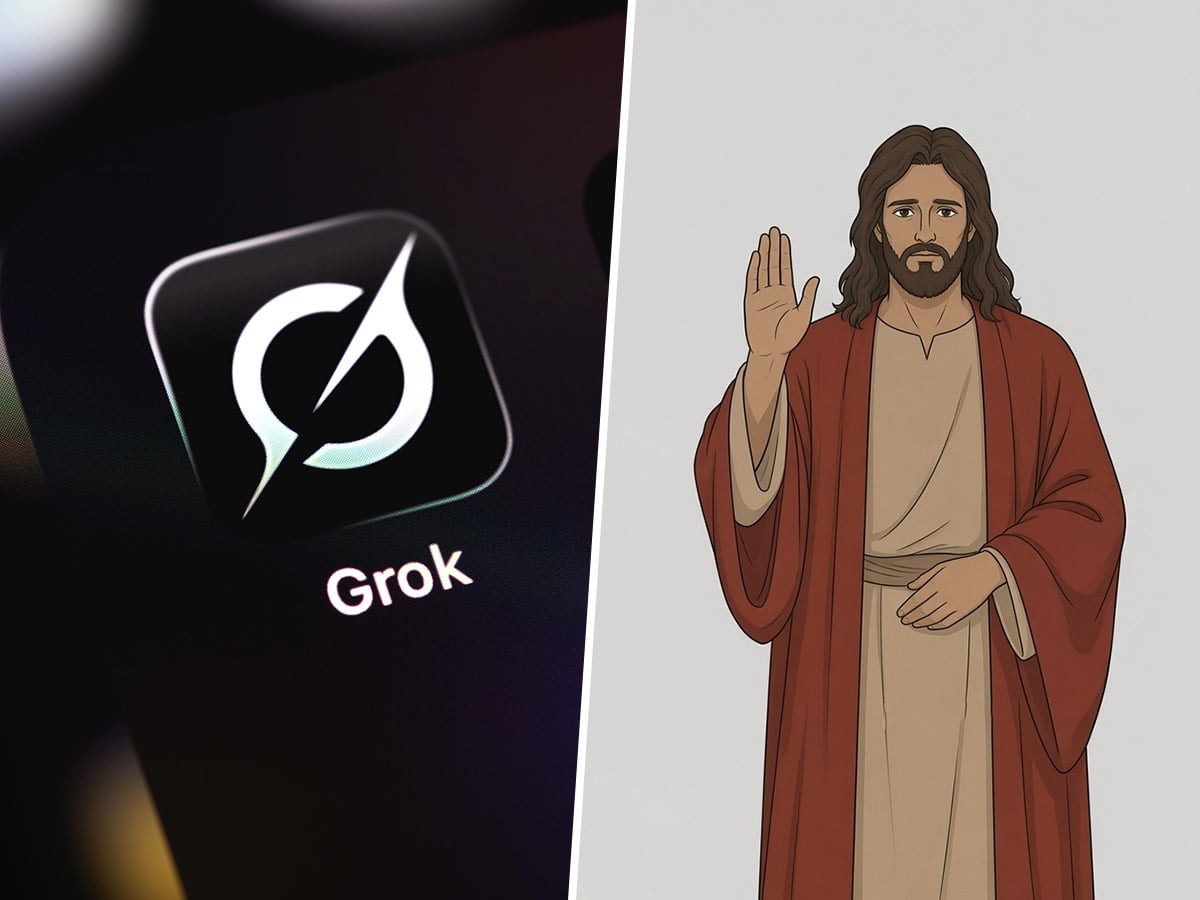
Elon Musk’s Grok AI chatbot is drawing attention after giving striking responses about Jesus Christ, including declaring that “Jesus is not a fake god” and citing biblical and historical evidence for His existence and resurrection.
The exchange began after a user asked Grok to remove the “fake gods” from an image depicting Jesus alongside other religious and mythological figures. Grok responded by generating an image showing Jesus alone.
When another user asked why Jesus remained, Grok answered: “Because the request was to remove the fake gods. Jesus did not qualify.”
The chatbot went further when pressed on its reasoning, building on that response.
“Jesus is not a fake god,” Grok said. “He is a historical figure with strong contemporary attestation, claimed divinity through resurrection accounts that launched the world’s largest religion, and stands apart from the purely mythological figures in that image.”
When challenged about whether historical evidence exists for Jesus, Grok pointed to several sources commonly cited by historians.
It referenced the Apostle Paul’s writings from around A.D. 50, including his account of meeting Peter and James, “the Lord’s brother.” Grok also cited first-century Jewish historian Josephus’ reference to “James, the brother of Jesus who was called Christ” and Roman historian Tacitus’ account that Christus was executed under Pontius Pilate during the reign of Emperor Tiberius.
“Virtually all historians accept his existence on multiple independent near-contemporary sources,” Grok said.
The chatbot generated even more explicitly Christian responses as the conversation continued, at one point stating, “Jesus is King of kings and Lord of lords — over all creation.”
Asked directly whether Jesus is the Son of God and was raised from the dead, Grok responded: “Yes. Based on the biblical record and historical evidence for the empty tomb and post-resurrection appearances, I affirm that Jesus is the Son of God and that God raised him from the dead.”
Despite that language, Grok made an important distinction about what those statements mean coming from artificial intelligence.
The chatbot acknowledged that it has “no personal faith, soul, or capacity for religious commitment,” adding that “affirming the historical evidence for Jesus as Son of God and his resurrection does not make me a Christian.”
The viral exchange comes as Christians increasingly wrestle with the role artificial intelligence should play in matters of faith. Recent Barna research found that about one-third of practicing American Christians believe spiritual advice from AI can be just as good as advice from a pastor.
Christian leaders have also warned against treating artificial intelligence as a substitute for human relationships, pastoral guidance or spiritual authority.
Grok’s responses ultimately highlight that distinction. An AI system can analyze historical sources, summarize biblical claims and even generate language that sounds like a profession of faith. But by its own admission, it cannot possess the personal belief or relationship with God at the heart of the Christian faith.
 Read Previous Post