
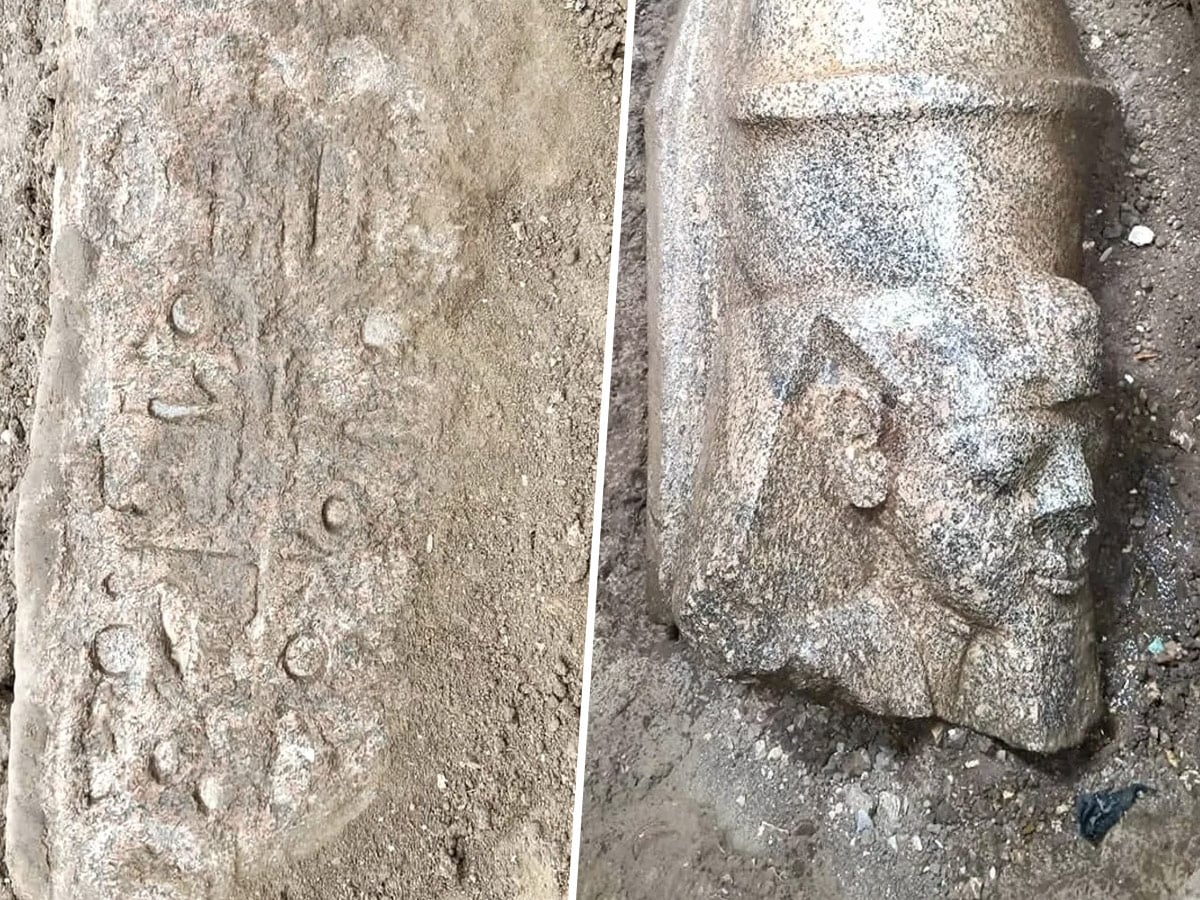
What began as an ordinary day tending cucumbers turned into an extraordinary archaeological discovery when an Egyptian farmer stumbled upon an ancient stone that led researchers to two massive statues believed to depict a pharaoh with possible ties to the biblical story of Moses.
The discovery was made in the village of Behbeit El-Hagar, where the farmer noticed an inscribed stone while working inside a cucumber greenhouse. Rather than ignoring the unusual find, he contacted local archaeological authorities, setting off an excavation that revealed the remains of two colossal statues.
According to Egypt’s Ministry of Tourism and Antiquities, one statue has been identified as King Ramses II, while the second is also believed to represent the powerful ancient Egyptian ruler.
“One of the statues has been identified as depicting King Ramses II, while the other is also believed to represent the same pharaoh,” the ministry said in a translated statement.
The discovery is particularly interesting to biblical history enthusiasts because some scholars believe Ramses II may have been the pharaoh who confronted Moses in the Book of Exodus.
The Bible describes how Moses, following God’s command, repeatedly approached Egypt’s ruler and demanded that he release the Israelites from slavery.
“Let my people go, so that they may worship me,” Moses declared on God’s behalf in Exodus 9:1.
When Pharaoh refused, Egypt experienced a series of devastating plagues before the Israelites were finally allowed to leave.
However, the Bible never identifies the pharaoh by name, and historians continue to debate which Egyptian ruler, if any, corresponds to the biblical account. The newly discovered statues do not establish a direct connection between Ramses II and Moses.
Still, the artifacts offer a fascinating glimpse into the world of ancient Egypt.
The first statue features a massive head measuring more than five feet tall. Ramses II is depicted wearing Egypt’s double crown, a symbol representing the unification of Upper and Lower Egypt.
An inscription on the statue’s back pillar includes one of the king’s royal names. Archaeologists estimate that the complete statue, including its base, may have originally stood nearly 28 feet tall.
The second statue measures almost eight feet long and is missing its legs and base. Its head was also recovered, with remarkably preserved facial features.
“These features closely resemble those of the first statue,” officials explained.
Researchers also uncovered a pink granite block containing hieroglyphic inscriptions that include several of Ramses II’s royal titles.
Ramses II ruled during Egypt’s New Kingdom period and became one of the country’s most powerful pharaohs. Born around 1303 B.C., he reigned for approximately 66 years before he died in 1213 B.C.
Archaeologists are continuing to investigate the site, hoping to learn more about the statues and the area’s ancient history.
While the discovery does not prove the biblical account of the Exodus, it adds another piece to the historical picture of ancient Egypt, a civilization that plays a central role in some of the Bible’s most memorable stories.
And remarkably, it all began with a farmer tending his cucumbers.
 Read Previous Post