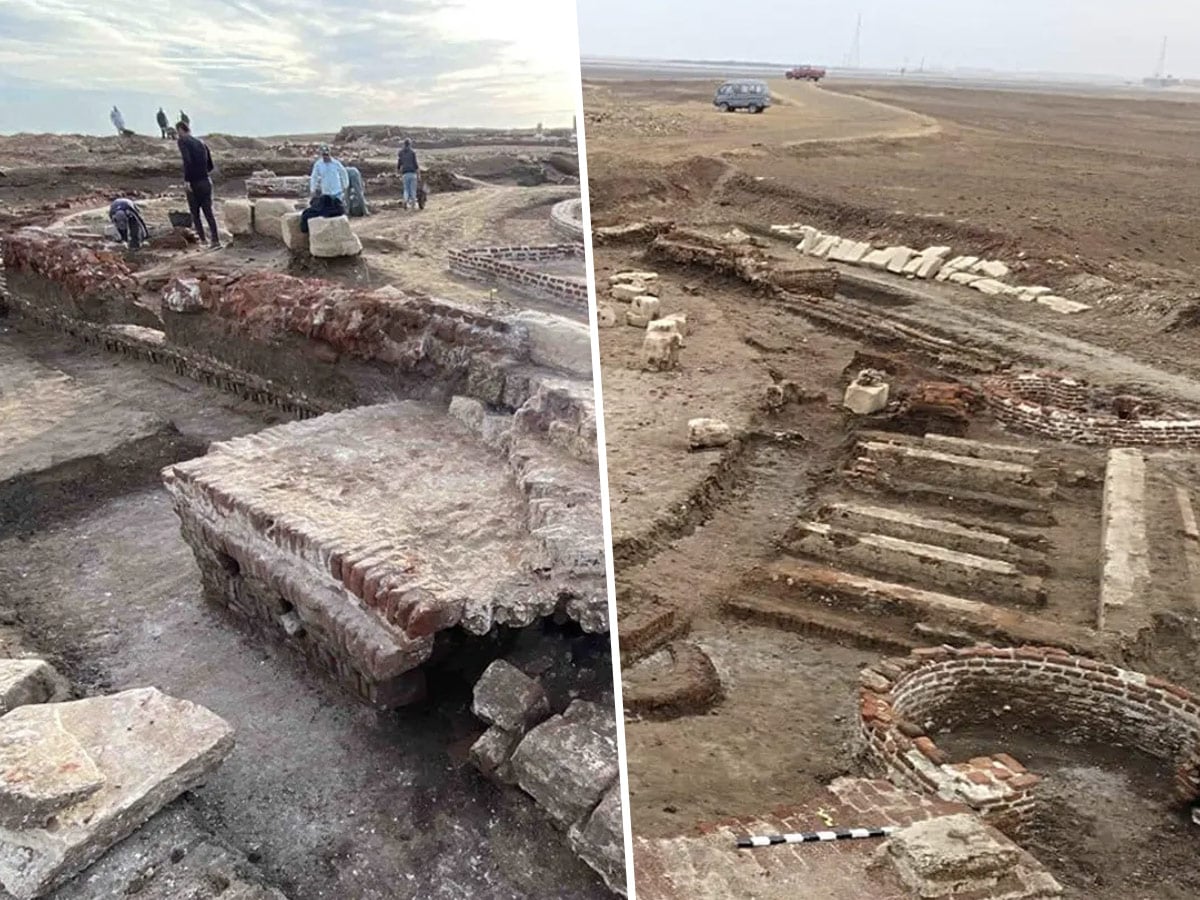
Archaeologists have uncovered an ancient religious complex in Egypt which appears to give insight into pagan practices in the region. The discovery was made in the ancient city of Pelusium, now the city of Tell el-Farama in North Sinai. The complex includes a round basin or poll that is about 115 feet in diameter. The pool is believed to have been used in water rituals. Such rituals would have been dedicated to the deity Pelusius, a river god whose name is derived from the Greek word “pelos,” which means “mud.”
The basin is encircled by a system of water channels designed for drainage. Archaeologists theorize that a square platform at the basin could have once held a statue of the Pelusius. Water in the basin would have been gathered from the Nile. The site appears to have been used from about the 2nd century BC to the 6th century AD. The site also has biblical connections, with some experts connecting the city of Pelusium to the “city of Sin” as mentioned in the book of Ezekiel. The city is portrayed as a stronghold of Egypt, with God saying in Ezekiel 30:15, “I will pour out my wrath on Sin, the stronghold of Egypt.” Early Greek translations of the Bible also connected Pelusium with Sin.
When excavations first began on the site in 2019, archaeologists believed they were uncovering some sort of senate building due to the circular red-brick structure they first discovered. Since that time, however, multiple entrances to the site have been uncovered as well as the site’s unique hydraulic system for the basin, hinting at an entirely different use. The area includes Hellenistic and Roman influences. After confirmation from Jean-Yves Carrez-Maratray of Sorbonne University, archaeologists with Egypt’s Supreme Council of Antiquities (SCA) concluded the site’s religious nature rather than civic. “Ongoing excavation and comparative studies have completely changed our understanding. We now know this was a sacred water installation used in religious rituals, not a political structure,” Hesham Hussein, undersecretary for Lower Egypt and Sinai archaeology, said in a statement.
Due to the Egyptian, Hellenistic, and Roman influences in the region, there is a mishmash of gods that have been uncovered in the city, including a temple dedicated to the god Zeus that was renovated under the rule of Roman Emperor Hadrian in the second century C.E. The god Pelusius was a later addition to the city’s religious landscape and has been linked to the Egyptian gods Isiris and Osiris according to the ancient Greek biographer Plutarch. If the basin was indeed dedicated specifically to Pelusius, it would be, according to Egyptologist Steve Harvey, “a stunning example of the presence of a temple for a deity previously attested only in Classical sources.”
 Read Previous Post