
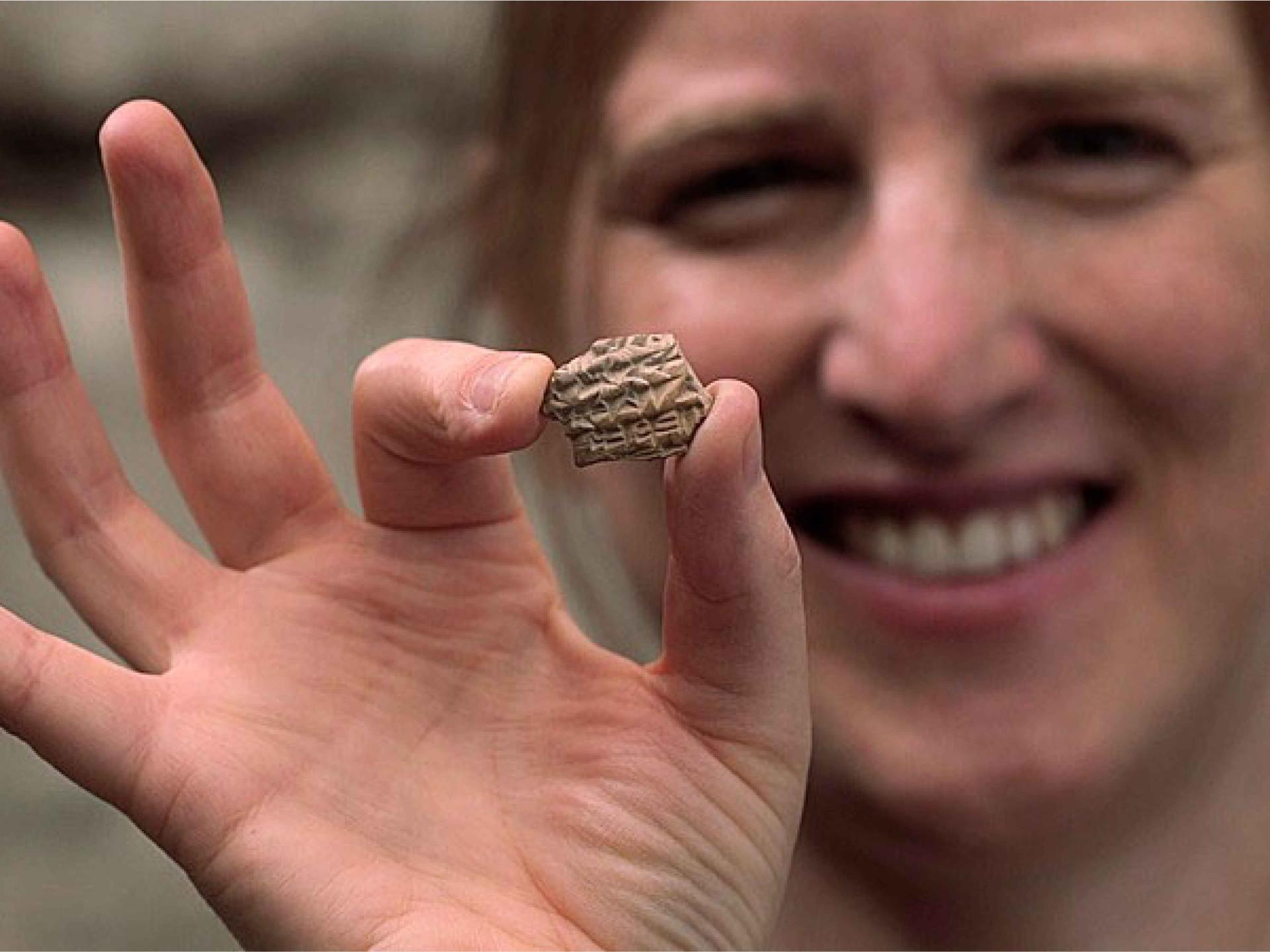
An ancient Assyrian inscription discovered near the Temple Mount in Jerusalem is giving some big clues about communications between the ancient kings of Judah and the outside world. The inscription was found on a 2,700-year-old pottery fragment inscribed in Akkadian cuneiform. The shard measures about 2.5 centimeters and was deciphered by Dr. Filip Vukosavović, Dr. Anat Cohen-Weinberger together, and Dr. Peter Zilberg of Bar-Ilan University.
The inscription appears to be a complaint from the Assyrian empire about a delayed payment that was expected from the kingdom of Judah. The complaint specifies the first of the month of Av as a due date for the late payment. Such a complaint could be traced potentially back to 2 Kings 18 and 19 during the days of King Hezekiah. Those passages mention 300 talents of silver and 30 talents of gold King Hezekiah was required to pay to King Sennacherib of Assyria. The dating of the shard places it around the time of Hezekiah’s reign or his son Manasseh, or possibly King Josiah, who came after them. Dr. Zilberg noted the significance of the text. “This small fragment may be short, but it tells a very important story. It’s part of an inscribed royal sealing, a clay bulla used to close or authenticate letters and official documents. What we’re seeing here is direct evidence of official communication between Assyria and Judah.” Such a communication is the first of its kind discovered.
Dr. Anat Cohen-Weinberger of the Israel Antiquities Authority (IAA) which excavated the site shared how archaeologists were able to determine the shard came from foreign lands and not Jerusalem. “Petrographic analysis of the fragment’s composition revealed that the material from which it was made is entirely different from the local raw materials typically used to produce pottery, bullae, and clay documents in Jerusalem and the southern Levant. Moreover, the bulla’s mineral composition generally corresponds to the geology of the Tigris Basin region, where the central cities of the Assyrian kingdom were located, such as Nineveh, Ashur, or Nimrud/Kalḫu.”
Although the shard can’t be directly linked to a specific passage of the Bible, it still serves as a key clue to the historicity of the kingdom of Judah. “While we cannot determine the background for this demand, whether it stemmed from a mere technical delay or was taken as a deliberate step with political significance, the very existence of such an official appeal would seemingly attest to a certain point of friction between Judah and the imperial government,” said researchers.
 Read Previous Post