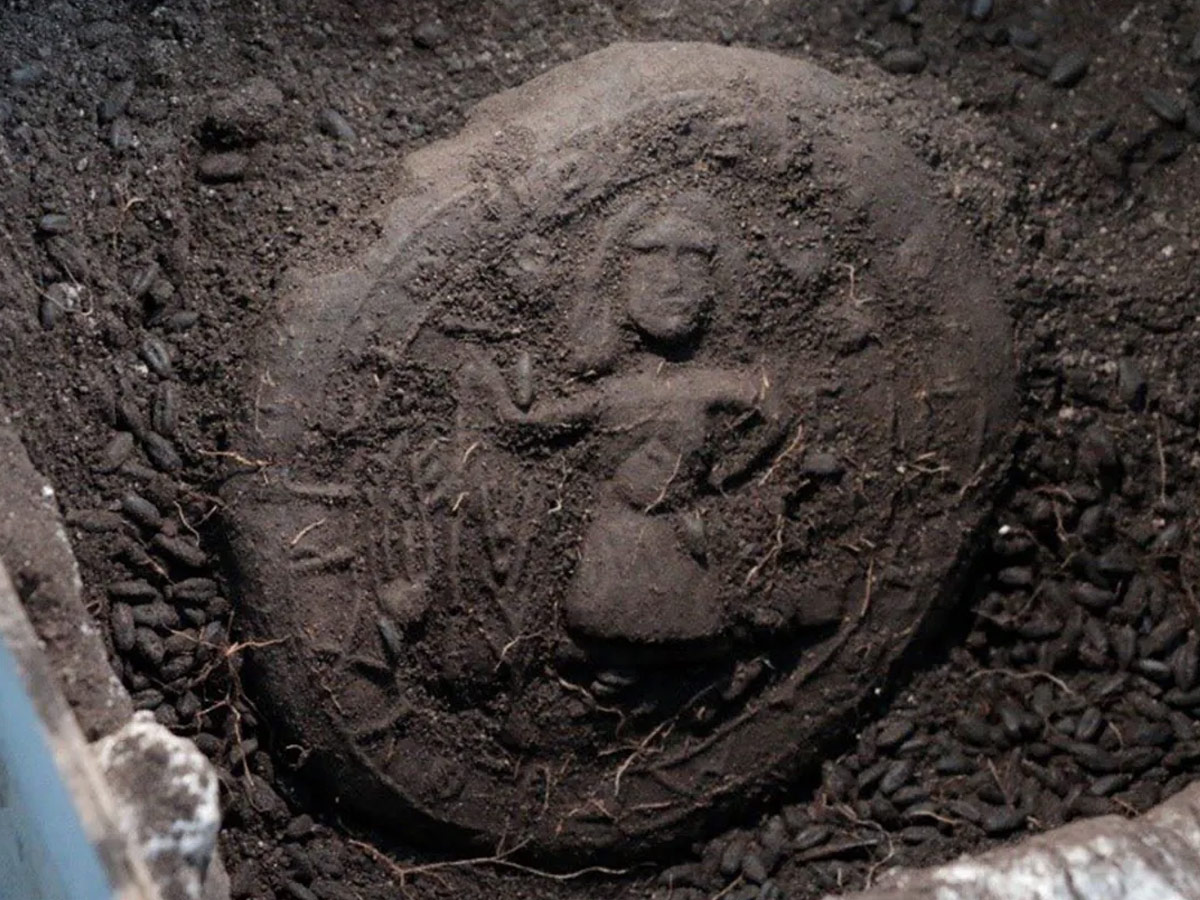
Archaeologists in Turkey announced the remarkable discovery of an ancient 1,200-year-old burnt loaf of bread that bears the image of Christ. Archaeologists were excavating Topraktepe, known throughout the ancient world as Eirenopolis when they uncovered five charcoal-colored circles, according to a Facebook post by the Karaman Governorship. An analysis revealed the circles were carbonized communion bread dating from the seventh or eighth century. The breads bore designs on them, with four of the breads being designed with what is known as the Maltese Cross printing. The Maltese Cross has its own significance in Medieval culture, with debate as to whether or not its origins are from Malta or Amalfi, a region in Italy.
A fifth loaf had an image of Christ, though the post noted that Jesus was not shown in what is known as Jesus the Savior (known as the Pantokrator) but rather as Jesus the Sower or Jesus the Farmer. “It is estimated that this iconography points to the symbolic importance of fertility and labor in the religious understanding of the period,” the post noted. The loaf also includes a transcription that states, “With gratitude to the Blessed Jesus.” Archaeologists believe the bread is an example of Communion bread used in liturgy during the early Church period.
The Christian community in Turkey would have been a strong one during the 7th to 8th centuries, as many Christians fled from persecution to the area of Asia Minor. There the Christian faith thrived during the Byzantine Empire. The rise of Islam, however, would eventually drive out the once-thriving Christian community and reduce it to a mere memory in the region. The number of Christians in Turkey has declined sharply since the First World War, with Christians making up about 20-25% of the population of Turkey in 1914 to a mere 0.4% to 0.2% today. This makes the find especially important as it gives a greater glimpse of Turkey’s lost Christian past. In addition to their rarity, the finds are also very well-preserved, adding to the greatness of the find. Officials noted the conditions of the bread and remarked on the find’s preservation. “The fact that the bread has become carbonated and reached our present day shows the extraordinary conditions of conservation,” the post concluded. “The finds are among the best preserved specimens found in Anatolia to date.”
 Read Previous Post