It may not have just been the earth that shook the day Jesus died — the heavens, it seems, were bearing witness too.
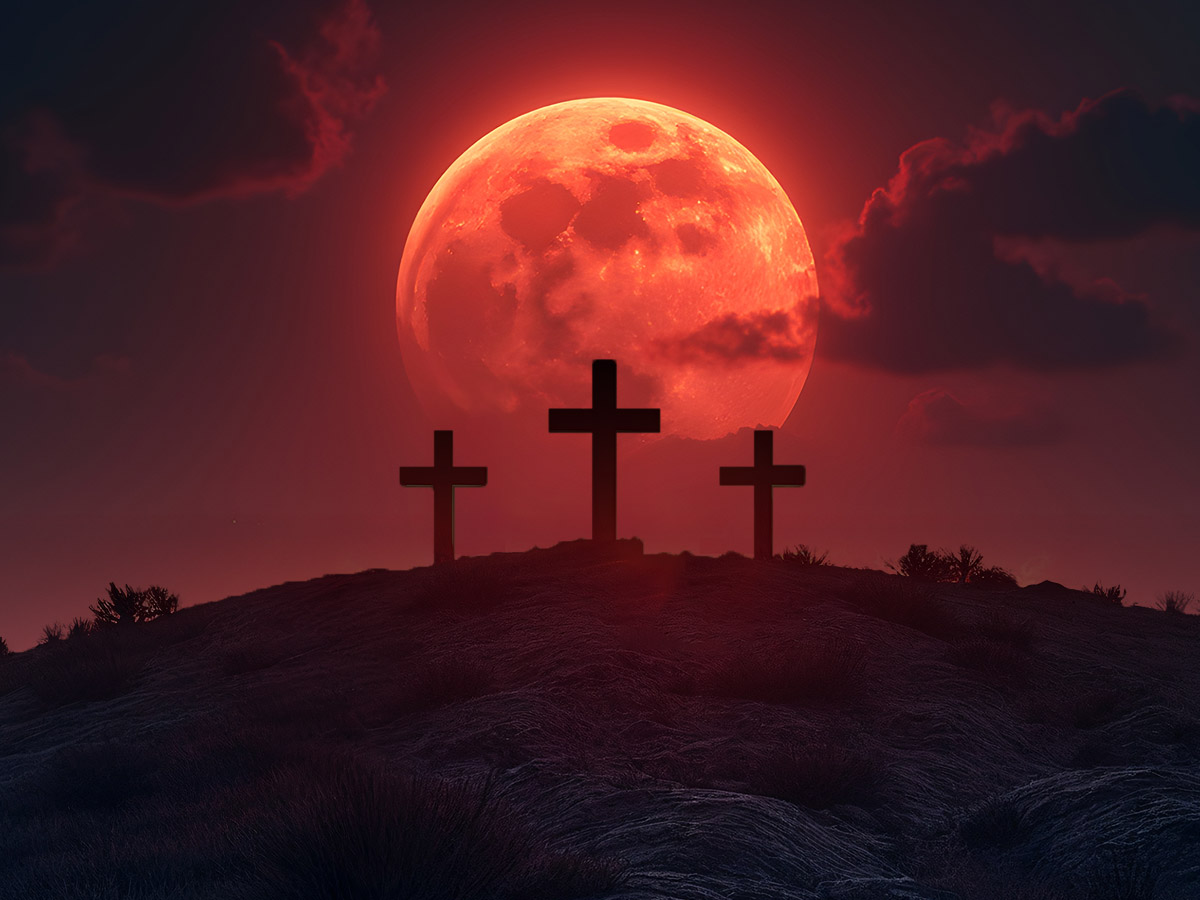
A recent revelation from NASA is stirring faith and fascination among Christians and scientists alike. It suggests that a lunar eclipse—often described as the moon turning to blood—occurred over Jerusalem on Friday, April 3, 33 AD, a date many biblical scholars already believe to be the day of Jesus Christ’s crucifixion.
According to the Gospel of Matthew, “From noon until three in the afternoon, darkness came over all the land” (Matthew 27:45). Now, centuries later, modern astronomical data may give that verse a striking scientific parallel.
Using sky-tracking software and historical models, NASA confirmed that a partial lunar eclipse—when the moon turns a deep red hue—was indeed visible in Jerusalem on that date, shortly after sunset.
Originally proposed by Oxford University researchers Colin Humphreys and W. Graeme Waddington, the theory is once again gaining attention, especially on social media platforms like TikTok in the lead-up to Good Friday.
“Christian texts mention that the moon turned to blood after Jesus’s crucifixion — potentially referring to a lunar eclipse,” NASA noted, further validating the researchers’ claims.
The imagery lines up eerily well with Acts 2:20, where Peter, quoting the prophet Joel, declares, “The sun will be turned to darkness and the moon to blood before the coming of the great and glorious day of the Lord.”
These ancient prophecies have long been interpreted as signs of apocalyptic times or symbolic warnings. But Humphreys and Waddington suggest that the dramatic descriptions may actually be firsthand accounts of a real and rare cosmic event.
Supporting evidence even comes from ancient Christian writings outside the Bible. In the Report of Pilate, a New Testament apocryphal text, it is written:
“At His crucifixion, the sun was darkened; the stars appeared, and in all the world, people lighted lamps from the sixth hour till evening; the moon appeared like blood.”
For those who believe, the convergence of scripture, science, and history offers profound affirmation. The celestial alignment — darkness at midday followed by a blood-red moon — seems to match the Gospel timeline in a way that’s both reverent and remarkable.
“This is not only a powerful connection between faith and science,” one Christian astrophysicist commented, “but a reminder that all creation testifies to God’s story — even the stars and the moon.”
Interestingly, the timing of Easter is itself based on astronomical cycles. Easter Sunday is celebrated the first Sunday after the full moon that follows the spring equinox — a system designed to keep it in sync with Passover, the Jewish festival during which Jesus was crucified. So even today, the moon continues to play a role in telling the story of the resurrection.
As Christians commemorate Good Friday, remembering Christ’s suffering and sacrifice, this cosmic revelation offers a humbling reflection: that maybe, just maybe, the heavens truly declared His glory — even in the hour of His death.
In a world where science and faith often seem at odds, moments like these remind us they may not be so far apart after all.
 Read Previous Post