"A Calling from Beyond the Stars"
Bush is to God-talk what Clinton was to policy-talk and Michael Phelps is to swimming. He's the master, the best. Though he occasionally stumbles, for the most part, there is no one better at discussing faith in a way that is both inspiring and non-threatening. In sheer number of words, he actually spoke about faith less in his acceptance speech than Kerry did in his. But when he did, it was powerful. Instead of saying directly that we have divine mandate to fight for freedom in the world, he said "we have a calling from beyond the stars to stand for freedom."
In talking about the mothers of soldiers who died, he said, "And I have met with parents and wives and husbands who have received a folded flag, and said a final goodbye to a soldier they loved. I am awed that so many have used those meetings to say that I am in their prayers to offer encouragement to me."
And how brilliant was this story about an Iraqi man who had been tortured by Saddam Hussein? "During our emotional visit one of the Iraqi men used his new prosthetic hand to slowly write out, in Arabic, a prayer for God to bless America," he said. Bush certainly can't be accused of promoting American religious triumphalism: It's about Muslims calling on Allah to bless America!
Oh, and Did We Mention God Must Be Thanked for Giving Us George W. Bush?
However, it must be remembered that Bush was, in effect, the author not only of his own words but all the words uttered by the major speakers. They all were written or edited by campaign central command. So while Bush's rhetoric was subtle and inspiring, he signed off on speech after speech that heavy-handedly implied he was put in office at this moment by God Almighty.
"He is one of those men God and fate somehow lead to the fore in times of challenge," said George Pataki.
"I thank God that on September 11th, we had a president who didn't wring his hands and wonder what America had done wrong to deserve this attack," he added.
"I thank God we had a president who understood that America was attacked, not for what we had done wrong, but for what we did right," he added again, in case you didn't get the message.
This echoed lines from Rudy Giuliani's speech:
"Spontaneously, I grabbed the arm of then Police Commissioner Bernard Kerik and said to Bernie, 'Thank God George Bush is our President.' And I say it again tonight: Thank God George Bush is our President."
The Silent Scream of the Platform
The Republican platform, p. 92: "We support a human life amendment to the Constitution." That means the official position of the party is banning pretty much all abortions, not just partial birth. And yet in the speech Bush merely said he would work to value "the unborn child." His refusal to actually speak about one of the most important positions of the Republicsan Party platform struck me as not exhibiting the forthrightness and moral clarity about which he spoke in other contexts.
Faith-Based Unilateralism
I was surprised Bush had only one line about the faith-based initiative. That seemed like a missed opportunity since his approach to that issue is actually quite similar to the approach he took to Iraq, showing hte same sense of toughness and swagger. He met with resistance from the cumbersome legislative branch, so he went around them and enacted his policies through executive order.
Of course, one could argue it showed the same flaws in his style as well. Critics say that he actually could have had a bipartisan agreement in Congress on the faith-based intiative--there was strong support–-but he preferred scoring political points to building a broad consensus. (Even the guy who actually ran his program said Bush opted for going alone over bipartisanship: "I could cite a half-dozen examples, but, on the so-called faith bill, they basically rejected any idea that the president's best political interests-not to mention the best policy for the country-could be served by letting centrist Senate Democrats in on the issue."). Bush has, in fact, accomplished a great deal through unilateral action but did so in a way that didn't build a bipartisan political consensus that was within his grasp.
Mary Cheney Missing Again?
Was Mary Cheney, the vice president' lesbian daughter, missing again from the final family celebration on the podium after Bush's speech? I'm eager to hear the explanation but at first blush this continues to be appalling. Even the most conservative of religious conservatives say that it's the duty of the parent to give unconditional love to their child.
What possible explanation is there here that doesn't make the Cheneys look like ghoulish parents? I suppose we should wait for more information; perhaps she had an appendicitis attack and was immobile. More likely, either they discouraged her from appearing or she voluntarily exiled herself, not wanting to embarrass her dad, at which point dad should have said, "I love you. You belong up here with me."
As I wrote earlier, perhaps Mary said she couldn't wound her partner by going up there without her. If that was the case, the compassionate thing for the Cheneys to do would be take away the awkwardness by having the podium scene without spouses. They would have produced a slightly less cheery photo up but made a powerful statement about love, pride and family.
And this has nothing to do with one's position on gay marriage. Having Mary Cheney up there would have in no way contradicted either Dick Cheney or George W. Bush's policies on gay marriage. Bush should be asked about this, too. Powerful evidence was offered that, on a personal level, Bush is a compassionate man. So why didn't he go to Cheney and say: "Hey, don't sweat it Dick. Mary is part of our family. Don't worry about the politics"?
And for the Rebuttal, Cardinal Egan
George Pataki: "Senator Kerry says, 'America should go to war not when it wants to go to war but when it has to go to war.' Well, Senator: the fire fighters and cops who ran into those burning towers and died on September 11th didn't want to go to war, they were heroes in a war they didn't even know existed."
New York's Cardinal Egan, selected by the Bush campaign to deliver the benediction Thursday night: "Make us, Lord, a people of wisdom and understanding who resort to conflict only when all hope of peace is lost."
Ann Coulter? Meet Ron Silver
Overheard: Conservative author Ann Coulter to actor Ron Silver, who spoke at the convention.
Coulter: "Your speech was spectacular! Spectacular!"
Silver: "So, please remember when you hear me on West Wing, those are Aaron Sorkin's words, not mine. I'm an actor."
Woodrow W. Bush
As I stood on the floor of the hall last night, I was thinking this could have been a speech delivered by Woodrow Wilson, the liberal Democratic president who led America in World War I. Bush mentioned the poor more than Kerry had and was more idealistic than Kerry was in his foreign policy aspirations. "The wisest use of American strength is to advance freedom," he said. Of course, it was the Republicans who argued at the time that such romanticism had no place in foreign policy and that the main goal of military strength should be defend America, not advance freedom.
Mary Cheney's Absence
I gather that after Dick Cheney’s speech, Mary Cheney, the vice president’s gay daughter, did not go up on the platform with the rest of the family--her sister, her sister's husband, and their kids.
This strikes me as potentially a huge and poignant story. Perhaps the Cheneys told her she couldn’t come up, but I think that’s extremely unlikely. I’m guessing that Mary Cheney faced an excruciating decision. If she went up without her partner it would be a huge insult to her partner. If she went up with her partner, it might hurt or complicate life for her father.
Dick Cheney could have avoided putting Mary in such an awkward position by not having any family members up after the speech, but then that wouldn't have been as good a photo op. Did he end up humiliating his daughter in order to get a better image?
Is That a Cross on the Podium?
Is there a cross subtly embedded in the speakers' lectern at the Republican convention? When liberal talk radio host Ellen Rattner first starting complaining about this I thought she must be hallucinating. Then I looked at the picture on the front page of the New York Times yesterday. Sure enough, the light-grained wood makes a clear cross on the speakers podium. "It is a cross. It's an embedded cross," Rattner said. "You can't miss it." She said she didn't notice it until a friend of hers who was raised evangelical pointed it out. She suspects, therefore, that it was one of those symbols designed to be missed by all except evangelicals.

The problem, of course, is that any two lines intersecting form a cross, so if you look for them, you can find crosses many places.
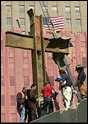 A very popular 9/11 icon is a photo taken of two World Trade Center steel girders mangled into the shape of a a perfect cross. Christian merchandizers sell images of this by the thousands. So I suppose if Christians believe that is a genuine spiritual sign, it's harder for them to say the podium is just a coincidence.
"How Can We Shoot Liberals?"
The campaign set up a Grand Old Marketplace stocked with Republican paraphernalia stores. Convention brochures described it as the place for "Official Convention Souvenier Shopping."
I have to say, the Republican button peddlers had a much better and funnier variety than those at the Democratic Convention, which just offered stodgy Kerry-Edwards buttons.
But I was also amazed at how mean some of them were. Among the buttons I picked up the mini-mall there were:
"Beauty and the Beast" featuring a picture of Laura Bush and Hillary Clinton.
"If They Take Our Guns How Can We Shoot Liberals?"
"The Good, the Bad, and the Ugly" with photos of Bush, Kerry and Hillary.
"Hollywood Acts...Like They're Un-American."
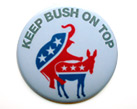
Right near the "Christians for Bush" button was one that made me do a double take. It appears to be an elephant mounting the backside of a donkey. "Keep Bush on Top." Surely this isn't what I think it is.
Well, here it is so you can decide for yourself:
The Righteous Rule
By the way, the most common religion buttons were:
"Christians for Bush" (No buttons for other religions)
"When the righteous rule, the people rejoice. Prov. 29:2" (Photo of Bush, head bowed)
"One Man, One Woman. Just as God Intended. Bush Cheney 2004"
Zell Miller's Faith
Several hours before watching Zell Miller's keynote speech I went to a screening of a movie called "George W. Bush: Faith in the White House." It is going to be sent to most churches in America. The narrative in a nutshell: Bush was raised in a religious home (but not too religious because that would ruin the story), became a louse and a drunk, found faith, became a strong leader and a better person. They had actors re-enacting key spiritual moment like Bush's conversation with Billy Graham--and, in great detail, the time he rebuffed a campaign worker who wanted to have an affair with him.
A few hours later Zell Miller yelled these words:
"I can identify with someone who has lived that line in 'Amazing Grace,' 'Was blind, but now I see,' and I like the fact that he's the same man on Saturday night that he is on Sunday morning."
It tracked nicely the official line on Bush's faith journey, which stresses not just his faith but his transformation. I was somewhat surprised that the film placed so much emphasis on his marital fidelity. With that fresh in my brain, I heard Miller's "Sunday morning" line as a subtle attempt to remind people of Clinton.
His other interesting religion line: "I am moved by the…fact that he is unashamed of his belief that God is not indifferent to America."
This was interesting on two levels. It appealed to the sense among many evangelicals that they are mocked and persecuted for their beliefs. George W. Bush has been unafraid to let it all hang out.
This line also delves into the controversial debate over whether God is specifically on America's side. In truth, most presidents have claimed God for the home team. Kerry took a different approach in his speech by quoting Lincoln: "I don't want to claim that God is on our side. 'As Abraham Lincoln told us, I want to pray humbly that we are on God's side.'"
Cheney on Evil
Cheney had only one faith-related line but it was an important one. He said Bush exhibited "a moral seriousness that calls evil by its name." I've long believed that, politically speaking, Bush's faith has strong appeal even among many people who aren't religious--because it seems to drive him toward moral clarity.
Billy Graham Shouldn't Get All the Credit
Campaign biographies, official and unofficial, say it was Bush's walk on the beach with Billy Graham that set him on the right path. Stephen Mansfield's book, "The Faith of George W. Bush," says that was an important moment but that actually it was another preacher who had already done the heavier spiritual lifting. Arthur Blessitt was an evangelist who achieved renown by carrying a 12-foot cross on long walks around the world. In April of 1982 he was in Midland, Texas. He got a call from Jim Sale, an oilman and Baptist Church member asking him to visit George W. Bush at Midland's Holiday Inn. According to Mansfield's account, which he attributes to both Blessitt and Sale, this is what happened next:
"After a brief greeting, Bush looked at Blessitt and said, 'Arthur, I did not feel comfortable attending the meeting, but I want to talk to you about how to know Jesus Christ and how to follow Him.'
"The evangelist reflected for a moment and asked, 'What is your relationship with Jesus?'
"'I'm not sure,' Bush replied.
"'Let me ask you this question,' Blessitt probed. 'If you died this moment, do you have the assurance you would go to heaven?'
"Bush did not hesitate. 'No,' he answered.
"The evangelist then began to explain what it meant to know and follow Jesus. He quoted Scripture after Scripture, commenting as he went, and making application to Bush's life. After he had outlined the Christian message, he said, 'The call of Jesus is for us to repent and believe. The choice is like this. Would you rather live with Jesus in your life, or live without Him?'
"'With Him,' Bush replied.
"'Jesus changes us from the inside out,' Blessitt continued. "The world tries to change us from the outside in. Jesus is not condemning you. He wants to save you and cleanse your heart and change your desires. He wants to write your name in the Book of Life and welcome you into his family, now and forever.' Blessitt then asked Jim Sale to tell of his own changed life, believing that Bush would relate to the testimony of a fellow oilman.
"When Sale was done, Blessitt said, 'Mr. Bush, I would like to pray a prayer for you, and then lead you in a prayer of commitment and salvation. You can become a follower of Jesus now.'
"Bush had some questions, though, and the two men took time to answer each one until he seemed satisfied.
"The evangelist pressed again: 'I want to pray with you now.'
"'I'd like that,' Bush said.
"Blessitt then prayed, asking Bush to repeat each phrase after him. The evangelist remembers the prayer as follows.
Dear God, I believe in You, and I need You in my life. Have mercy on me a sinner.
Lord Jesus, as best as I know how, I want to follow You. Cleanse me from my sins, and come into my life as my Savior and Lord.
I believe You lived without sin, died on the cross for my sins, and arose again on the third day, and have now ascended unto the Father.
I love You, Lord; take control of my life. I believe You hear my prayer. I welcome the Holy Spirit of God to lead me in Your way.
I forgive everyone, and I ask You to fill me with Your Holy Spirit and give me love for all people. Lead me to care for the needs of others. Make my home in heaven, and write my name in Your book in heaven.
I accept the Lord Jesus Christ as my Savior and desire to be a true believer in and follower of Jesus. Thank You, God, for hearing my prayer. In Jesus' name, I pray. "When the prayer ended, Bush was smiling, and Blessitt began 'rejoicing.' It was 'an awesome and glorious moment.'"
Republicans: The Secular Party?
Just when you think you've got it all figured out. The Democrats were supposed to be uncomfortable with religion and yet speaker after speaker in Boston got up and quoted the Bible and praised the Lord. Since Republicans actually love God-talk, it stood to reason that their convention would be a veritable revival meeting.
Instead, it's been more like an ACLU retreat, at least in terms of the use of religious rhetoric from the top speakers. None of the marquee acts on the first two nights so much as threw in a Bible passage. Democrats Bill Clinton and Barak Obama were downright Pentecostal compared to John McCain and Arnold Schwarzenegger. Laura Bush didn't even talk about her husband as a person of strong faith. Given that today's theme was "compassion," I thought they'd surely hit hard the President's "faith based initiative." None of the prime time speakers did so.
Earlier in the day, my colleague Deborah Caldwell went to a “Family, Faith, and Freedom” rally and found it subdued. Jerry Falwell and Gary Bauer, religious firebrands, were there but not allowed to speak. In fact, they weren’t even recognized from the podium. And check out the preamble of the Republican platform, the section that usually has the most inspirational rhetoric: not a single appearance of “faith,” or “God” or “Almighty.” Why the role reversal? For one thing, it's such a given that Bush and the Republicans are religion-happy, they really have nothing to prove. The Democrats, on the other hand, were trying to fix a perceived weakness, so they made a big point of it.
Based on the selection of the speakers, the Bush campaign is clearly viewing the convention as a way of appealing to undecideds more than to rev up the base. They did have two strongly pro-life speakers Tuesday night--Elizabeth Dole and Sam Brownback--but both were before the networks tuned in. No need to scare moderates, after all.
In fact, at this point, it must be clear that while Bush's religiosity has been mostly a positive, Americans still have some sensitivity about mixing politics and religion. A recent Pew Religion Forum poll found that 69% thought it was improper for political campaigns to ask for church rosters and that 65% said churches shouldn't endorse candidates. Sixty-four percent said it was improper for Catholic bishops to deny communion to pro-choice Catholic politicians.
But mostly the explanation is not that Republicans are suddenly religion-shy but that they're concentrating on the grassroots where religion is concerned. While the convention talks of other things, the party is busy implementing what appears to be the most sophisticated effort to mobilize religious voters in American history.
Red God, Blue God
As noted in these pages, the so-called religion gap is actually a church attendance gap. But why does THAT exist?
At a panel discussion Tuesday morning, Michael Cromartie, head of Evangelical Studies at the conservative Ethics and Public Policy Center, suggested that the gap exists because 15% of Democratic voters now are secular, and the party has avoided religious rhetoric and moved to the left on social issues in order to appease that voting block. That in turn has made the party less welcoming to religious voters. The two Democratic panel members disagreed with each other over whether that was true. Mike McCurry, Bill Clinton's former press secretary, felt there was a grain of truth to that theory, but his old friend John Podesta, the former White House chief of staff, said he couldn't recall a single meeting where any adjustments in rhetoric or policy were made to appeal to secularists. "I just have never heard that point made," he said.
This being the Republican convention, the focus was on what mistakes the two political parties have made. But it's also time we asked what this God gap says about religion. Conversely, the question is not why less-frequent attenders vote Democratic, but why Democrats are drawn to church less often. Why are progressive houses of worship unable to create an urgent reason for liberal people to show up on Sundays?
The Olasky Controversy
When I mentioned the Olasky debate to Michael Cromartie, who is a friend of Olasky's, he simply put his hands over his face and shook his head.
Deny Communion to Arnold?
Each time a conservative Catholic suggests that Kerry should be denied communion because he's pro-choice, Democrats point out that few such criticisms get leveled against the pro-choice Republican governors of New York and California. But there is at least one pro-life group that has been consistent in applying its criticism in a bipartisan manner.
Today, about twenty volunteers from the American Life League protested outside a black tie pro-choice fundraiser attended by George Pataki and Rudolph Giuliani, both pro-choice Catholic Republicans. The signs: "You Can't Be Catholic and Be Pro-Abortion" and "Babies Die in Big Tent GOP." Joe Starrs, the director of the Crusade for Defense of Our Catholic Church, said he believed that the bishops should deny communion not only to Kerry, but to Arnold Schwarzenneger and George Pataki.
You're More Uncivil! No You! No You!
There's been much discussion about who caricatures whom most. Our beloved Loose Cannon rebuked Clinton for complaining about mudslinging and then did it himself. At the Red God, Blue God panel, John Podesta talked angrily about the conservative attacks on two different Kerry campaign officials working on religious issues. I've certainly met people this week and at the Democratic convention who caricatured their opponents in grotesque ways. I saw a guy with a Bush button dotted with swastikas and a woman wearing one saying "Terrorists for Kerry," for instance.
This is horribly depressing. Neither side even seems to realize it when they're demonizing their opponents. I'm not going to try to decipher which side is worse. Right now, I'm at the Republican Convention talking mostly to Republicans so I'm more conscious of their excesses. For instance, at a press conference Monday, the American Conservative Union said it would be sending to thousands of churches a helpful, factual pamphlet called "Who Is John Kerry?" Included in that booklet, which will be present alongside pamphlets for the church soup pantry or the Wednesday Bible study, are passages such as these:
"Liberals opposed the death penalty because apparently they don't think people like John Wayne Gacy and Jeffrey Dahmer are really responsible for their grisly crimes. Beside, liberals seem convinced that nearly everyone on death row is innocent."
"Liberals don't seem to like traditional families either, because they apparently believe that Mom and Pop teach the kids to be little right-wingers. Many on the Left would like to see children raised in state-approved day care centers or by social workers."
"John Kerry…never met an abortion he didn't like."
"Liberals tend to disapprove of their own country. For this reason, they seem anxious to surrender our nation's sovereignty to any and all world organizations."
"As a young hard-shell leftist who had turned against the war, Kerry may have had an ideological predisposition to favor the communist regime in North Vietnam."
"Like many children of affluent parents, John Kerry joined the so-called New Left in its relentless attack on America."
"You'd have to search carefully through the annals of American history to find a US Senator whose public statements have been better crafted to demoralize our troops at war or to embolden our enemies to resist us more resolutely."
I'm all for churches encouraging their members to vote and to weigh what values are most important to them. But wouldn't it be exciting if houses of worship pledged that they would not allow material in their sacred spaces that dehumanized their opponents, grotesquely mischaracterized their views, or questioned their motives?
The Bush Daughters
I thought the Bush daughters were terrible, just as bad as Teresa Heinz Kerry had been at the Democratic convention. By speaking French in her talk in Boston, Teresa reinforced the idea that the Kerrys were elitist, haughty and, well, French. By issuing forth a string of superficial wise cracks, the Bush daughters reminded me of the less attractive qualities of their Dad. Maybe speechwriters who have no trouble telling some governor or senator to cut out an embarrassing paragraph, get less courageous when it comes to criticizing the candidate's offspring or spouse. I suspect these family appearances {including Laura Bush's strong performance} actually matter more than pundits think. Even though few would admit it, people do judge others by their children and mates. After all, they are walking, talking reflections of the candidate's "family values."
Terrorists for Kerry
Went to a party thrown by the estimable conservative magazine National Review. Spoke to a woman wearing an "I Only Sleep with Republicans" button.
"Hey, I thought Republicans advocated abstinence before marriage," I said.
"That's conservative Republicans," she said.
Who says they don't have a big tent? She said she's uncomfortable wearing Bush-Cheney material in liberal Manhattan, recalling the moment in 1996 when she was wearing a Dole-Kemp button on the subway and people literally got up and walked to another part of the car. It was the consensus of the Republicans I spoke to at this particular bash that Democrats were mean and intolerant. Of course they were wearing buttons like "Terrorists for Kerry" featuring a picture of bin Laden and Saddam Hussein.
Giuliani Thanks God for Bush
I thought former New York City Mayor Rudy Giuliani's speech was quite effective. Sure, there were ironies, like the fact that Giuliani could never be nominated by the Republican Party because he's viewed by many religious conservatives as something close to a war criminal for his support of partial birth abortion. But unlike some of the other speakers who merely conflated Al Quaeda and Iraq (i.e. we were attacked by Al Quaeda, so we struck back…in Iraq), Giuliani actually explained how pummeling Iraq fit into the war on terror.
The speech had one fascinating religious moment. Describing the moments after the 9/11 attacks, he said, "Spontaneously, I grabbed the arm of then Police Commissioner Bernard Kerik and said to Bernie, 'Thank God George Bush is our President.' And I say it again tonight: Thank God George Bush is our President."
The fact that Giuliani repeated that phrase made it one of those magical sentences that works in different ways for different audiences. Some heard the casual, colloquial meaning. But to those Americans who believe that God watches over world events, it had a deeper, more literal meaning. Bush and his aides have been quoted as saying that God wanted him to be president for a reason. Giuliani came as close to stating that as one could without blaspheming.
Whether by design or coincidence, this was also a speech that could attract Jewish voters. Guiliani traced the history of terrorism back to the murder of the Israeli Olympians in 1972. He then spoke about the murder of Achille Lauro passenger Leon Klinghoffer, who was killed because he was Jewish. He ridiculed the idea of Yasser Arafat winning the Nobel Peace Prize. The rise of terrorism, he was saying, resulted from the world's unwillingness to combat terrorism against Jews.
Salaam Alaikum. This Mike On?
When a Muslim woman named Zainab al-Suwajj, wearing a head scarf, took the podium and began her speech by saying, "I offer you the traditional Muslim greeting: As Salaam Alaikum--Peace be upon you," the convention crowd did not exactly burst into cheers. Perhaps the delegates didn't know whether it was polite to do so. They listened politely until she started thanking President Bush for liberating Iraq, when they grew enthusiastic. "America, under the strong, compassionate leadership of President Bush, has given Iraqis the most precious gift any nation has ever given another--the gift of democracy and the freedom to determine its own future," she said. "As Iraqis assume full sovereignty, they embrace the American people in friendship and gratitude. I promise you: we will never forget what your sons and daughters did for us." The crowd roared.
A Christian Teleprompter
When I read the prepared text of the speech by Mississippi congressional candidate Clinton LeSueur, I saw the line "The foundation of this great nation is faith," and thought there was nothing controversial in that. Chris Suellentrop at Slate listened to the actual speech, in which LeSueur declared instead: "The very foundation of this country is Christianity and faith in Jesus Christ."
"You Do Not Exist to Bless America"
The popular Christian author Max Lucado gave the benediction at the end of Monday's convention. The most interesting line: "Remind us, oh Lord, that you do not exist to bless America. We exist to bless you."
The full text:
Oh Lord, God of our fathers, You direct the affairs of all nations. You made from one man every nation of mankind to live on all the face of the earth. We echo the declaration of Job: "God makes nations great, and destroys them; He enlarges nations, and guides them." Please guide us.
You are the supreme strength of the universe. We trace every decision and blessing back to your hand. Thank you for this nation.
And have mercy upon her.
Please unite our citizens. Nurture the poor, abused, and abandoned.
Protect our children; keep our homeland free from harm. Remind us, oh Lord, that you do not exist to bless America. We exist to bless you. Remind us of your unquenchable, unconditional love.
Affirm us when we seek your will, forgive and correct us, when we don't.
Speak to us about the brevity of this life and the beauty of the next.
And, most of all, prepare our souls for the moment we meet You face to face.
We lay this election before you. And, in the end, Thy will be done.
By the source of mercy we pray.
To you be the glory forever and ever.
Amen.
Fortune Cookie Messages About Cloning
Dick Cheney's comments last week about believing that states should be able to sanction gay marriages or civil unions prompted a counter-offensive from religious conservative activists.
Tony Perkins, the head of the Family Research Council, told me today that it was Cheney's comments that prompted his group to propose a new amendment to the GOP platform getting the party on record opposing state laws that allow civil unions. "This was all clouded further by Cheney, which is why we took the opportunity to push this amendment," he said. The proposed platform language adds the sentence: "We further believe that legal recognition and the accompanying benefits afforded couples should be preserved for that unique and special union of one man and one woman which has been called marriage."
Perkins also showed off a big pile of fortune cookies today filled with messages designed to keep the President on a conservative message. "The party's fortune and future will be determined not by the stars but by how they position themselves" for conservatives, he said. The fortune cookies, which will be distributed to delegates, each have a special conservative message:
Support a Constitutional Amendment to Protect Marriage
Impeach an Activist Judge
Embryonic Stem Cell 0 - Adult Stem Cell - 45
Hillary Clinton
(Asked by one reporter whether the last one was a bit "mean," Perkins said, "If you can't take a joke, you don't need to be in politics.")
Might Conservatives Stay Home?
The premise of today's press conference by the Family Research Council, the Eagle Forum, and the American Conservative Union, and many other conservative efforts this week, is to warn the White House that if they don't take care of conservatives they may not be able to generate enough turnout of conservative religious voters.
But is that a plausible threat? At the same press conference that Perkins was raising that prospect, Richard Lessner of the American Conservative Union, said, "It's clear who the conservative is in the race: it's George Bush, not John Kerry."
And, of course, this is exactly the White House's calculation. They can afford to tack to the center a bit at the convention because they can count on conservatives to loathe Kerry enough to vote against him.
What's the God Gap?
You may be hearing about the "God gap" and wondering what it means.
There is no big spirituality gap. On measures of general spirituality, such as belief in God or the afterlife the parties are similar.
There is, however, a church attendance gap. As a Pew Research Center survey in the fall of 2003 showed, people who go to church more often are more likely to vote for Bush over a Democratic opponent.
Church Attendance
| Bush | Democrat | |
| More than 1/week | 63% | 37% |
| Weekly | 56% | 44% |
| 1-2/month | 52% | 48% |
| 1-2/year | 46% | 54% |
Those who go to church some but not weekly are split. As a result, the Bush campaign is trying to make sure regular church goers get to the polls and both sides are trying to sway the midle group. More analysis on WHY there is a church attendance gap as the week proceeds.
Once Born (Kerry) vs. Born Again (Bush)
Influential conservative writer Marvin Olasky, who coined the term "compassionate conservatism" and helped craft Bush’s original faith based agenda, has raised an interesting distinction between the spiritual lives of George W. Bush and John Kerry. In the course of a column about the paths they chose related to Vietnam, Olasky writes:
"The other thing both of us [Olasky and Bush] can and do say is that we did not save ourselves: God alone saves sinners (and I can surely add, of whom I was the worst). Being born again, we don't have to justify ourselves. Being saved, we don't have to be saviors.
"John Kerry, once-born, has no such spiritual support, nor do most of his top admirers in the heavily secularized Democratic Party. It would be great if he could say: 'I was young and vainglorious and often self-absorbed. I exaggerated and lied at times, and since then have thought it necessary not to disavow the fantasies I wove. But I do deserve credit for being there and serving my country in a mixed-up era in which I at times was also mixed-up.'"
This prompted liberal blogger Josh Marshall to ask whether Olasky was saying “John Kerry fibs about his war record because he's a Catholic.” I wondered about that and a few other points so I wrote to Olasky, who emailed back quickly. Our exchange:
Me: "Being born again, we don't have to justify ourselves." Could you elaborate?
Olasky: I'm a sinner. My hope is not in my own actions, but in the finished work of Christ.
Me: "John Kerry, once-born, has no such spiritual support." What do you mean here by "no such spiritual support"?
Olasky: As I wrote, "he evidently does not believe that all have sinned and fall short of the glory of God." Based on the evidence I've seen, he seems to want to justify himself. If there's evidence to the contrary, I'd be glad to see it.
Me: If you don’t have to justify your actions, does that mean you don't have to lead a good life....as you long as you accept Jesus Christ?
Olasky: [After noting that he didn’t have time then to answer fully—I’d written him at 10 pm on a Friday night, after all—he wrote] I'll direct you (or your readers) to chapter six of Romans. Paul writes, "Are we to continue in sin that grace may abound. By no means." He then explains why we should not let sin reign. His thinking is far better than mine.
Me: On a more pedestrian level. Isn't it hard to be a politician without "justifying" yourself? Doesn't President Bush (and any other politician) do that every time he explains why he behaved a certain way?
Olasky: "Justifying" vs. justification; big difference between explaining actions and claiming a life of perfection.
Me: I guess what I was hoping to explain to our readers was what the "such" in "no such spiritual support" means. In other words, by not believing that all have sinned--by wanting to justify himself--why does that mean he is denying himself of "spiritual support"? Is it that the gift of Christ's absolution is so liberating that if you forgo that benefit you carry an unfathomable burden?
Olasky: Yes.
Memo to clergy, bible scholars and religion reporters: Is John Kerry at a spiritual disadvantage being merely a "once born"?
We have spent much time analyzing the effect of evangelicalism on Bush, but an argument can be made that his effect on the religion is just as profound.
Terry Eastland, the publisher of the Weekly Standard, mentioned to me at the last convention that he thought Bush had altered evangelical Christianity by making it more open to religious pluralism. I think he’s right.
Keep in mind, the number one Evangelical political leader is no longer Jerry Falwell or Pat Robertson, it’s George W. Bush. The fact that he has insisted that faith based grants be available for Muslims, Jews or any other group – and his relentlessly upbeat rhetoric about Islam – has certainly given Evangelical Christianity a different face and perhaps changed some hearts as well. It’s easy to forget just how much worse things could have been for Muslims here if Bush hadn’t embraced Islam after 9/11 as a “religion of peace.” This really annoyed evangelicals but he did it anyway.
It was a key reason Beliefnet named him a finalist in its 2001 Most Inspiring Person award. “Bush went farther than he needed to, and his comments carried special weight coming as they did from someone as religious as he. Just as it took Nixon (a fervent anti-Communist) to open up relations with China, and it took Bill Clinton (an antipoverty Democrat) to reform welfare, it took Bush-–a devout Christian-–to legitimize and defend Islam.”
Was it God, Billy Graham--or a Hangover?
Forgive the rather cynical headline, but I was surprised when reading two recent books about President Bush and his faith to learn that Bush’s original explanations for why he quit drinking were not quite as spiritual as subsequent ones ("There is only one reason that I am in the Oval Office and not in a bar," he later said. "I found faith. I found God.")
The books--"The Faith of George W. Bush" by Stephen Mansfield and "God and George W. Bush" by Paul Kengor--both recount this story. The morning after his 40th birthday bash, he went jogging as usual. "This dash, however, was not like the others," writes Kengor. "When he returned he felt awful. He went back to the hotel and informed Laura flatly, 'I'm quitting drinking.'"
Mansfield quotes Bush directly. "This run was different. I felt worse than usual, and about halfway through, I decided I would drink no more."
Cynics might say that it was experiencing his 40-year-old body not rebounding from boozing the way it used to that caused him to stop drinking. But both authors point out that whatever the proximate cause, it was his faith that gave Bush the self-disciple to do it. And self-discipline, they note, had not been something Bush had demonstrated prior to his religious conversion.
Can I Say I Was Tear-Gassed?
President Bush has dramatically improved the spiritual lives of Democrats. My evidence is that the anti-Bush demonstrations in New York on Sunday had many more God-related placards than one customarily sees from the Left. Among those I saw:
Who Would Jesus Bomb?
Keep Your Religion Out of My Body
I Love My Country. I Believe In God. I Support John Kerry.
God Told Me Not to Vote for Bush
God's Way Is Love Not War
And, less poetic, Ashcroft is a Pious Toad.
It was sometimes hard to tell who was protesting what. There were actual Communists, attacking both parties. There were Republicans pretending to be Communists, carrying signs like "Ask France First" and "Communists for Kerry." Then there were liberals dressing up as Billionaires For Bush, shouting "Lower the Minimum Wage!" and "Tax Wages, Not Wealth."
Two women were handing out material protesting the persecution of the Falun Gong. Next to them another woman handing out brochures was wearing a t-shirt that said "Free" something. I figured it was Free Tibet until I got closer and saw it was "Free Pizza" and that the brochures were coupons.
While trying to make my way over to the Christian Defense Coalition rally, I saw a New York City policeman pick up a protester who was slow to get out of the way and hurl him over a metal barricade. The protestor's buddies moved toward the police who quickly retaliated by spraying them with tear gas. A few drops bounced off the rabble and hit me. It only stung a teensy bit but I think it's enough so that I can now tell my kids I got tear-gassed trying to cover the convention.
By the time I made it to the Christian Defense Coalition rally, it had ended. Luckily, Randall Terry, founder of Operation Rescue and now head of a group called Society for Truth and Justice was still there, flanked by a volunteer holding a poster declaring, apropos of nothing, "Islam Supports Kerry." Terry hates Kerry but is fuming over the Bush campaign's spotlighting of pro-choice politicians like George Pataki and Arnold Schwarzenegger. "It's despicable that they are the new poster boys of the Republican Party," he said.
Reverend Clinton
Earlier Sunday morning, I had attended services at Riverside Church. It's a gorgeous cathedral, with triumphant stained glass windows, a huge, luminous gold cross, and preachers who speak in multiple languages about Jesus Christ as Lord and Savior. In fact, I briefly had a "Why-can't-we-all-get-along" moment, when it occurred to me that both liberal and conservative Christians really do believe in God and Jesus as Lord. That may sound like an obvious point, but I think deep down many conservatives believe that liberal Christians are faking it. And more than a few liberals doubt the sincerity of conservatives.
My fantasy of conservatives and liberals passing the peace at Riverside vanished when I began to realize how furious liberal Christians are at having their piety challenged. For some time now, conservative Christians have had a monopoly on righteous rage. But there are signs that liberal Christian torpor is declining. It would be only appropriate that such a movement take life at Riverside. For many years, it was the pulpit of William Sloane Coffin, one of the most effective anti-war clergy of the 1960s. Riverside's current senior pastor, James Forbes, spoke at the Democratic convention and clearly has ambitions to lead a liberal Christian movement.
But yesterday's featured preacher was Bill Clinton. "Politics and political involvement dictated by faith is not the exclusive province of the right wing," he declared at the outset. In an extemporaneous speech brimming with Bible quotations, Clinton essentially laid out a playbook for the Religious Left.
It's worth reading the whole sermon but the gist of his argument was that it is not only social issues like abortion or gay rights that are laden with "values." Clinton was particularly insistent that we view tax policy as a forum for expressing values and religion. In his view, each program that Congress could have passed but didn't because it no longer had the money was a statement of values--because it was tax cuts for the wealthy that drained the treasury. So, refusing to allocate government money to double the number of port inspectors was not only unwise security policy--they're the ones looking for biological and chemical weapons--it was immoral, he argued.
Clinton repeatedly recast familiar political arguments in religious terms. The misleading swift boat ads were not about politics but "bearing false witness." "It is wrong to demonize and cartoonize one another and ignore evidence and to make false charges and to bear false witness. Sometimes I think our friends on the other side have become the people of the Nine Commandments."
On Tuesday, Riverside is calling on people around New York City to stand outside with candles or flashlights to protest the Bush administration's policies. It'll be interesting to see how many folks they can rouse.
Faith Based Plan: Mission 5% Accomplished
A recent study rebutted the view that President Bush’s faith based initiative had fizzled. In fact, Bush has "moved aggressively" to promote religiously-connected programs–-not through legislation but through executive action, according to a new report from the Roundtable on Religion and Social Welfare Policy. The administration says that, as a result, more than $1 billion has made it to faith based groups.
But Bush had two major elements in his Compassionate Conservative agenda. One was his effort to make it easier for religious groups to get aid, an effort I generally supported. The other was a proposal that would have enabled taxpayers who didn't itemize-–most people-–to take deductions when they made contributions to charity. Supporters estimated that such a plan would cost $20 billion but generate an $80 billion increase in charitable giving. It was an ambitious and (I think) admirable proposal.
Alas, President Bush had to choose during budget negotiations between fighting for the charitable deduction and his proposal to repeal the estate tax. Bush decided to fight for the estate tax repeal instead of the charity tax deduction.
Dollars isn't the only way of keeping score, but it's certainly one. Bush's initial proposal to release the "armies of compassion" involved $20 billion that would leverage $80 billion more. Depending on how you count it, then, his $1 billion in grants represents either 5% or 1.2% of his goal.
Did Conservative Bishops Help Kerry?
Kerry has pulled ahead of Bush among Catholics, according to a few recent polls. Earlier in the year Bush was winning among Catholics 56% to 41%, according to Gallup polls. Now, Kerry is leading 51% to 45%.
The fascinating thing is that this shift didn't occur after the Democratic convention. It happened in May. What was going on in May? That was when there was the most coverage of conservative bishops and Catholic activists suggesting that Kerry be denied communion for being pro-choice. The shift to Kerry may have resulted simply from the fact that the attacks on Kerry notified Catholics of something that they hadn't known about the candidate: that he was Catholic.
The shift to Kerry may also be because, while Bush is more in sync with the Catholic Church, Kerry is more in sync with the Catholic voters, the majority of whom are pro-choice. Perhaps the voters themselves, some of whom have had their own Catholic credentials challenged, felt sympathy for him as a kindred, misunderstood spirit. A recent Pew poll showed that 72% of Catholics believed it was improper for bishops to deny communion to pro-choice Catholic politicians. Even Republican Catholics didn't like it.
It all makes me think: if Bush loses, one of the indirect causes may be the Catholic Church sex scandal. To the extent it reduced the moral authority of the Church, it diminished the Catholic hierarchy's political influence on Catholic voters. Note to Karl Rove: Blame Cardinal Law.
1,235,000 Abortions Under Pataki
Based on New York Department of Health statistics, Beliefnet estimates that roughly 1,235,000 abortions have been performed in New York State on Republican Governor George Pataki's watch. For those who believe that an abortion is murder, he has presided over a blood bath. To be sure, a governor does not have the power to stop abortions, but states can impose regulatory hurdles to make it harder--such as parental notification. Pataki has not tried to do that. Fair to ask: why have the Catholic bishops been so quiet about the record of this pro-choice Catholic Republican governor?
Actually, to their credit, some pro-life activists do plan to picket Pataki and Giuliani during the convention here. I'll let you know how those go.
Where Are Those Evangelicals Hiding?
The old conventional wisdom was that the evangelicals must have voted in massive numbers for Bush last election. Then we learned that Bush strategist Karl Rove believed that turnout was actually so limp in 2000 that they ought to be able to rustle up an extra 4 million evangelical votes this time.
But WAS evangelical turnout really that bad last time? According to the National Survey of Religion and Politics conducted by Professor John Green, turnout among "religious right" voters was 56%. The national average was 51%. So it was a bit above average. To get an extra four million votes, the Republicans will have to generate evangelical turnout significantly higher than the national average. Understand that and you understand why the Republican party has put so much money and muscle into organizing churches for Bush. Raising evangelical turnout is going to be very important--and very hard.
Bye Bye Amy, Joe, and Gordon
My wife has taken my kids out of town for the week of the convention. She's terrified of traffic mayhem, less from terrorists than the anarchists. The existential question: This being New York, how can one tell if the anarchists are having an impact?
All week the Democrats had been working to re-establish a connection between religion and their party. In speech after speech, men and women who rarely discussed religion spliced Bible passages between policy proposals. But there was always a lingering question: would Kerry himself be able to show himself a man of faith, connect his life and policies to a spiritual dimension? Would his religious life be defined entirely by defensiveness--squirming to avoid controversies involving the Catholic bishops and shying away from religion? I was truly skeptical he would be able to find a way of doing this, because so many of his comments in past months about religion have been awkward and forced.
Tonight, Kerry found his faith voice. Not surprisingly, the key that unlocked his spiritual closet was Vietnam. It started with the introductory speech by Max Cleland, the wounded Vietnam veteran. “The Bible tells me that no greater love has a man than to lay down his life for his friends,” he said before describing Kerry’s personal heroism.
The second phase was the bio film, in which Kerry declared, “I am alive today because of the grace of a higher being.”
In the speech itself, Kerry at first used religion as a prism through which to view public policy. While talking about the environment, he said that trees were “cathedrals of nature.” While talking about protecting Social Security, he cited “one of the oldest Commandments: Honor thy father and thy mother.”
I honestly thought that, given his reluctance to speak about his faith, he would stop there. But he moved into a direct assault on the so-called “God gap.” Allow me to interrupt the flow of this passage with some Talmudic commentary, for almost every phrase seemed politically calibrated:
“And let me say it plainly: in that cause, and in this campaign, we welcome people of faith.” This is an attack on the growing public perception that the Democrats are anti-religion. “America is not us and them. I think of what Ron Reagan said of his father a few weeks ago, and I want to say this to you tonight: I don’t wear my own faith on my sleeve.” Here he’s saying a) that his relative reticence on faith should not be interpreted as a weakness, but as a strength and that b) Bush does wear his faith on his sleeve. “But faith has given me values and hope to live by, from Vietnam to this day” His faith is battle tested and deep... “from Sunday to Sunday” a poetic way of pointing out that he’s a regular churchgoer. “I don’t want to claim that God is on our side"--as Bush has. “As Abraham Lincoln told us, I want to pray humbly that we are on God’s side.” You can agree with Bush’s interpretation, or you can agree with Lincoln's. “And whatever our faith, one belief should bind us all: the measure of our character is our willingness to give ourselves for others and for our country.” Willingness to serve is itself a demonstration of a faith-based character trait.And the Religion Section that Didn't Mention Religion
One part of the speech was really about religion, even though no faith language was used. “What if we find a breakthrough to cure Parkinson’s, diabetes, Alzheimer’s and AIDS? What if we have a president who believes in science, so we can unleash the wonders of discovery like stem cell research to treat illness and save millions of lives?”
A president who “believes in science”--as opposed to what? Ideology. Theology. That’s the implication. Sort of like Creationism vs. Evolution. The stem cell issue is the Democrats’ indirect way of turning Bush into William Jennings Bryan in "Inherit the Wind"—a religious buffoon standing in the way of progress and common sense. Or, if not a religious zealot himself, someone beholden to extremists. I don’t know if that one will stick; most people don’t think of him that way. But politicially speaking, it’s clever in that it enables them to hint at Bush's being too extreme without criticizing his faith.
Is there a Catholic Vote?
Part of why Kerry's Catholicism is such a mysterious factor in the campaign is the "Catholic vote" itself is perplexing. On the one hand, it's a huge voting bloc--25% of the total. On the other hand, in a political system characterized mostly by hardening positions, the Catholic vote seems unusually fluid.
Look at the Catholic vote over time:
| Year | Republican | Democrat | Independent |
| 1956 | 49% | 51% | -- |
| 1957 | 49 | 51 | -- |
| 1964 | 22 | 78 | -- |
| 1968 | 33 | 59 | 8 |
| 1972 | 52 | 48 | -- |
| 1976 | 41 | 57 | -- |
| 1980 | 47 | 46 | -- |
| 1984 | 61 | 39 | -- |
| 1988 | 51 | 49 | -- |
| 1992 | 35 | 47 | 18 |
| 1996 | 35 | 55 | 10 |
| 2000 | 46 | 51 | 2 |
Moreover, several battleground states have large Catholic populations: Pennsylvania (30%), New Jersey (45.9%), Ohio (28%), Michigan (28%), Wisconsin (34.4), Minnesota (28.7%) and New Hampshire (38.2%).
So if there is even a minor shift to Kerry by Catholics as a show of ethnic or religious loyalty, it could have a big impact.
Polls differ on where Catholic voters are now. A June Gallup poll said that Kerry led 50%-42% among Catholic registered voters. That represented a large improvement on a January poll that showed Bush had leading 56% to 42%. But other polls have showed the two running even among Catholics.
Another way pollsters study Catholics is by dividing regular church attenders and those who go less frequently. According to a survey by Stanley Greenberg, Clinton's former pollster, the overall Catholic vote has remained static but regular church attenders are shifting to Bush--he now leads among them by 16 points--while Kerry is now pulling comfortably ahead among those who attend less often.
It is not at all clear at this point how one appeals to each of these groups. One poll showed that churchgoers are extremely patriotic but also strongly support raising the minimum wage. Which will they care more about this year?
Though the Catholic regular church-goers are trending for Bush, they are not as solidly Republican as regularly church-going Protestants. In other words, Kerry does have a shot at doing well among them. Unfortunately for Kerry, the Catholics among whom he is doing best is also the group less likely to care about him being Catholic and maybe less likely to vote at all (people who go to church more are more likely to vote).
Catholic Mysteries
So here are the questions I find myself wondering about:
Will moderate church-attending Catholics' excitement about Kerry being Catholic overwhelm their distaste for his position on abortion?
Will the efforts of some Bishops to criticize Kerry backfire and increase his appeal among some Catholics? Or will it remind conservative Catholics why they dislike liberal Catholics?
Will conservative Catholics be able to swallow Kerry's cultural liberalism because of his service in Vietnam?
Will Kerry's support for partial birth abortion turn off moderate pro-life voters who occasionally vote for pro-choice candidates?
Will Bush's diminishing emphasis on compassionate conservatism--a major appeal for Catholics in 2000--hurt him among that group? Will the focus of the entire election be so relentlessly on Iraq and terrorism that the values issues will become relatively unimportant? And if so, which candidate does that benefit?
Barack Ata Ado...
Overheard: Sen. Joe Lieberman commenting to a friend that Barak Obama's first name means "blessed" and wondering if it has the same roots as "Baruch," the Hebrew word for blessed.
Bar-Hopping with an Orthodox Rabbi
Your faithful correspondent to the Democratic Convention has failed you in one profound way: I haven't gotten into any good parties to hobnob with Ben Affleck. On Wednesday, I tried to get into the GQ magazine party but was too late so I ended up at a bar with Shmuley Boteach and his producer Bobby. While bar hopping with an orthodox rabbi is a memorable experience, I was still hoping for something a bit more, um, glamorous. Last night I finally made it to the bar at the Four Seasons hotel, which did draw Tom Brokaw, Charlie Rose and Arianna Huffington. Also chatted with Barak Obama's policy director, Amanda Fuchs, who pointed out one important religion-related line in his speech that I forgot to mention earlier: that Kerry would not "use faith as a wedge to divide us." That's been a sentiment I've heard a lot here this week.
Edwards Declines to Bible-Thump
The conventional wisdom among the tipsy journalists and political operatives at the bar was that John Edwards' speech was good but not great. That was pretty much my view too. A bit too vague for my taste. But that was certainly a battle-tested speech--most of it Edwards has given many times--so he presumably knows what works. Curious what you folks who saw it on TV thought.
On the question of faith, it was interesting that Edwards, who can talk "Southern Christian" as well as Bush and Clinton, chose not to. In fact, it was practically the only major convention speech so far that didn't have a biblical reference. He did state up front that his parents taught thim "the values that I carry with me in my heart: faith, family, responsibility, and opportunity for everyone." The fact that "faith" was not only listed but listed first would seem to indicate Democrats' sensitivity to the issue.
But mostly the speech highlighted for me a reality about this whole faith question: it's all pretty indirect. A key reason Kerry and Bush speak about faith is not to appeal to religious voters but to convey a sense of strength and conviction more broadly. Similarly, the drive to win some of the swing Catholic vote is not likely, for Democrats anyway, to be focused on overtly religious messages. Most Catholics just don't vote on those factors and those who do are likely to be pro-life voters who can't stomach Kerry's position.
Based on the polling I've seen about what moderate Catholics care about, I'd say the aspects of Edwards speech that would mostly likely appeal (beyond the general pitches on security and economics) are the emphasis on "values" and his championing of the working poor. Polls have shown that conservative Catholics differ from conservative Protestants in one respect: they care more about poverty and social justice issues, which is part of why Bush stressed "compassionate conservatism" in the last election.
I had a fascinating chat this morning with Mike McCurry, Clinton's former press secretary. Turns out he's become intensely interested in this question of how to get the party to express its religious side. In fact, two months ago he and some other outside consultants visited with the Kerry campaign to press their case. According to McCurry, campaign aides told him, "It's very hard for Kerry to do it - it's just not a comfortable thing to address." McCurry offered more of his own thoughts on the matter: "That type of Northeastern Catholic just doesn't like talking about personal spirituality. You ask a Northeast Catholic to talk about his faith and he says, 'Eh, no. What is this, catechism?'"
Just this morning McCurry visited the South Carolina delegation meeting. One of the delegates had broken an ankle so the group's leader was asking everyone to put her on their prayer list. If that had happened in the Massachusetts delegation, McCurry noted, she would have gotten a card and some flowers, but not prayers. "Blue state delegates would probably say, 'Hey, why are we praying?'''
But McCurry believes the Kerry campaign has come around to the need to show a little spiritual leg. "All of a sudden, values is big in the campaign. So there's a realization that they can't tip toe around it."
Why has the party struggled so? McCurry believes it's that Democratic hyper-sensitivity to offending minority groups, especially, in this case, Jewish voters. "Because we want to be politically correct, in particular being sensitive to Jews, that's taken the party to a direction where faith language is soft and opaque."
One of the biggest riddles is why Kerry hasn't talked about the role of faith in getting him through Vietnam. In this case, though, Kerry's reticence to talk about religion combines with his reticence to discuss some of the details of his Vietnam experience. But McCurry believes that's likely to be one of the most effective ways for Kerry to express his spiritual biography. "That's a dimension that he needs to share."
We Are Religious! Really. Seriously. No Kidding.
There were three separate events today geared toward breaking the Republican monopoly on faith. The DNC organized a "People of Faith caucus," attended by about 100 clergy and activists. In opening the luncheon, Leah Doughtry, chief of staff for the party (and a Protestant minister in her private life), declared, "This is historic. This is the first time in the history of the Democratic Party that we've made space for people of faith" to hold a meeting like this.
That statement alone reflects just how much catching up the Democrats have to do. These folks show a combination of urgency and frustration. They believe that by refusing to talk about their religious motivations, they have allowed the Republicans to lay claim to religion as being, inherently, conservative. "When Democrats withdraw into secularism, we cede it to Republicans to define faith as they wish," said Rev. Jim Wallis, head of the Call to Renewal. The emphasis in the party has been on doing good deeds but Wallis suggested inverting the famous saying: "It's not enough to walk the walk, we also have to talk the talk."
Earlier in the morning, I sat in on a group of 40 young activists discussing the same topic. "It seems like the right wing has a monopoly on morals! That's not true!" said a young man named Jeff. "A lot of people believe the Republican party is the ONLY party for religious people."
Again the issue came up of whether the Democrats were too PC to allow varied religious expression. "The Democratic Party needs to be more ok with putting people with intense faith in the forefront," said one young activist named Greg Landsman. "To be ok with including Christian leaders is NOT an infringement on diversity or tolerance." So disgusted are liberals by what they view as the intolerance of the religious conservatives, they've come to believe that religious expression itself is inherently dangerous. "It's throwing the baby out with the bathwater," said Landsman. "It positions the Democratic Party as being anti-religion because of a problem with the Religious Right."
Rev. Albert Pennybacker, head of the Clergy Network, is organizing clergy throughout the country to become more politically active. He was also on the Democratic Party platform committee - the only member of the clergy. Democrats, he believes, tend to be more concerned about the views of civil libertarians than those of the rank and file voters who are mostly religious. It's spiritually wrong, he says, and it's lousy politics. "All I'm saying is: count the votes!"
So What Is the Agenda of the Religious Left?
They all agree that liberal religious leaders need to assert a progressive faith-based agenda. They all agree that candidates should use more religious language. But what do they believe?
The most common issue cited is the importance of fighting poverty, which is interesting because that's not one that Kerry talks much about. One person after another tied that imperative to Jesus' call to help "the least of these." Other frequently mentioned priorities: health care and the environment. Many view opposition to the Iraq war as a religious requirement (a view endorsed by the Catholic Church).
And then there are those who have other issues. One activist talked about the need to get more Buddhists and Baha'is in Congress.
Dems Assault GOP's Ownership of God
Ok, I admit it: given all the earlier signs of religification, I was surprised that the Teresa Heinz Kerry speech didn't tell us what a good Catholic her husband was. The closest thing to religious autobiography was her son's description of her as a "spiritual" force.
But what we did see again throughout Tuesday night's speeches was a persistent Democratic yearning to disrupt the public association of the Republican party with faith and morality. Helping with this was Barak Obama, the Democratic candidate for Senate in Illinois. "It's that fundamental belief--I AM my brother's keeper, I am my sisters' keeper-that makes this country work," Obama said, an allusion to the moment in Genesis when Cain asks, "Am I my brother's keeper?"
One of the emotional highpoints of the speech was when he declared: "The pundits like to slice-and-dice our country into Red States and Blue States; Red States for Republican, Blue States for Democrats. But I've got news for them, too. We worship an AWESOME God in the Blue States." A pretty direct rhetorical assault on the Republican ownership of God.
Teresa Heinz Kerry didn't try to reclaim God but did try to Democratize "morality." The people of the world "want America to return to its moral bearings. It is not a moralistic America they seek, it is a moral nation," she said. Then, playing off Lincoln's first inaugural, she said, "Today, our better angels of nature are just waiting to be summoned."
And most amazingly, Ron Reagan, Jr-.-son of the politician who helped birth the "religious right"--declared that those who oppose stem cell research are imposing their troglodyte faith on others. "Their belief is just that, an article of faith, and they are entitled to it. But it does not follow that the theology of a few should be allowed to forestall the health and well-being of the many." In closing he became even more pointed, "We can choose between the future and the past, between reason and ignorance, between true compassion and mere ideology."
Ronald Reagan attacking religious conservatives. Pause a moment to consider how amazing that is. Picture 20 years from now Chelsea Clinton getting up at a Republican convention to attack the permissive immorality of the Democratic Party. A jarring thought, no?
Who's Religifying Kerry?
Some of the pressure for Kerry to speak more about faith is coming from former Clintonites. Mike McCurry, former press secretary, John Podesta, former Chief of Staff, and Paul Begala, a political consultant have all weighed in urging Kerry to be more proactive, sources tell me.
At a panel at MIT this morning, Podesta, a shrewd political operative, declared that the party has lost ground in part because "we're losing our moral voice." He cautioned that Kerry needs to be, above all, authentic in his God-talk, citing Howard Dean's botched efforts to sound religious by referring to the book of Job as being in the New Testament. "Kerry needs to speak not only about public policy but about the values from whence they come. I have no doubt that when we see him Thursday, we'll see that. Kerry has got to find that set of of moral issues--but it's all about the passion and conviction."
He suggested that Kerry take one page from John Kennedy, who made his big don't-worry-about-me-being-Catholic speech to a group of Protestant pastors. Kerry should go to a Catholic or evangelical institution to lay out how his faith informs his policies. "The setting is important. The photos are important. But most important is showing whether his policies come from intellectual analysis only or whether they come from a set of moral concerns."
I then went back to the Fleet Center to the area where all the conservative radio hosts have set up shop--a whole lot of yelling in that hallway!--to be interviewd on Rabbi Shmuley Boteach's radio show. Shmuley was appalled by Kerry's efforts to seem religious when, according to Boteach, he doesn't seem to care about "fighting evil." I argued that fighting evil was not the only theme in Christianity--I gather that helping the poor is mentioned in the New Testament here and there as well. But I do wonder whether Kerry will be able to show his soul without seeming like he's faking. How HAS faith translated into his political life? He doesn't actually talk that much about poverty. It's certainly not abortion that's motivated his politics.
It made me think: there's another way at this for Kerry, not how faith informs his politics but how faith strengthens him as a person. Bush's effectiveness has not been in tying faith to a particular set of policies (except occasionally the faith-based initiative) but rather that he is steadfast and morally clear.
In that sense, the obvious way for Kerry to go is, once again, Vietnam. He's mentioned that he carried a rosary and a medal into battle. Perhaps he would be wise to elaborate on what that rosary actually did for him.
Pro Life Shut Out
Unfortunately, today's religion-and-politics panel conflicted with a Democrats for Life rally. As of now there are no pro-life Democrats speaking in a prominent role at the convention, though the head of the National Abortion Rights Action League (NARAL) spoke today.
I'm coming to think Kerry is botching the approach to partial birth abortion. Even though the majority of Catholics are more-or-less pro-choice*, they do oppose partial birth abortion. I didn't realize this but Kerry was one of a handful of Democratic Catholic senators who tried to work out a compromise that would have banned abortions after a fetus became viable. According to Amy Sullivan, a Washington Monthly writer who was then working for Senate Minority Leader Tom Daschle, the amendment was scuttled in part because of opposition from other liberals!
In other words, Kerry actually has a more centrist position on abortion than he is saying. Why on earth, from a political point of view, would he obscure a more centrist voting record on abortion at this stage in the election? One theory came from Sean Casey, a professor at the Wesley Theological Seminary: "There's so much early pro-choice money in the Democratic Party." He's right. Interest group politics drive the Democrats toward a position on abortion that's out of the mainstream of American public opinion.
Bush Jews
Anna Greenberg, a pollster at Greenburg Quinlan Rosner Research, estimates that the Jewish vote is at about 75% for Kerry. In 2000, nearly 80% of the Jewish vote went to Gore. That's a shift amounting to relatively few votes--except for the fact that among the states with the highest Jewish populations are Florida and Pennsylvania, two battleground states. She said the vote has not shifted more because, while many Jews love Bush's support of Israel, most don't consider that the key factor in their choice.
Clinton and Isaiah
I was standing on the floor during Clinton's speech, when he dazzled the crowd with the phrase "Send me".
"During the Vietnam War, many young men--including the current president, the vice president, and me--could have gone to Vietnam but didn't. John Kerry came from a privileged background and could have avoided it, too. Instead, he said, 'send me.'"
That "Send me" construct is from the book of Isaiah (6:8), where God asks who will go tell Israel the bad news of His judgment for the unfaithful. "Then I heard the voice of the Lord, saying, "Whom shall I send, and who will go for Us?" Then I said, "Here am I. Send me!"
As Darrell Bock, a Bible scholar at the Dallas Theological Seminary, wrote in an email to me immediately after the speech, Isaiah volunteered even though it was a "difficult, even unpopular, circumstance," making it a pretty good analogy to Vietnam.
God Sent John Kerry
From a religious perspective, though, the most amazing speech of the evening was given by the Rev. David Alston, who, as a young man, was in John Kerry's swift boat in Vietnam. After describing Kerry's courage in guiding the boat right into enemy fire and his compassion as a commander, he said:
"The 27th Psalm tells us, 'Though an army besiege me, my heart will not fear. Though war break out against me, even then I will be confident.' I stand before you tonight, alive, while many of our brothers never made it home. I am grateful to have lived to enjoy my children, to see them grow up. But I stand here before you only because almighty God saw our boat safely through those rivers of death and destruction, by giving us a brave, wise, and decisive leader named John Kerry."
Clinton's and Alston's speeches continued the process of giving John Kerry soul. The first night of the convention had more faith references than probably the first several months of Kerry's campaign rolled into one. "Remember the scripture," Clinton urged. "Be not afraid." And a 9/11 tribute was followed by a moving violin rendition of "Amazing Grace". It is the Religification of John Kerry.
Forgiveness and Reconciliation
The Al Gore speech drew a very emotional response from the crowd. Standing near the Arizona delegation, I couldn't help but think that if I'd been through what Gore had, I would have become deeply depressed or twisted. Putting aside the question of whether he should have won, no one has ever come that close to winning the presidency only to lose. What if I had campaigned in West Virginia? What if I hadn't said that one stupid thing about my grandmother? Any one of a thousand decisions made a different way would have meant that he would be in the history books as President of the United States instead of as a famous loser. Add to that his feeling that the election was stolen. That Gore hasn't either become a drug addict or a serial killer is, for me, quite impressive.
I also felt like the crowd, by giving him generous cheers, was telling him: "We forgive you." So much attention was paid to the anger held by Democratic activists over the election that it's often forgotten that they were also furious that he didn't run a better campaign.
Can Kerry Corner the 'Bad Catholic' Vote?
"I may be a good Catholic, a bad Catholic or a so-so Catholic," Teresa Heinz Kerry recently told Newsweek.
It's unlikely that her husband will proclaim himself a "bad Catholic and proud of it" any time soon. But the strange thing is, he might pick up a few votes if he did.
Figuring out whither the Catholic vote this year is complicated by two ironic facts. First, the Protestant candidate is closer to the Catholic Church position on abortion, euthanasia and gay marriage than the Catholic candidate. Second, the candidate at odds with the Catholic Church is more in synch with the majority of Catholic voters.
Gaming this out politically is complicated. The Republicans are going hard after Catholics who attend church regularly. That's about 9 percent of the electorate. Right now, Bush is beating Kerry among those Catholics. But an analysis by Stanley Greenberg, Clinton's 1992 pollster, showed that while church-attending Catholics are breaking for Bush--very bad news for Kerry--those who attend less often are moving toward Kerry.
Maybe these are the "bad Catholics" of which Teresa Heinz spoke. If so, how does one appeal to them?
"And when I'm president, I will encourage churches to hold services monthly instead of weekly... Lent will be shortened to seven days and chocolates will be given a special exemption!"
In truth, these voters are probably shifting to Kerry for reasons having nothing to do with their Catholicism--perhaps the war or the economy.
But there is one way in which Kerry's own complicated views might forge a bond with these Catholics, sometimes derisively known as "Cafeteria Catholics" since they pick and choose which church doctrines they follow. If the Bishops in effect say that since he's pro-choice Kerry really shouldn't call himself Catholic, they are essentially insulting 56% of American Catholics.* If Kerry defends himself, he is defending them, too.
That's why George Marlin, a conservative activist who recently wrote a book about Catholic voting patterns, believes that Kerry might actually benefit from being denied communion. "Narcissists that they are, they'll say, 'We're all victims because we express our freedom and the church tries to muzzle us.' It will emancipate a lot of Cafeteria Catholics if they see John Kerry being a victim."
Kerry's Faith Offensive
Earlier I wrote that if you look carefully you could see "signs" that Kerry might be showing a little bit more leg, spiritually speaking. Allow me to amend that. It's not subtle anymore. We are in the midst of a full-bore John-Kerry-is-a man-of-faith offensive.
In addition to the signs I mentioned earlier, we now have this: The campaign has released a new TV ad in which John Edwards says Kerry is, "a family man, a person of strong faith." If that's not clear enough, the announcer then says, "John Kerry is a man of faith." We then hear Kerry saying, "I began life baptized and confirmed as Catholic. I served as an altar boy. There was a period in my life when I thought I might even be a priest--as a young person. And then I went to Vietnam. And in Vietnam I think most of the time I wore a rosary around my neck when we went into battle. So I believe. I still believe. And I have great personal faith and I think the more you learn about the universe; the more you learn about the unanswered questions, the harder it is for many people not to, in my judgment. But many people chose not to and I understand that and I respect that. That's what I want to get to. We are a country founded on the notion of diversity and our freedom of choice and freedom of religion."
It's also become part of the official talking-points for speaker surrogates. Michigan Governor Jennifer Granholm told the International Herald Tribune. "People need to know him as a person," Granholm said. "He is a man of faith; he is a person of conviction."
Kerry Coming Out of the Closet
I'm starting to think Kerry will, spiritually-speaking, come out of the closet this week. It's something to watch.
So far, he's been quite shy about his faith. "Faith--that has been probably the hardest thing for the Kerry campaign to come to grips with," says one Kerry aide. The issue, said the campaign insider, is that Kerry "personally just has a deep-seated aversion to talking about it."
But there are signs of change. In the last month, he has started lacing speeches with Bible references such as one from the book of James stating that people should be judged based on deeds not just words. He endorsed more money for faith-based social programs and on Larry King Live said of faith--"It's your rock. It's the bedrock of your sense of place, of where it all fits." In an interview with Cokie Roberts on ABC, John Edwards said that voters "want their leaders to be good people" and that "if you're a person of faith, that adds to the equation of trust for most Americans."
If Kerry goes Godly on us it will be because he's come to realize that religion talk is not primarily about appealing to religious voters. President Bush's use of religious rhetoric hasn't only helped him with religious voters--it's helped generally convey an impression of steadfastness. Religious conviction translates into just plain conviction. For Kerry, the opposite is true. He is increasingly viewed as a waffler (thanks in part to President Bush's TV ads making that point). Worrisome for Democrats, Kerry is viewed as a "person of strong faith" by only 7% of voters. "Part of the reason voters are interested in religious views is whether the candidate believes anything strongly-- such as whether there's such a thing as absolute right and wrong," the Kerry aide says.
God-talk is probably also necessary to convince voters that Kerry is like them. If Kerry is seen as not comfortable with religion then he'll be seen as not comfortable with Americans. So, talking about faith is akin to riding a motorcycle and tossing a football--it shows he's a regular fellow.
There's also the small matter of the Catholic vote being up for grabs, but more on that later.
Are Pro-Choice Activists Akin to the NRA?
Some of Ray Flynn's anger toward John Kerry appears to be personal. When I talked to him last Thursday he noted at some length that as Mayor of Boston he went out on a limb as one of the first active supporters of John Kerry's political ambitions. And despite that, Kerry has not even spoken to Flynn since he began his run for the presidency. Flynn, who became ambassador to the Vatican after he was mayor, says "I just assume Kerry doesn't want to hear what I have to say."
What Kerry would hear if he did call Flynn was that the Democratic Party is making a huge mistake by shutting out pro-life voters. "We're almost like politically homeless," Flynn says. "I'm a registered Democrat, pro-social justice and pro-life." He's furious that the party has not allowed any prominent pro-life speakers at the convention--at least so far.
In his day, Flynn notes, a guy could be pro-life and still get elected in a Democratic primary. "I was the highest vote getter in the history of Boston and I was pro-life--and it's a liberal Democratic city," he says. "People voted overwhelmingly for me because they could trust me."
Based on the speakers rosters made public so far, the Republican convention will actually be more tolerant of different views on abortion than the Democrats are. Arnold Schwarzenegger, Rudolph Giuliani, and George Pataki are all pro-choice and all speaking primetime.
How did this happen? According to Flynn, "The party has been taken over by powerful special interests--liberal activists, radical feminists--those are the voices of the Democratic party."
I'm not sure I would put it that way but I do think that there are some similarities between the role of pro-choice activists in the Democratic Party and the National Rifle Association in the Republican Party. Many Democrats voted against restrictions on "partial birth abortions" because it was considered a vote on the principle of "choice." True, not many women use this procedure, the argument went, but restricting it would take us down a slippery slope toward further abortion restrictions. It's exactly the same argument the NRA makes about assault weapons. True, not many hunters use assault weapons, but restricting their use would take us down a slippery slope toward further gun restrictions.
Will Flynn's views have any impact? A group called Democrats for Life issued a press release on Friday declaring that Democratic Party chairman Terry Mcauliffe had now promised to allow some pro-life speakers. I can't quite tell whether that's their way of trying to force his hand, or a sign of a change on the part of the Democrats. It will be an interesting thing to watch as the week goes on.
Swarms
I shared a cab to the Fleet Center with Willie Brown, the former Mayor of San Francisco and czar of the California assembly. "I think Bush really believes he was mandated by God to be president," he said. How should the Democrats counter Bush's religious appeal? "Oh I guess you're starting to see Kerry do it with all this talk about values." There was a slight roll of the eyes, and then that trademark broad Willie Brown grin.
The small packs of reporters following interview subjects remind me of my 7-year-old's soccer games--swarms of people huddled close together following the same ball. Small swarm around Jesse Jackson and Garrison Keiler. Enormous swarm around Michael Moore.