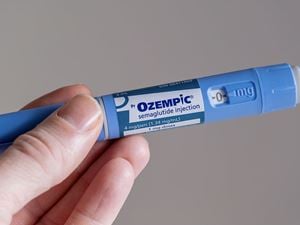
Emily* realized her marriage was over the day she was propositioned by a younger male colleague. They had happily worked side by side for years, but she never assumed a man like Julian* – tall, handsome and in his late 20s – would find her attractive.
Six months on Wegovy, a weight-loss jab, changed that. Emily, 35, felt herself being looked at by the opposite sex for the first time in years.
According to research from academics in Sweden, Emily’s case is far from unique. In fact, people who undergo rapid weight loss are twice as likely to divorce as the general population. Although the study – which came out earlier this year – focused on people who had been fitted with gastric bands, the lead researcher believes that the rise of GLP-1s will trigger an even larger divorce trend.
“Very similar mechanisms could occur with Ozempic as with surgery, with regards to changes in relationships,” says Professor Per-Arne Svensson, from the University of Gothenburg. “People who embark on the weight-loss journey usually have a lot of other life changes as well. That means that they are probably becoming more social and trying to live a healthier life. If the partner is not really on the train there, and if they don’t follow this person along in this change, that might be something that causes tension.”
Emily was initially surprised when she felt Julian gently massage her lower back during after-work drinks. “But I found it really hot, and even though I went home shortly afterwards, I couldn’t get the thought out of my head that I had felt completely dead from a sexual perspective for a very long time,” she recalls.
Later that night, as she watched her husband, John*, get undressed for bed, Emily realized the spark had completely gone from their marriage. She no longer had any urge to sleep with him.
While the era of weight-loss drugs has been heralded as a boon for people who have struggled to have sexual relationships for confidence and even health-related reasons, less research has been done into the marriages that have been damaged by one person changing their body shape, their attitude to food, and sometimes, their entire personality.
“It could also be that you have a person who is stuck in a bad relationship,” adds Professor Svensson, “but doesn’t have the self-confidence to break it off because they worry about who would date them, if not their current spouse.”
Emily and John got married when they were in their early 30s, and both put on a significant amount of weight in the first few years of their relationship. While Emily was keen to try injectable GLP-1s once they arrived in the UK, John was resistant. Over time, she found herself blossoming. She was delighted to buy new clothes, go out with friends and exercise for the first time in years. Her husband, by contrast, reminded her of the rut she had been in.
“We never had sex,” says Emily. “I suspect it was because we found ourselves unattractive, and with time, it became a habit to never touch each other in a sexual way. For a long time, I told myself it didn’t matter because we were good companions, but once my perspective changed, I realized that wasn’t true.”
Emily’s divorce was made easier by the fact that the couple chose not to have children. But for Fiona*, 39, who has three young sons, the prospect of separation is out of the question. Still, she worries that her marriage is no longer as healthy as it was, ironically, because her husband is himself far healthier.
Luke* started taking Ozempic six months ago. He began putting on weight around the birth of their first son. While Fiona stayed trim throughout the baby-making years, he gained about 15kg (2.4st) in total. She supported Luke when he decided to try GLP-1s, but she never expected him to undergo an entire personality change while he was on them.
At first, she was mostly bothered by the obvious differences from their former lives. The couple loved good food and sharing a bottle of wine on weekends, and Fiona missed having a partner with an interest in those things.
Their marriage also felt increasingly unfair. Before Luke began taking medication, Fiona would deal with the boys’ bedtimes while he would cook dinner and clean the house. Now, she comes downstairs to an empty kitchen and a husband mutely watching television with a tonic water.
More concerning is his sudden apathy for life. “Luke was one of those people who was up for anything,” she says. “If I suggested a last-minute trip away, he’d always tell me to just book it because life is too short not to try new experiences – but that side of him has vanished. It’s like the sparkle has gone out of his eyes, and I find I really miss my funny, teddy bear of a husband, even if he was a bit overweight.”
Giles Yeo, a biologist, believes that while the physical changes that accompany weight-loss drugs are well-documented, research has paid less attention to the mental shift that can also occur. “[Weight-loss drugs] make you feel full,” he says, “but what we don’t focus on as much is the way they also raise the hurdle for what you need to eat to feel good, and how these hurdles can be raised for other things too. Food is one of the greatest pleasures of life, and if GLP-1 drugs ultimately dampen that pleasure for you, then they will probably dampen the pleasures for many other things too, making so much of what was once desirable feel uninteresting.”
Within a few months of taking GLP1-s, Nick*, 55, noticed that his wife, Caro*, had lost many of the habits that made her who she was – the nightly glass of wine, the anxious nail-biting and the late-night online shopping – but also the delicious meals, the raucous parties in the garden and the general zest for life that had always drawn him to her.
“The best way I can describe it is that she became emotionally flat,” says Nick. “We also always had a pretty good sex life for middle-aged people with kids, but she just lost interest in that. Even though she blamed it on menopause, I’m pretty sure it was the weight-loss drugs.”
Studies have linked GLP-1s to an increased risk of erectile dysfunction for men, and while the picture for women is more complicated, a 2025 clinical review argued that libido can decrease for both genders because the same reward pathways that drive eating also drive sexual motivation. Interestingly, this is often masked by the confidence boost of weight loss, which tends to increase sexual availability even when the underlying desire has dropped.
Unlike Nick, Robin*, 47, found his wife, Jess*, became far more extroverted when she went on GLP1-s. After largely working from home and dedicating herself to her husband and children, Jess became almost euphoric in the first few months after losing weight. She bought herself an entirely new wardrobe, made a new set of friends and went into the office at least three days a week.
Robin felt jealous for the first time in his marriage, and – unsure if it was because he felt rejected by a woman who had always seemed delighted to put her feet up on the sofa with her husband, or because his wife now looked so different to how she had before – he found himself secretly checking her phone when she was asleep.
Soon, he discovered Jess was meeting male colleagues and old male friends from university for drinks, and while he never found out anything hugely incriminating, he worries that the trust they had built over the past 20 years had been damaged.
“Mostly, I feel really sad,” he says. “I never would have thought that a weekly injection that I have no control over her taking would have such an impact on my marriage – and my life. I just hope that one day soon she decides to go off them.”
*All names have been changed.
This article was originally seen on The Telegraph.