
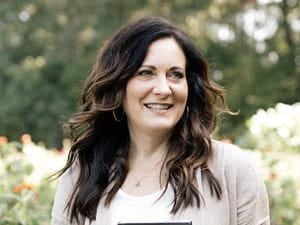
"Home is where I've been broken open and put back together," author Lysa TerKeurst has said. A writer of Christian non-fiction, TerKeurst has become an expert on heartbreak and healing after heartbreak.
She experienced profound grief after losing her sister, struggled to survive a broken marriage, endured the emotional anguish of a cancer diagnosis, and pondered the mysteries of why God allowed so much suffering in her life.
And she survived.
The author is the president of Proverbs 31 Ministries and has written more than a dozen books. They include several New York Times bestsellers, such as Forgiving What You Can't Forget, along with Unglued: Making Wise Choices in the Midst of Raw Emotions. She also has written I Want to Trust You, but I Don't: Moving Forward When You're Skeptical of Others, as well as Afraid of What God Will Allow and Doubtful of Your Own Discernment.
Her "self-deprecating humor and ability to be vulnerable, combined with insightful Bible references," make her books relatable "in a hundred little ways each day," according to one book review.
TerKeurst was a Christian in her early years but abandoned the faith when her sister died. She later rediscovered God and looked to him when her first marriage turned ugly. Her husband was a serial philanderer who struggled with substance abuse, and the couple separated after a long marriage. They later reconciled and renewed their vows in 2018, but ultimately separated again and divorced in 2022 after 29 years together. Two years after the divorce, TerKeurst married Chaz Adams, who had also experienced a difficult divorce.
The betrayal in TerKeurst's first marriage was devastating. Her husband continued to cheat after their reconciliation, and she decided to move ahead with the divorce. At one point, she accused her husband of withdrawing more than $118,000 of the money the couple shared and spending it on a woman he met through SugarDaddy.com.
TerKeurst might have found the pain more difficult to bear had she not "seen God move in astounding ways… not always the ways I thought He would, but I guess that's why we are called to follow Him with faith."
She explained, "I'm learning that, sometimes, trading grief for victory means choosing to see what is instead of being blinded by what isn't. It's a tough choice in some moments. Brutal, actually. But it's a battle that is worth fighting."
TerKeurst has admitted, "I wish with every fiber of my heart that I could erase parts of my story. But staying stuck in trying to wish something away will cause me to miss the beauty of what is… and even better… trusting God for what can be."
She took time to heal after her divorce rather than dating immediately. She explained that she didn't want to rely on another person to help her heal. Had she met someone too soon, she said she might have gotten into an unhealthy relationship.
But she met someone special on a dating app, even though she had earlier said she would never use one. She chose one that seemed "pretty safe" and asked several girlfriends to help by talking online with the men who interested her. Adams passed the screening process with flying colors.
"I am not endorsing (dating apps) in any way," TerKeurst said. "I think it can be a treacherous environment, but the one that I chose felt safer than the others, and it is how we came together. So, I'm grateful for that."
Laughter helped TerKeurst and Adams connect in the beginning, but the two also had serious conversations. Like TerKeurst, Adams went through a difficult divorce and experienced the death of a sibling – in this case, his 39-year-old brother.
As they became acquainted, he told her that he was a recovered alcoholic who found sobriety through Alcoholics Anonymous. He said he hasn't had a drink in 10 years. Adams' alcoholism didn't deter TerKeurst. Instead, she discovered that she valued being with a man who had an addiction and overcame it.
"The thing that had attracted me to you was not that you would struggle with an addiction but rather that you have the humility and the wherewithal to get the help that you needed, and I wanted somebody who had been intentional about getting healthy," she told him during a recent livestream conversation.
TerKeurst says she liked the fact that Adams surrendered himself to God, surrounded himself with godly men, and continues to attend AA meetings. TerKeurst said the changes he had made had radically altered his life.
The author learned a great deal about trust, boundaries and forgiveness during this time -- and other women can learn some valuable lessons from her, such as:
-
One important step toward building a new life after betrayal is seeking God's wisdom through Bible study and prayer. Be still, dial down the noise and listen for God's voice.
-
Boundaries can be important in relationships. They aren't a form of punishment. Rather, they help people protect themselves, especially when a relationship is destructive. In that type of situation, boundaries can include limiting or ending contact with the other person.
-
Forgiveness is a process that takes time. But in the long run, it reduces the emotional burden that a person carries when a relationship has ended in betrayal.
-
Forgiving the other person doesn't mean forgetting. It means making a conscious decision to forgive, turning the matter over to God and letting go.

