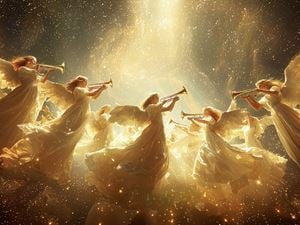
Angels are one of the most fascinating topics in the Bible, yet many beliefs about them are shaped more by movies, artwork, and popular culture than by Scripture itself. From guardian angels to winged babies playing harps, countless misconceptions have influenced the way many Christians view these spiritual beings. While angels are real and play important roles throughout the Bible, they were never meant to become the focus of worship or obsession.
The Bible teaches that angels are servants of God who carry out His will, protect His people, and point others toward Him — not toward themselves. Understanding what Scripture truly says about angels can help strengthen your faith while keeping your focus where it belongs: on God.
Here are five common myths about angels many Christians still believe — and what the Bible actually teaches about these heavenly beings.
1. Angels Are to Be Worshipped
Angels are fascinating because of their unique nature. Unbelievers and believers alike can get into the habit of idolizing angels and treating them as God. This is dangerous because angels are not God. Angels are sent to do God’s will and obey His instructions (Hebrews 1:14).
The Father, Jesus, and the Holy Spirit are God. This means you should only worship, praise, and turn to the Father, Jesus, and the Holy Spirit. Angels cannot answer prayers. They can provide protection, but this is only because God tells them to provide protection (Psalm 91:11).
2. Every Angel's Name is Given in the Bible
When you reflect on the Bible, you will find only a few angels are listed by name: the archangel Michael, the messenger angel Gabriel, and the fallen cherub, Satan. It could be God didn’t give additional angel names in the Bible to prevent angel worship.
Michael: Michael is an archangel, which would show he is within the highest ranks of angels. He has proven himself to be faithful to God throughout all time (Daniel 10:21). Michael has served in numerous physical and heavenly wars. He also protects humans by the direction of the Lord. Many scholars have proposed the idea that Michael is the angel who transports our soul from this physical earth to God from the description given in Jude 1:9.
Michael will be active in the end times; he and the angels under his command will fight the devil (Revelation 12:7-9). They will imprison Satan for a thousand years and then Satan will be released to test the nations (Revelation 20:1-10). Michael has been faithfully serving God, obeying Him, and will continue for all eternity. Satan would have tempted Michael in the rebellion, yet Michael chose to follow God.
Gabriel: Gabriel is a messenger angel, who is sent out to give messages from the Lord to His people. The most notable time we see Gabriel passing on a message is when he tells Mary she will supernaturally conceive and give birth to the Messiah (Luke 1:19). Gabriel is also seen in the Book of Daniel (Daniel 8:15-17, 9:21). He has a different function from an archangel, but he is still powerful and does as God commands. Like Michael, Gabriel did not take part in the devil’s rebellion and chose to stay loyal to God.
Satan: Satan was a garden cherub angel (Ezekiel 28:12-18). Cherubim are angels who worship at the foot of the throne of God. This means that Satan would have been in the very presence of God when he was planning his rebellion. Satan didn’t want to serve God — he wanted God to serve him. This is why he led the rebellion and caused many angels to follow him. The angels who followed him in the rebellion are fallen angels, also known as demons. In the future, God will cast Satan into the lake of fire (Revelation 20:10).
3. Everyone Has a Guardian Angel
Many Christians believe that everyone has a guardian angel, who protects them. It is a nice thought, but it is not biblical. However, even though no one has a guardian angel does not mean you are without help.
Your help comes from God, the Maker of Heaven and earth (Psalm 121:1-8). God sends angels to protect you, although they are not the ones who make the decision to come to our aid. The Lord is the One who protects you, keeps you, and guards your heart (Psalm 46:1). He is greater than any angel, demon, or other spiritual force.
4. Media Has Accurately Depicted Angels
Artistic depictions also have a way of portraying angels with big fluffy wings, playing harps, and sitting on clouds. These types of depictions do a great disservice to angels. Many angels do not have wings, such as Michael and Gabriel; however, there are angels who do have wings. The cherubim have wings, but not in the traditional sense.
Cherubim are not chubby, cute, baby angels as often depicted in art. Rather, cherubim are described as having four faces — one being a man, a lion, an ox, and an eagle (Ezekiel 1:10). They are also said to have four huge wings (two for flying and two for covering themselves), have the likeness of man, and under their wings, they have hands that look like human hands (Ezekiel 1:1-21).
In the same way, the seraphim have six wings and can fly, which also makes them different from what you would assume angels to look like (Isaiah 6:1-7). Therefore, while the cherubim can fly, not all angels can. Angels are unique and we don’t need to strictly associate them with what we have seen in art, movies, and television. Instead, we need to base our knowledge of angels and demons on the Bible.
5. All Angels are Good
Good angels cannot turn bad and fallen angels cannot turn good. During the rebellion of Satan, every angel had the choice to remain with God or to follow Satan. While there were many who followed Satan, there were also many who stayed with God. Those who stayed with God will be good angels forever; they will never turn bad, nor will they start following Satan.
Similar to humanity, angels have free-will. They had to choose whether they were going to be obedient to God or follow their own ideas. As stated, Michael and Gabriel are two angels that we know chose to follow God; however, there are many angels who also remained with God. One third of the angels followed Satan, yet two thirds remained with God (Revelation 12:4).
Angels are powerful and fascinating parts of God’s creation, but they were never meant to replace God in our hearts or become objects of worship. Many common beliefs about angels come from culture rather than Scripture, which is why it is important to ground our understanding in the Bible. When we view angels through a biblical lens, our focus shifts back to God’s power, authority, and care for His people. Ultimately, angels exist to serve Him — and to point us toward Him, not themselves.