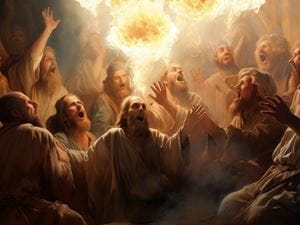
One of the most significant events in the history of the Church is Pentecost. Just 50 days after the Resurrection, the Disciples gathered for prayer, probably in the same upper room where they celebrated Passover on the night Jesus was betrayed. Suddenly, they heard the sound of a violent wind and witnessed something even a man as eloquent as Luke had trouble describing. The Spirit of God came upon the Apostles like tongues of fire and birthed the Church.
A striking feature of the event was what is known as the gift of tongues. With this gift, the disciples could communicate the Gospel to the throng who had gathered for the Feast of Pentecost in their native tongues. Speaking different languages on Pentecost was an act of God with deep significance. It fulfilled the Old Testament prophecy, reversed the effects of the Tower of Babel, empowered the Apostles for God's mission, and pointed to the universal nature of God's work.
Prophecy Fulfilled
First, the gift of tongues was a fulfillment of prophecy. In Joel 2:28–32, which Peter references on Pentecost, God promises to pour out His Spirit on "all flesh." The promise is that the Spirit will transcend all linguistic boundaries. God never intended the Gospel to be the purview of one nation or ethnic group. The saving message of the Gospel is for every human from every place. When the Spirit was poured out on Pentecost, the process of pouring out on "all flesh" began.
The Gospel to the Nations
Pentecost was a Jewish feast, and thousands of faithful Jews from all over the empire had gathered. Many of them did not speak Aramaic as their native tongue. The miracle of Pentecost was that the Apostles were able to communicate with the crowd in their native tongues. This miracle was a sign that the Gospel was intended for all nations. It was the beginning of the keeping of Jesus' promise that the Gospel would go to the ends of the earth.
Overcoming Obstacles
The miracle of Pentecost appears unlike the speaking in tongues that Paul addresses in 1 Corinthians. The tongues on Pentecost were intelligible to the hearers in their language. This miracle emphasizes the power of the Gospel to overcome every obstacle, even something as common—and as difficult—as the language barrier.
Since the beginning of Christianity, the Gospel has faced opposition. Religious leaders in ancient Jerusalem, worshipers of pagan deities in the ancient Mediterranean, political leaders in the Roman Empire, and many others have opposed the Gospel. The miracle of Pentecost points to the fact that the opposition to the Gospel message is futile. The Gospel is for the world, and no obstacle can overcome it.
Reversing Babel
One often overlooked aspect of Pentecost is that it reverses what happened at Babel. Genesis 11 records the gloomy story of a group who wanted to build a tower to reach the heavens. The Tower of Babel was an effort for the people to "make a name for themselves." They wanted to avoid God's command to fill the earth and a demonstration of their self-sufficiency and pride. In God's judgment on Babel, God confused human languages. People were suddenly unable to communicate. They were divided, and they were alienated from God.
Pentecost reverses this judgment. At Pentecost, God was drawing all the differing nations to Himself through the power of the Spirit. As God drew the people together despite their language difficulties, God was building a new community. This new community was not based on the desire to "make a name" or disobedience. This new community was based on the power of the Gospel. The new community started at Pentecost and began a reality Revelation 7:9 describes, where a throng of people from every nation, tribe, and tongue worships God.
Pentecost and the Meeting Place
If a person in ancient Jerusalem heard the question, "Where is God?" They would answer, "God dwells in the temple." Yes, they would know that God cannot be contained in earthly houses and that God is the creator of the universe and cannot be contained in it. God, however, made His presence known at the temple. The temple was the "House of the Lord." It was to be a place where instruction, healing, wisdom, and direction were dispensed. The temple was to be the meeting place between God and His people.
At Pentecost, all of that changed. God is no longer merely in the temple or present everywhere. The tongues of fire resting on the Apostles remind us that God is within and among God's people. If there is an answer to the question, "Where is God?" post-Pentecost, the answer is, "God is in the lives and hearts of God's people."
The shift from God in the temple to God in the hearts of God's people is one of the most important shifts in the New Testament. In reading the Old Testament, the presence of God is undoubtedly in the Tabernacle, then the Temple, and occasionally the Spirit would empower a prophet, a judge, or a king. In the New Testament, the Spirit of God is now with God's people.
This presence is comfort. Jesus describes the Spirit as a comforter, a teacher, a guide, and a friend. The Bible also describes the Spirit as the One who prays for us and with us, even groaning on our behalf (Romans 8). The Spirit, then, is nothing short of God's presence with us.
Pentecost and Mission
Pentecost was remarkable in that it spread the message of the Gospel throughout the known world. Jews from Mesopotamia, Egypt, and Rome attended Pentecost, as it was a significant Jewish festival. This multi-lingual audience heard the Gospel, and 3,000 accepted salvation in Jesus Christ.
Pentecost and the Spirit
The event of Pentecost points to the Spirit's role as the One who empowers God's mission, the reconciliation of humanity to Him. All believers share in God's mission of reconciliation, and all receive gifts from the Holy Spirit for that purpose.
Pentecost was not just a one-time miracle—it was a turning point in history. The gift of languages that day showed the world that God's message would not be confined by geography, race, or language.
It fulfilled ancient prophecies, tore down the walls erected at Babel, and declared that the Spirit of God now dwells not in temples made by hands but in the hearts of His people. It empowered the Church for its mission, igniting a movement that continues today. As followers of Christ, we carry that same Spirit and, with it, the call to share the Gospel so that every tribe, tongue, and nation might hear and believe.