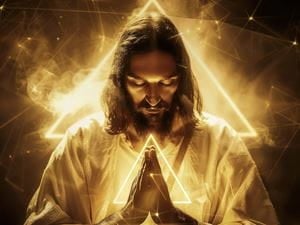
"Behold, I am coming quickly, and My reward is with Me, to reward each one as his work deserves. I am the Alpha and the Omega, the first and the last, the beginning and the end" (Revelation 22:12-13).
Revelation uses the phrase "the Alpha and the Omega" three times—twice to refer to God the Father and once to refer to Jesus the Son. Revelation also uses similar phrases, "the first and the last" and "the beginning and the end," to refer to Jesus.
What does it mean that Jesus is "the Alpha and the Omega"?
From A to Z
Alpha and Omega are the first and last letters of the Greek alphabet. An ancient writer saying "the Alpha and the Omega" would be like a modern person saying "from A to Z." The phrase means that God is totally complete and sufficient.
Contemporary English uses many similar phrases, such as "everything but the kitchen sink" or "the whole nine yards."
Both the Father and the Son are completely God and are completely sufficient to accomplish anything necessary to bring God's purposes to fruition.
Revelation Exclusive
The use of the phrase "the Alpha and the Omega" in Scripture is specific to the Book of Revelation. The exact phrase "the Alpha and the Omega" is used three different times:
- Revelation 1:8, spoken by God and referring to Himself
- Revelation 21:5-6, spoken by God (the one who sits on the throne) and referring to Himself
- Revelation 22:12-13, spoken by Jesus and referring to Himself
In addition, both Revelation 1:17-18 and Revelation 2:8 quote Jesus as using the phrase "the first and the last" to refer to Himself (in 1:17-18, speaking to John; in 2:8, in the letter to the church at Smyrna).
Two interesting observations arise from these passages from Revelation. First, when God uses the phrase "the Alpha and the Omega" to refer to Himself, He does not go on to say, "The first and the last." However, when Jesus uses it, He adds "the first and the last."
What is the significance of this? Perhaps it is connected to Jesus's status as the "only begotten Son of God" (John 1:14). He is the "first fruits" of those who come to God through faith (1 Corinthians 15:20-24, for example). Paul also refers to Jesus as the "last Adam" in that same chapter, in 1 Corinthians 15:42-49.
The most likely reason for the addition of "the first and the last" is to emphasize Jesus' eternality – He was with God in the beginning (John 1:1) and will reign with Him in the end (Revelation 22:1). John's use of "the Alpha and the Omega" to refer to both God the Father and Jesus the Son also confirms Jesus' divine status and nature – He is co-equal with God.
The second observation is that in the New American Standard Bible text, the passages spoken by Jesus are in red letters, while the two passages spoken by God are not. This is common across several translations (for example, NIV, NLT, and ESV; other translations do not use red letters to indicate Christ's words). The translators and editors of these versions of the Bible indicate that both God and Jesus use the phrase "the Alpha and the Omega" to refer to themselves.
This affirms classical Christian theology that the Father and the Son [as well as the Holy Spirit] share the divine nature.
So what does it mean that Jesus is "the Alpha and the Omega"?
Jesus was present and actively involved in the creation of the universe. In Genesis 1:26, God said, "Let Us make mankind in Our image, according to our likeness." People often use this passage to emphasize that mankind is created in God's image.
However, it also confirms that God is and has always been "plural." What else could it mean for God to say, "Let Us make mankind in Our image"? John addresses this in the Prologue to his Gospel: "In the beginning was the Word, and the Word was with God, and the Word was God. He was in the beginning with God" (John 1:1-2).
Next, "the Alpha and the Omega" affirms that the Son is eternal in the same way as the Father – without beginning or end. There was never a time when God did not exist; that is true for God the Father, God the Son, and God the Holy Spirit. While Jesus Christ, the human incarnation of the Son, had a beginning that applies only to His earthly nature, not His divine nature. Jesus Christ had a beginning – conceived by the Holy Spirit, born of the Virgin. But Jesus – the Word made flesh – will have no end; He will live and reign eternally with the Father. In Him, the eternal divine nature of the Son is united with the perfect human nature of Jesus of Nazareth. In that unity, He will live and reign forever.
In addition to the passages from Revelation and John's Gospel, both 1 John and Hebrews also refer to the Son's eternal and divine nature. First, John 1:1-3 says that "the Word of Life" was "from the beginning." John goes on to say that "the life was revealed, and we have seen and testified and proclaim to you the eternal life, which was with the Father and was revealed to us."
In Hebrews 1:8-12, the writer of Hebrews compares Christ with the messengers – both human and angelic – who came before Him to demonstrate that the Son is different. That passage states that the Father said to the Son: "You, Lord, in the beginning, laid the foundation of the earth, and the heavens are the works of Your hands; they will perish, but You remain; and they will all wear out like a garment, and like a robe, You will roll them up; like a garment, they will also be changed. But You are the same, and Your years will not come to an end" (Hebrews 1:10-12, quoting Psalm 102:25-27).
Jesus, the Alpha and the Omega
"Behold, I am coming quickly, and My reward is with Me, to reward each one as his work deserves. I am the Alpha and the Omega, the first and the last, the beginning and the end." (Revelation 22:12-13). The One who was present and active in the creation of the world will also be present and active in the creation of the new heaven and new earth (Revelation 21:1). Jesus Christ is the human incarnation of the Son – "the Word made flesh," as John puts it. He is God at the beginning, God at the end, and God through it all!